Skip to content

Five industries worked hands on, so we arrive knowing where the gaps usually are.

All industries →Request a demo

Four ERP platforms in house, and fifteen capability modules. The recommendation is never tied to a licence quota.

All solutions →Request a demo

One team from platform selection through to the reports on your desk.

All services →Request a demo

Learning Centre

Guides, how-tos, comparisons and a plain-English glossary, written by the consultants who deliver the projects. No form in front of any of it.

Free toolsNo gate before you use them
Plain EnglishBOQ, retention, WIP and IPC explained
Written in houseBy the people who run the projects
Browse all resources →

Nobody in UAE ERP publishes their tools or their pricing. We do both.

Free tools →Request a demo

Consultants in the UAE, technical team in South Asia. Cost stays sharp without cutting corners.

About QZ Infomatics →Request a demo
Request a demo +971 4 243 4010

E-Invoicing UAE

Structured invoices, an accredited provider,
and a system that is ready before January.

The UAE is moving to mandatory electronic invoicing in phases from January 2027. Not PDFs by email — structured data files exchanged through accredited providers and reported to the Federal Tax Authority. We get UAE businesses ready: readiness assessment, master data, ERP configuration, ASP integration and go-live.
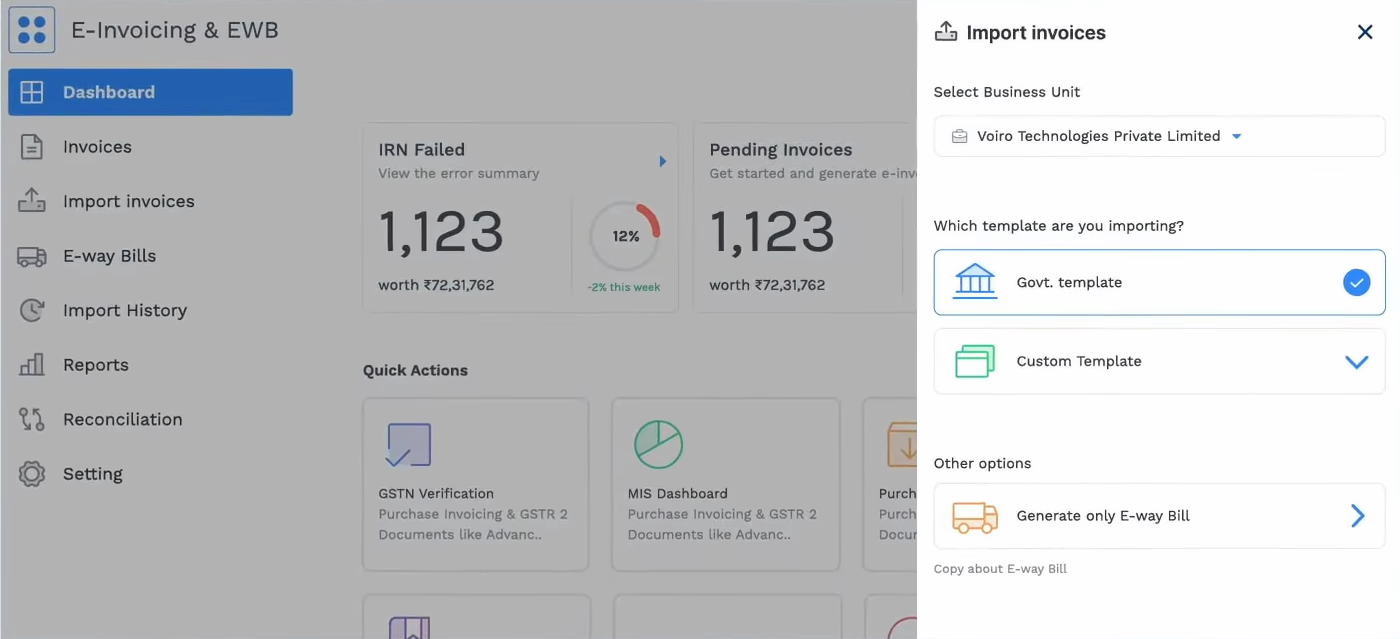
✓ PINT AE format✓ Peppol 5-corner model✓ ASP integration✓ Odoo · Dynamics · NetSuite
UAE e-invoicing readiness
Appoint your ASP by30 Oct 2026
Phase 1 go-live1 Jan 2027

The timeline

When e-invoicing becomes mandatory

Businesses with revenue of AED 50 million or more must appoint an Accredited Service Provider by 30 October 2026. Go-live follows on 1 January 2027. The appointment deadline was extended once, from 31 July. The go-live date was not.

UAE e-invoicing phase deadlines
Who | Appoint an ASP by | Mandatory from
Pilot / voluntary — any business meeting the technical requirements—Open since 1 July 2026
Revenue AED 50 million or more30 October 20261 January 2027
Revenue below AED 50 million31 March 20271 July 2027
Government entities31 March 20271 October 2027

The AED 50 million threshold decides which phase you fall into, not whether you are in scope. A business turning over AED 8 million is fully in scope — it simply has a later date.

The change

From a document to a data file

A PDF is not an e-invoice

Neither is a scan, a Word file, or an invoice attached to an email. If a person has to read it to extract the data, it does not comply. Invoices must be structured XML in the PINT AE format.

You cannot send it yourself

Businesses do not connect to a government portal. Invoices travel through Accredited Service Providers licensed by the Ministry of Finance, over the Peppol network, with tax data reported to the FTA.

It sits on top of VAT, not instead of it

The mandate does not change your VAT rate or your corporate tax position. It changes the plumbing invoices flow through. Your existing obligations continue unchanged.

Legal basis: Federal Decree-Law No. 16 of 2024, with operational detail in Ministerial Decisions 243 and 244 of 2025.

Scope

Who the mandate applies to

Out of scope, or deferred

Not covered, for now

  • × Business-to-consumer transactions, for now
  • × Government transactions in a sovereign capacity
  • × Certain airline services
  • × Exempt financial services
  • × Intra-VAT-group transactions — 24-month grace period from 1 January 2027
In scope

Covered by the mandate

  • ✓ All persons conducting business in the UAE
  • ✓ Business-to-business transactions
  • ✓ Business-to-government transactions
  • ✓ Free zone entities
  • ✓ Businesses below AED 50 million — later date, still in scope

Your customer may not be ready before you are. The phasing means some suppliers go live before their customers. Where a UAE business customer has no Participant Identifier yet, the supplier still processes the invoice through the system using a prescribed temporary endpoint.

The mechanism

The Peppol five-corner model

The UAE has adopted a decentralised continuous transaction control and exchange model. You do not connect to a government platform — that is the structural point that distinguishes it from the clearance models used elsewhere.

  1. 01

    Supplier

    Your ERP generates the invoice data.

    Corner 1
  2. 02

    Your ASP

    Validates against PINT AE and transmits.

    Corner 2
  3. 03

    Buyer's ASP

    Receives and delivers.

    Corner 3
  4. 04

    Buyer

    Receives structured data into their system.

    Corner 4
  5. 05

    FTA

    Receives tax data and returns an electronic confirmation.

    Corner 5

Both parties need an ASP. Records must be stored within the UAE — worth checking against your current archiving arrangement if your ERP is hosted regionally.

The requirement

Six things your system must handle

Produce every mandatory PINT AE field

Not a report of them — the structured output. One missing field is a validation failure.

Hold clean master data

Customer TRNs, complete addresses, valid item descriptions, correct VAT treatment per transaction.

Connect to your ASP

Native connector, API or middleware, depending on platform.

Handle the response

Cleared invoices return a reference to store. Rejections must route to someone who can fix and resubmit.

Receive inbound e-invoices

Easy to forget. From go-live you must receive structured invoices from suppliers, not only issue them.

Retain records in the UAE

For the required period, stored within the country.

All the major platforms can be made compliant. Whether your specific instance, on your version, with your customisations, produces every mandatory field is a question only testing answers.

Where the effort actually goes

Most of this is data quality, not software

Businesses assume e-invoicing readiness is a software project. In practice the majority of the effort is master data — and it is work you can start today, regardless of which platform or provider you eventually choose. What blocks validation, in order of frequency:

Missing or invalid TRNs

The single most common failure. Every B2B customer needs a valid tax registration number in your system.

Incomplete addresses

Emirate missing, or the whole address in one free-text line.

Duplicate customer records

The same customer under three account codes with three conflicting TRNs.

Vague item descriptions

Line items reading “misc” or “as per quotation”.

Incorrect VAT treatment

Zero-rated coded as exempt, reverse charge applied inconsistently, designated zone supplies treated as standard.

Blank units of measure

Mandatory in the structured format, frequently empty in legacy data.

A business with clean master data and no ASP is in far better shape in October than one with an ASP and 4,000 customers missing TRNs.

What we do

Getting you compliant before your deadline

We take UAE businesses from wherever they are today to issuing and receiving compliant e-invoices. Most engagements start with the first item and stop when the deadline is met.

Readiness assessment

1–2 weeks. Where you actually stand. We check whether your ERP version can produce every mandatory PINT AE field, run an exception report against your customer and item masters to quantify the data gap, map your non-standard document types, and confirm which phase you fall into. You get a written readiness report with a scope, a timeline and a cost — usable whether or not you continue with us.

Master data remediation

2–6 weeks. The largest task in most projects. Missing TRNs, incomplete addresses, duplicate customer records, item descriptions and VAT code corrections — worked through systematically rather than discovered at validation. You get master data that passes validation, and a process that keeps it that way.

ERP configuration and field mapping

2–4 weeks. Configuring your system to output the PINT AE structure. Field mapping, VAT treatment logic, document type handling, and the awkward cases — free zone supplies, exports, margin scheme, summary invoices, continuous supplies. Odoo, Microsoft Dynamics 365, Oracle NetSuite, and custom or legacy systems via middleware.

ASP selection and integration

2–3 weeks. Shortlisting accredited providers against your platform and volume, modelling the per-document pricing at your actual invoice count, and building the connection — outbound and inbound. We are not an ASP and we do not resell one, which means the recommendation is not a commission.

Testing, parallel run and go-live

4+ weeks. Test transactions across every document type you issue. Parallel running through the voluntary window so failures cost nothing. Error handling and resubmission configured. Billing and accounts payable trained on what a rejection means. The first live invoice is not the first invoice you have ever sent through the system.

Not every business needs all five. A company already on a current ERP version with clean data may only need ASP integration and testing. The assessment establishes which.

What to do

Three stages, in order

  1. 01

    Now, before appointing anyone

    Confirm which phase you fall into. Run a master data audit and quantify the exception count — that number tells you how big the project is. Get a written answer from your ERP partner on whether your version can produce the mandatory fields. Map your non-standard document types.

    Stage 01
  2. 02

    Before your ASP deadline

    Shortlist and appoint an accredited provider, checking the MoF list and their experience with your platform. Build and test the connection, including inbound receipt. Run test transactions covering every document type you issue.

    Stage 02
  3. 03

    Before go-live

    Run in parallel through the voluntary window while your existing process still operates. Configure error handling and resubmission. Name the person who owns exceptions. Train billing and accounts payable — a rejected invoice is a cash flow event.

    Stage 03

The businesses that will struggle in January are the ones waiting for the mandatory date. The voluntary phase exists so failures happen while they are free.

Frequently asked questions

UAE e-invoicing questions

What is e-invoicing in the UAE?

UAE e-invoicing is a national system requiring businesses to issue and receive invoices as structured, machine-readable files exchanged through accredited providers, with the data reported to the Federal Tax Authority. It replaces PDF and paper invoices for B2B and B2G transactions. The legal basis is Federal Decree-Law No. 16 of 2024 and Ministerial Decisions 243 and 244 of 2025.

When does e-invoicing become mandatory in the UAE?

The voluntary pilot opened on 1 July 2026. Businesses with annual revenue of AED 50 million or more must be live from 1 January 2027, smaller businesses from 1 July 2027, and government entities from 1 October 2027. Deadlines have already shifted once, so confirm current dates on the Ministry of Finance website.

Who does the UAE e-invoicing mandate apply to?

It applies to VAT-registered businesses in the UAE, including free-zone entities, for business-to-business and business-to-government transactions. The rollout is staged by annual revenue rather than by sector. B2C transactions sit outside the initial scope, and a limited set of exemptions applies.

What is an Accredited Service Provider (ASP)?

An ASP is a provider licensed by the Ministry of Finance to transmit e-invoices on your behalf across the Peppol network. Businesses cannot send invoices directly to the FTA — the ASP validates your invoice against the required format and routes it to your customer and to the authority.

What is the five-corner model?

The five-corner model is the exchange architecture the UAE has adopted: supplier and buyer each connect through their own accredited provider, with the FTA as the fifth corner receiving the tax data. An invoice travels from supplier to their ASP, on to the buyer’s ASP and buyer, with a reporting copy to the authority.

What format must UAE e-invoices use?

Invoices must be structured XML conforming to the PINT AE specification, the UAE national profile of the Peppol International Invoice standard. A PDF is not an e-invoice under the mandate, even when generated automatically. Your ERP needs to produce the required data fields, not simply a printable document.

What are the penalties for non-compliance?

Penalties for failing to issue, transmit or retain compliant e-invoices are set out in Cabinet Decision No. 106 of 2025 and apply from your mandatory go-live date, not during the voluntary phase. They accrue per breach and per month, so an unaddressed systems gap becomes expensive quickly.

How do I prepare my ERP for e-invoicing?

Four steps: clean your customer, supplier and item master data; confirm your ERP can output every mandatory PINT AE field; appoint an accredited service provider; then run an end-to-end test during the voluntary window. Most of the effort is data quality — missing tax registration numbers and inconsistent addresses are the usual blockers.

Do Odoo, NetSuite and Dynamics 365 support UAE e-invoicing?

Odoo, NetSuite and Dynamics 365 can all be configured for the UAE mandate, either through native localisation or an ASP connector. What matters is whether your specific version and setup produce every mandatory field and can transmit through an accredited provider. That gap is worth checking now rather than in the quarter before go-live.

What should businesses do before their deadline?

Confirm which phase you fall into by revenue, appoint an accredited service provider well ahead of the appointment deadline, run a data-quality review across your master files, and complete a live test cycle during the voluntary period. Businesses that wait for the mandatory date lose the ability to fail safely.

Does the VAT group grace period mean we can delay?

No. It applies only to transactions between members of the same VAT group, for 24 months from 1 January 2027. Everything else is unaffected.

What happens if my customer is not ready?

The supplier still processes the electronic invoice through the system, using the prescribed temporary endpoint where the customer has no Participant Identifier.

Talk to a consultant

Find out where you actually stand

Thirty minutes to establish three things: whether your ERP produces every mandatory field on your current version, how many customer records fail validation today, and what has to happen before your deadline. You leave with a scope, not a proposal.

  • ✓ A consultant who has done this, not a sales call
  • ✓ We integrate any accredited provider — we do not resell one
  • ✓ A written readiness report you can use either way
  • ✓ If you are already compliant, we will tell you

Book a readiness assessment

We reply within one working day.

Or WhatsApp us on +971 4 243 4010

Request a demo