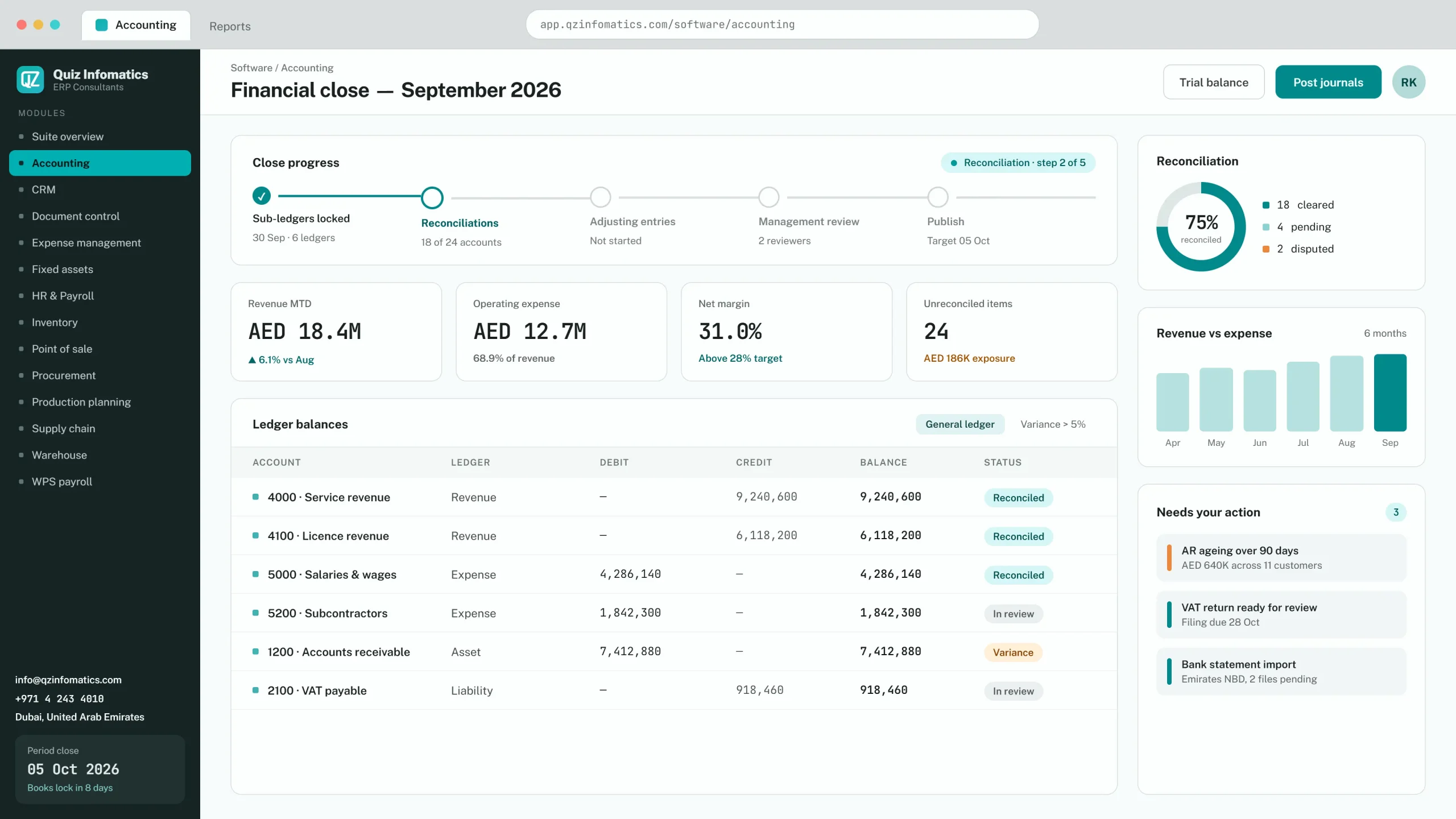
Your accounts should be a description of what happened, not a monthly reconstruction of it.
Accounting software records and reports every financial transaction — sales invoices, purchase bills, payments, bank reconciliation, journals, fixed assets and financial statements. Inside an ERP it shares one database with sales, inventory and payroll, so entries post as transactions happen rather than being re-keyed from other systems at month-end.
✓ 5% VAT applied per transaction✓ Corporate tax reporting from clean books✓ Multi-currency with AED as base✓ A defined path to e-invoicing
UAE compliance
What UAE accounting software has to handle
Compliance in the UAE has changed substantially in a short period. Software chosen before VAT, before corporate tax and before e-invoicing may still be running, but it is unlikely to be covering all three.
5% VAT
With zero-rated, exempt and reverse-charge treatments, applied per transaction rather than per customer.
FTA-compliant tax invoices
Carrying every mandatory field, in the required layout, without anyone editing a template each time.
Corporate tax reporting
Reliable financial statements, clean separation of allowable and disallowable expenses, and related-party transaction records.
Multi-currency
With AED as reporting currency, including revaluation. Essential for anyone importing in dollars or euros.
Multi-company
Separate books per entity, inter-company transactions and consolidated reporting, for groups spanning mainland and free zone licences.
Bilingual invoicing
Arabic and English layouts, expected by many UAE customers and required by some government entities.
E-invoicing readiness
A defined path to producing structured invoices in the required format and transmitting through an Accredited Service Provider.
VAT
VAT: what compliant software actually does
At transaction level
What compliant software actually does
It applies the correct treatment at transaction level, produces tax invoices with the mandatory fields, and generates the figures needed for your FTA return.
› Correct treatment applied per transaction, not per customer
› Tax invoices carrying every mandatory field
› The figures your FTA return needs, without a spreadsheet
The authority asks for supporting documentation behind specific figures. Being able to trace a return line back to individual invoices in minutes is the difference between a straightforward audit and a difficult one.
› A return line traced back to individual invoices
› Retention handled by the system, not by a folder
› Non-compliant supplier documentation caught at entry
› Correcting it later means a voluntary disclosure
Corporate tax is less about a software feature and more about how your books are structured. The work is in the structure.
A chart of accounts that separates
Allowable from disallowable expenses, without a manual analysis every period. This is set at implementation, and restructuring it in year three is expensive.
Consistent categorisation
The same expense coded the same way each time, plus related-party transaction records maintained as they arise.
Disciplined period closing
So the financial statements the computation rests on are actually final. Any product claiming a single button that produces your corporate tax position is overstating it.
Which is the strongest argument for getting the chart of accounts right at the start. Corporate tax tooling →
E-invoicing
E-invoicing
What the mandate requires
A PDF is not an e-invoice
The UAE e-invoicing mandate requires structured, machine-readable invoices exchanged through accredited providers, with data reported to the FTA — even when the PDF is generated automatically.
› Every mandatory PINT AE field produced by your system
› A connection to an Accredited Service Provider
› Whether your product and version can do it, established now
› The voluntary window is the time to test, not the quarter before go-live
Most of the preparation work is not software at all. It is missing tax registration numbers, inconsistent customer addresses and incomplete item descriptions.
› Missing tax registration numbers on customer records
› Inconsistent addresses across the ledger
› Incomplete item descriptions
› That cleanup can start today, on whatever system you run
Separate books per entity with inter-company transactions and eliminations, plus consolidated reporting. UAE group structures make this a requirement rather than an enhancement.
› Separate books per entity
› Inter-company transactions and eliminations
› Consolidated reporting across the group
› The point at which basic bookkeeping tools stop being viable
Multi-entity groups needing strong consolidation and financial depth, at a materially higher cost.
The honest decision rule: if you carry stock, run projects, or operate more than one entity, a standalone accounting package will need supplementing within two years. If you do none of those things, an ERP is more system than you need.
Banking
Bank reconciliation and automation
01Feeds vary by bank and platform
Some platforms offer direct feeds with UAE banks; others rely on statement import. Confirm your specific banks before choosing rather than after.
02The saving is in the matching
Automated matching of payments to invoices using reference and amount rules turns a day of reconciliation into a review of genuine exceptions.
03And the rest can automate too
Supplier invoice capture, expense claims and recurring journals. Those are covered separately under expense and invoice automation.
Migration
Moving to new accounting software
01
Map the chart of accounts
Old structure to new, with the corporate tax separation designed in rather than retrofitted.
Designed, not copied
02
Load the opening trial balance
Plus open receivables and payables, item by item rather than as a single summary journal.
Line by line
03
Reconcile back to the old system
Not optional. A migration that does not balance costs several times more to fix later than to check now.
The gate
04
Go live at a year start where you can
Moving at the start of a financial year makes the audit trail considerably cleaner, and is worth waiting for if the timing is close.
Accounting software records and reports every financial transaction: sales invoices, purchase bills, payments, bank reconciliation, journals, fixed assets and financial statements. Inside an ERP it shares one database with sales, inventory and payroll, so entries post automatically instead of being re-keyed from other systems.
What should accounting software in the UAE support?
5% VAT with zero-rated, exempt and reverse-charge treatments, FTA-compliant tax invoice formats, corporate tax reporting, multi-currency with AED as base, and a defined path to e-invoicing compliance. Bilingual Arabic and English invoice layouts are expected by many UAE customers and required by some government entities.
Is the software VAT-compliant and FTA-ready?
Compliant software applies the correct VAT treatment per transaction, produces tax invoices carrying every mandatory field, and generates the figures needed for the FTA return. It should also maintain the audit trail and record retention the authority expects to see during a tax audit.
How does accounting software handle UAE corporate tax?
Corporate tax needs reliable financial statements, clear separation of allowable and disallowable expenses, and related-party transaction records. Accounting software supports this through chart-of-accounts structure, consistent expense categorisation and disciplined period closing rather than through a single tax button. Specialist tax tools then handle the computation itself.
Can it do multi-currency and multi-company accounting?
Yes. Multi-currency handles transactions and revaluation with AED as reporting currency, which matters for importers paying in dollars or euros. Multi-company adds separate books per entity with consolidated reporting and inter-company eliminations, which group structures spread across mainland and free zones need.
Does accounting software connect to UAE banks?
Some platforms offer direct feeds with UAE banks while others rely on statement import. Either way, the time saving comes from automated reconciliation matching payments to invoices. Confirm which of your specific banks are supported before choosing, because coverage varies considerably between platforms.
What is the best accounting software in the UAE?
There is no single answer — it depends on transaction volume, whether you need inventory and projects, how many entities you run, and budget. Small service businesses do well on cloud bookkeeping tools. Anything carrying stock, projects or multiple entities is usually better served by an ERP.
How long does it take to move to new accounting software?
Four to eight weeks for a single entity. The work is mapping the chart of accounts, loading the opening trial balance, open receivables and payables, then reconciling back to the closing figures from your old system. Moving at the start of a financial year makes the audit trail much cleaner.
Book a free 30 minute call with QZ Infomatics in Dubai. You will leave it with a platform recommendation, the reasoning behind it, a realistic timeline and an indicative budget band — before you commit to anything.
✓ A consultant who delivers projects, not a sales desk
✓ Odoo, Microsoft Dynamics 365 and Oracle NetSuite compared honestly
✓ Licence cost and implementation cost quoted as separate numbers
✓ If we are not the right fit for you, we will say so