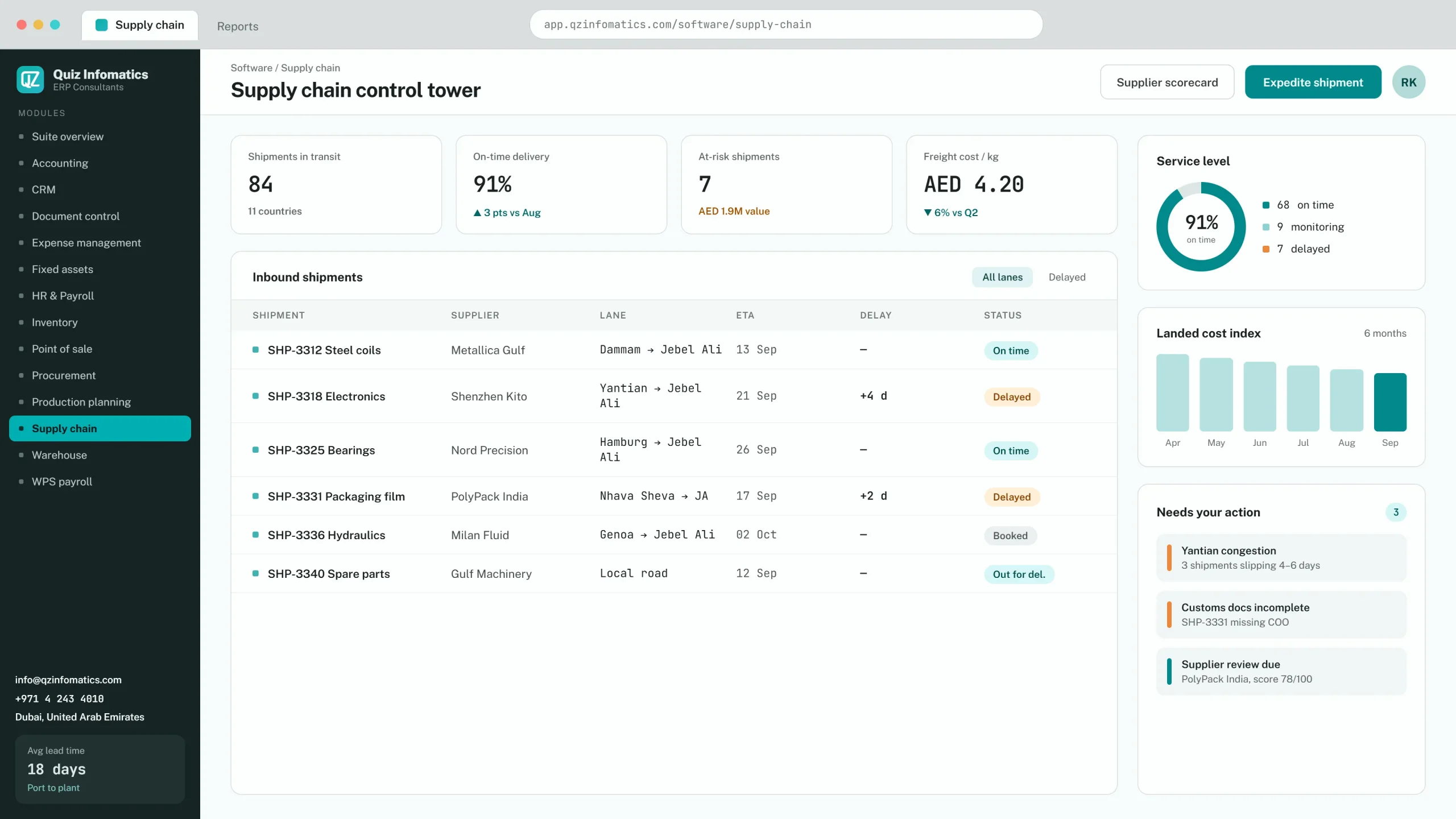
Every delay in your supply chain is already known by somebody. It just isn't known by everybody.
Supply chain management software coordinates the movement of goods from supplier to customer — demand planning, purchasing, inbound logistics, warehousing, fulfilment and distribution — in one connected system. When a shipment slips, sales and finance see it at the same moment as the logistics team, instead of three weeks later when the customer calls.
Most businesses already run parts of it. A purchasing process exists. Stock is tracked somewhere. Deliveries get scheduled. What is usually missing is the connection between them.
› Purchasing works from last month's sales report
› The warehouse discovers a shipment on the day it arrives
› Finance finds out about the extra freight when the invoice appears
› In ERP terms this is not one module but five working from the same data
Each one is a module you can buy separately. The value is in them sharing a database.
Demand planning
Forecasting future requirement from sales history, seasonality and promotions, then converting that into recommended order quantities and reorder points.
Procurement
Requisitions, RFQs, supplier comparison, purchase orders and approval workflow, with committed spend visible from the moment an order is raised. Procurement software.
Inbound logistics and landed cost
Shipment tracking, customs documentation, and allocation of freight, duty, insurance and clearing charges across received items.
Inventory and warehousing
Multi-location stock, transfers in transit, put-away and picking, batch and expiry handling. Warehousing.
Distribution and transport
Delivery scheduling, route planning, proof of delivery, and freight cost by route or customer.
Demand planning
Demand planning is where the money is
Why it matters here
Long lead times, expensive in both directions
For UAE importers, planning accuracy matters more than in almost any other market, because lead times are long and the cost of being wrong runs in both directions.
› Order too little and you lose the sale to a competitor holding stock
› Order too much and cash sits in a Jebel Ali warehouse for eight months
› A twelve-week shipping lead time forces the decision early
› The product ages while the cash is tied up in it
Demand planning uses sales history, seasonality, promotional calendars and supplier lead times to produce a recommended order quantity per SKU per location.
› Ramadan and Eid demand shifts
› Summer slowdowns across most categories
› Promotional calendars, not just last year's sales
› Reorder timing derived from the actual lead time
Forecasting only becomes reliable once you have twelve months of clean transaction history in one system, which is why most businesses implement inventory and purchasing first and add planning as a second phase.
Landed cost
Landed cost: the number most UAE businesses get wrong
A product's supplier price is not its cost.
Everything that gets it here
Freight, insurance, customs duty, clearing charges, port handling and inland transport, all recorded against the shipment rather than expensed separately.
Allocated across what arrived
By value, weight or volume across the items received. The resulting unit cost is what margin should be calculated from.
The gap nobody sees
Businesses that skip this step consistently overstate margin on heavy, bulky or low-value goods. In some categories the gap between invoice price and landed cost exceeds the entire trading margin.
Each supplier carries agreed lead times, minimum order quantities, price tiers, payment terms and performance history. The system uses that to recommend who to order from and when.
Supplier scorecards give you something factual for annual negotiations. Most UAE businesses negotiate on relationship and gut feel, because the data to do otherwise has never been collected.
A transport management system plans and tracks the movement of goods: route planning, carrier selection, freight cost allocation, delivery scheduling and proof of delivery.
Route planning and scheduling
Delivery scheduling, carrier selection and route planning, with proof of delivery captured against the drop rather than on a paper sheet.
Freight cost allocation
Cost by route, by customer or by order, so delivery is a line you can manage rather than an overhead you absorb.
Own fleet or third party
It matters most to distributors running their own fleet across the emirates. For businesses using third-party logistics, the carrier handles most of it and the requirement reduces to tracking and cost allocation.
Route efficiency is a direct cost line for a distributor, and driver time is usually the binding constraint. Fleet tracking →
Implementation
Phase it, or it stalls
Three to six months for full scope, because it crosses purchasing, warehousing, sales and finance simultaneously. Attempting all four phases at once is the most common cause of a stalled supply chain project.
01
Inventory and purchasing
Get the transactional foundation and the data right. Everything after this depends on stock balances people believe.
Phase one · the foundation
02
Warehousing
Add locations, put-away and picking once volumes justify it and the picking team has outgrown verbal knowledge.
Phase two · when volume justifies it
03
Demand planning
Switch on once twelve months of clean history exists to forecast from. Earlier than that and the forecast is arithmetic on noise.
Phase three · after twelve months of data
04
Transport
Last, and only where you run your own fleet. For third-party logistics the requirement is usually smaller than it first appears.
Supply chain management software coordinates the flow of goods from supplier to customer: demand planning, purchasing, inbound logistics, warehousing, order fulfilment and distribution. It gives one view across those stages, so a delayed shipment becomes visible to sales and finance at the same moment as to the logistics team.
How is supply chain software different from inventory software?
Inventory software tells you what you hold now. Supply chain software plans what you will need, when to order it and how it will move. Inventory is a component of supply chain management rather than a substitute for it, and most UAE businesses implement inventory first and add planning later.
What does demand planning do?
Demand planning forecasts future requirement from sales history, seasonality, promotions and lead times, then converts that into recommended order quantities and reorder points. For UAE importers with long lead times from Asia or Europe, planning accuracy is what decides whether you carry excess stock or run out.
Can it manage suppliers and lead times?
Yes. Each supplier carries agreed lead times, minimum order quantities, price tiers and performance history, so the system can recommend who to order from and when. Supplier scorecards covering delivery reliability and quality give you something factual to bring to annual price negotiations.
What is a transport management system?
A transport management system plans and tracks the movement of goods: route planning, carrier selection, freight cost allocation, delivery scheduling and proof of delivery. In the UAE it matters most to distributors running their own fleet across the emirates, where route efficiency is a direct and measurable cost line.
How does supply chain software handle imports and landed cost?
It records freight, insurance, customs duty, clearing charges and handling against each shipment, then allocates those costs across the items received. That produces true landed cost per unit rather than supplier invoice price, which is the figure that determines whether a product is genuinely profitable.
How much does supply chain software cost in the UAE?
Supply chain capability is usually licensed as modules within an ERP — purchasing, inventory, warehousing and planning — rather than bought as a standalone platform, so cost scales with users and modules. Dedicated planning and transport systems are separate purchases and generally suit larger distribution operations.
How long does supply chain implementation take?
Three to six months for a full scope, because it spans purchasing, warehousing, sales and finance at the same time. Most UAE businesses phase it: inventory and purchasing first, then warehousing, then demand planning once twelve months of clean transaction history exists to forecast from.
Book a free 30 minute call with QZ Infomatics in Dubai. You will leave it with a platform recommendation, the reasoning behind it, a realistic timeline and an indicative budget band — before you commit to anything.
✓ A consultant who delivers projects, not a sales desk
✓ Odoo, Microsoft Dynamics 365 and Oracle NetSuite compared honestly
✓ Licence cost and implementation cost quoted as separate numbers
✓ If we are not the right fit for you, we will say so