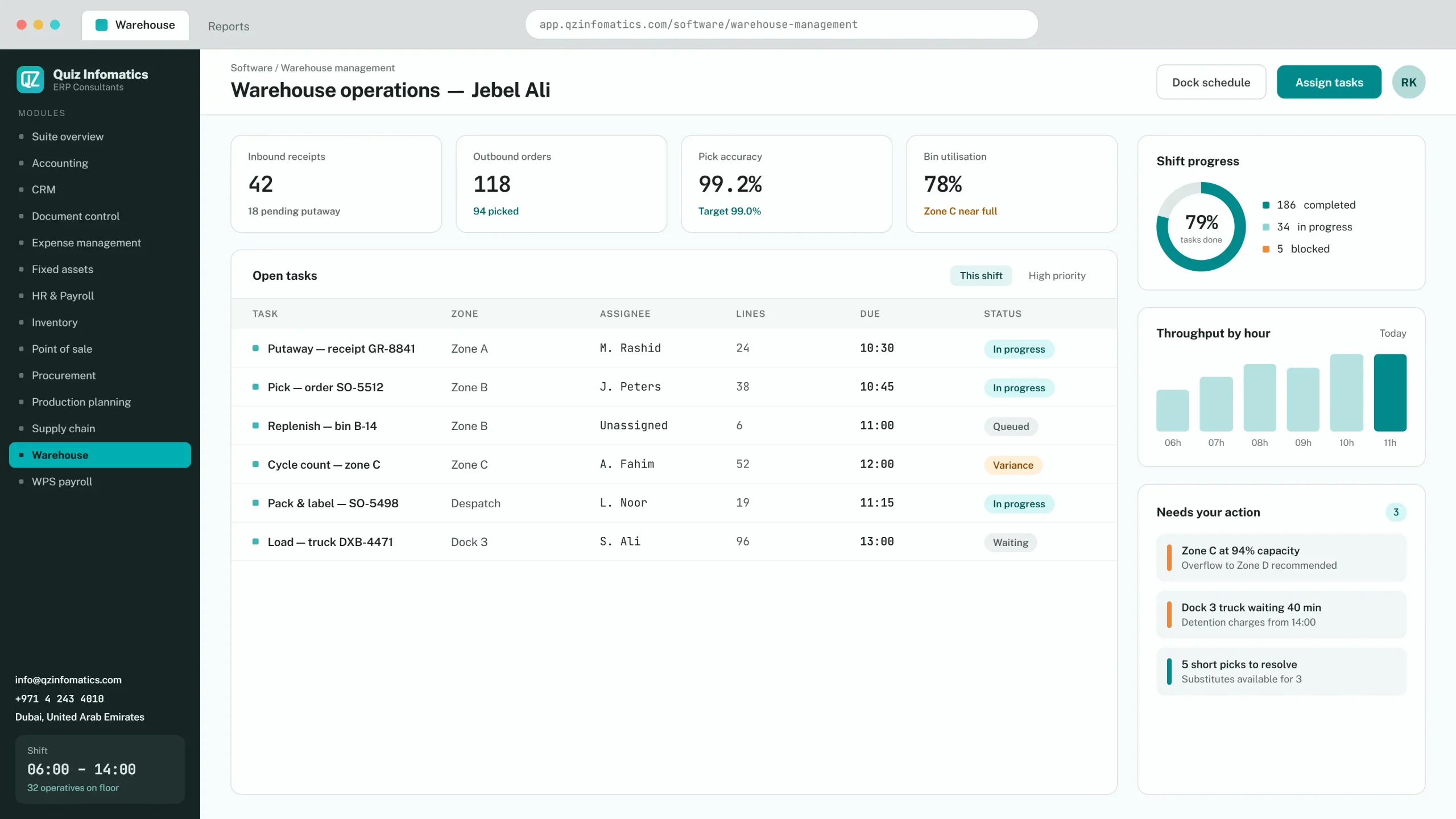
Your stock figure can be perfectly accurate and your warehouse still be a mess.
A warehouse management system controls the physical movement of goods inside a warehouse — receiving, put-away, bin locations, picking, packing and dispatch. It directs staff to the right location, verifies every move by barcode scan, and keeps a live map of exactly where each item sits.
That distinction becomes expensive at a specific point: when your pickers spend more time walking and searching than picking, and when a wrong-item dispatch costs you more than the item was worth.
The test
Do you need a WMS or just inventory software?
When a UAE business needs a warehouse management system rather than inventory software
You need inventory software
You need a WMS as well
One storeroom or a few simple locations
Racking, multiple aisles, defined zones
Stock found by someone who knows where it is
A picking team who cannot know every location
A few dozen orders a day
High order volume, or multi-line orders
Accuracy checked at count
Accuracy needs to hold continuously
Value and quantity are the questions
Speed and location are the questions
Most UAE businesses start with inventory and add warehouse management when headcount in the warehouse crosses the point where verbal knowledge stops scaling. Inventory software.
Functions
Core WMS functions
Directed put-away
The system decides where incoming stock should go based on velocity, size, batch and existing locations, rather than the nearest empty space.
Bin and zone management
Every location addressed and mapped, with capacity limits and product restrictions held against it.
Picking strategies
Single order, batch, wave and zone picking, with routes optimised to minimise walk distance across the building.
Barcode and RFID scanning
Every movement confirmed by scan at receipt, put-away, pick, pack and dispatch.
Cycle counting
Rolling counts by location or velocity class, so the warehouse never shuts for a full count.
Dispatch and documentation
Packing lists, delivery notes, and the customs paperwork that re-export operations require.
Scanning
Scanning is the whole point
A WMS is built around handheld scanners. Each movement is confirmed by scan as it happens, not keyed in later from a note.
Recorded by hand
Accuracy that degrades all year
× A transfer done and not written down
× A pick substituted at the shelf without a record
× A return put back in the wrong bay
× Errors discovered only at the count, months later
× A count that shuts the warehouse for two days
Confirmed by scan
Accuracy that holds between counts
✓ Handheld scanners or rugged Android devices
✓ Each movement confirmed as it happens, not keyed in later
✓ Substitutions either impossible or visible
✓Offline capability, because metal racking and concrete create Wi-Fi dead zones
✓ Cycle counts instead of an annual shutdown
A scanner that stops working in aisle 12 stops being used at all, and the operation reverts to paper within a month. Offline handling is worth testing before buying, not after.
UAE specifics
Free zone, bonded and re-export
UAE distribution has a requirement most international WMS products treat as an afterthought.
Mainland and free zone held apart
Stock must be tracked as distinct locations with their own documentation rules, for customs purposes rather than for convenience.
Bonded stock not commingled
Bonded stock cannot be mixed with duty-paid stock of the same SKU, which is a constraint most international products treat as an afterthought.
Re-export paperwork from the system
The trail customs clearance requires, produced by the system rather than assembled afterwards from three spreadsheets.
Any WMS being considered for a Jebel Ali, DAFZA or KIZAD operation should be tested against this specifically, not accepted on a general specification.
Multiple sites
Multiple warehouses
Across sites
One system, several warehouses
Stock visible across all of them and transfers tracked in transit rather than disappearing between dispatch and receipt.
› Stock visible across every site
› Transfers tracked in transit, not assumed
› Replenishment pulled automatically to forward locations
Plus the hardware itself. Where you already run an ERP, the warehouse module is usually the cheaper route. Specialist WMS platforms cost more but handle high-throughput 3PL, cross-docking and wave picking that ERP modules do not.
02Six to twelve weeks for a single site
The schedule is set by physical preparation — labelling bins, mapping zones, agreeing put-away and picking rules, testing scanner coverage across the building — rather than by software configuration.
03Never at peak
Go-live is normally timed for a quiet trading period. A WMS cutover during peak season is the one scheduling decision that reliably goes wrong.
WMS FAQs
What buyers ask us about warehouse management
What is a warehouse management system?
A warehouse management system (WMS) controls the physical movement of goods inside a warehouse — receiving, put-away, bin locations, picking, packing and dispatch. It directs staff to the correct location, verifies each move by barcode scan, and keeps a live map of exactly where every item sits.
How is a WMS different from inventory management software?
Inventory software answers how much you have and what it is worth. A WMS answers where exactly it is and what the fastest way to pick it is. Businesses with one storeroom rarely need a WMS; operations with racking, multiple aisles and a picking team almost always do.
What features should a WMS in Dubai include?
Look for barcode and RFID scanning, directed put-away and picking, bin and zone management, wave and batch picking, cycle counting, and dispatch documentation. For re-export and free-zone operations the system should also hold bonded stock separately and produce the paperwork customs clearance requires.
Does a WMS work with barcode scanners and mobile devices?
Yes. A WMS is built around handheld scanners or rugged Android devices, with every movement confirmed by scan rather than keyed in afterwards. Scanning at receipt, put-away, pick and dispatch is the main reason scanned warehouses hold far higher stock accuracy than manually recorded ones.
Can a WMS handle multiple warehouses and free-zone stock?
Yes. A WMS manages several sites under one system, with stock visible across all of them and transfers tracked in transit. UAE operations often need mainland and free-zone stock held separately for customs purposes, which the system handles as distinct locations with their own documentation rules.
How does a WMS improve order fulfilment?
By routing pickers along an optimised path, batching several orders into one trip, and verifying each item by scan before packing. The result is faster order turnaround and fewer wrong-item dispatches — the two failures that most damage a distributor’s standing with retail customers.
How much does a WMS cost in the UAE?
WMS pricing depends on the number of warehouse users, sites and scanning devices, plus the hardware itself. Where you already run an ERP, the warehouse module is usually the cheaper route. Specialist WMS platforms cost more but handle high-throughput 3PL and cross-docking scenarios that ERP modules do not.
How long does WMS implementation take?
Six to twelve weeks for a single site. The schedule is set by physical preparation — labelling bins, mapping zones, agreeing put-away and picking rules and testing scanner coverage across the building — rather than by software configuration. Go-live is usually timed for a quiet trading period.
Book a free 30 minute call with QZ Infomatics in Dubai. You will leave it with a platform recommendation, the reasoning behind it, a realistic timeline and an indicative budget band — before you commit to anything.
✓ A consultant who delivers projects, not a sales desk
✓ Odoo, Microsoft Dynamics 365 and Oracle NetSuite compared honestly
✓ Licence cost and implementation cost quoted as separate numbers
✓ If we are not the right fit for you, we will say so