
Skip to content

Five industries worked hands on, so we arrive knowing where the gaps usually are.

All industries →Request a demo

Four ERP platforms in house, and fifteen capability modules. The recommendation is never tied to a licence quota.

All solutions →Request a demo

One team from platform selection through to the reports on your desk.

All services →Request a demo

Learning Centre

Guides, how-tos, comparisons and a plain-English glossary, written by the consultants who deliver the projects. No form in front of any of it.

Free toolsNo gate before you use them
Plain EnglishBOQ, retention, WIP and IPC explained
Written in houseBy the people who run the projects
Browse all resources →

Nobody in UAE ERP publishes their tools or their pricing. We do both.

Free tools →Request a demo

Consultants in the UAE, technical team in South Asia. Cost stays sharp without cutting corners.

About QZ Infomatics →Request a demo
Request a demo +971 4 243 4010

Manufacturing ERP Software UAE

ERP solutions built around how your factory actually runs.

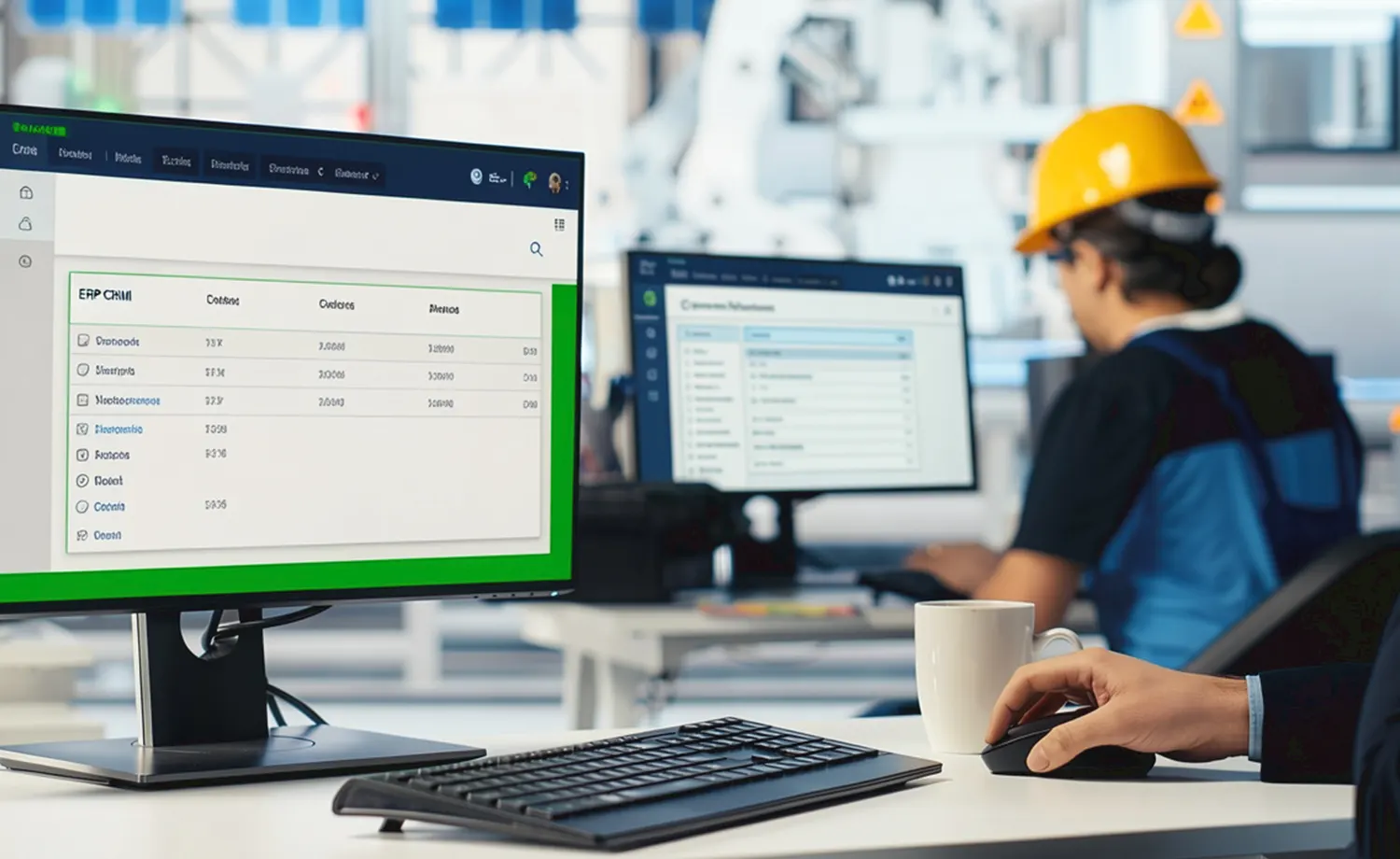
Production planning, bill of materials and quality checks configured for your operation, not a generic template that needs constant workarounds. Manufacturing ERP connects production to the rest of the business — bills of materials, work orders, shop-floor recording, quality control, inventory and costing, all sharing one database with sales, purchasing and finance. It answers three questions a factory needs answered daily: what to make, what that needs, and what it actually cost.

✓ Multi-level BOM & routing✓ MRP-driven scheduling✓ Batch & lot traceability✓ Actual vs standard costing
Manufacturing ERP Software UAE

Where it starts

Most manufacturers do not have a software problem

The real problem

Not software — data

Most manufacturers do not have a software problem. They have a data problem that software exposes.

  • › Bills of materials exist informally, in two people's heads
  • › Standard costs were set three years ago and never revisited
  • › Machine downtime is remembered rather than recorded
  • › Production is planned in a spreadsheet that assumes infinite capacity
Start with what you make →
What ERP adds

One database, three daily questions

Manufacturing ERP connects production to the rest of the business, sharing one database with sales, purchasing and finance.

  • › What to make, from confirmed orders and forecast
  • › What that needs, from the BOM and current stock
  • › What it actually cost, against standard
  • › For discrete, process and make-to-order producers across the UAE
Production planning →

Challenges

Manufacturing challenges we solve

Eight problems come up in almost every UAE factory we assess. None of them is caused by poor management. They are what happens when production runs on systems that were never designed to talk to each other.

Planning disconnected from demand

Production planning done in spreadsheets, with no link to confirmed orders or forecast.

No visibility into work-in-progress

Production status known by walking the floor and asking, rather than from a system.

BOM version control causing errors

The wrong revision built, because the current one lives in a file somebody renamed.

Cost of goods manufactured calculated inaccurately

Or calculated accurately and far too late to act on.

Quality rejections not captured against cost

Scrap absorbed into overhead rather than attributed to the batch that produced it.

Raw material stockouts stopping the line

The most common and most expensive production failure, and almost always one component.

Machine downtime not recorded against cost

So deferred maintenance looks like a saving rather than a cost.

Maintenance reactive, never planned

Servicing happens after failure, which is the most expensive point at which it can happen.

These compound in a predictable order. An outdated BOM produces a wrong material plan, which produces a stockout, which produces a line stoppage that nobody costs — and by the time the margin shortfall reaches the P&L, the cause is three steps back and impossible to isolate.

Coverage

What our ERP solution covers

Five areas, configured around your actual production method rather than adapted from a generic template.

01 — Plan

Production planning

MRP works backwards from confirmed orders and forecasts, using the BOM, current stock, open purchase orders and supplier lead times to tell you what to make and what to buy, and by when.

  • › MRP-driven production scheduling
  • › Capacity planning across work centres
  • › Make-to-order and make-to-stock workflows
  • › Production order management and tracking
  • › Subcontracting and outsourced operations
Production planning →
02 — Define

Bill of materials and routing

The BOM and routing are the foundation everything else depends on — material planning, production costing and stock deduction all read from them, which is why version control matters more here than anywhere else.

  • › Multi-level BOM creation and version control
  • › Phantom and co-product BOM support
  • › Engineering change order management
  • › BOM cost rollup and analysis
  • › Routing and work centre definition
Why versions matter →
03 — Check

Quality control

Inspection results are recorded against the batch and the work order, so a quality rejection carries its production cost with it instead of disappearing into overhead.

  • › Incoming inspection and goods receipt QC
  • › In-process quality checkpoints
  • › Non-conformance recording and disposition
  • › Customer return and defect analysis
  • › Quality cost reporting
Traceability →
04 — Hold

Inventory and warehouse

Raw material, work in progress and finished goods tracked as distinct stages, with yield and scrap recorded at each transition rather than reconciled at the count.

  • › Raw material, WIP and finished goods management
  • › Bin-level stock management
  • › Yield and scrap tracking
  • › Inventory shared with sales and purchasing
  • › Subcontracting and toll processing management
Inventory →

Costing & finance sits across all four: actual material, labour and machine time recorded against each work order, compared against standard, with variance separated by cause rather than reported as a single margin figure — plus job and process costing, multi-plant consolidation and manufacturing-specific VAT and compliance reporting.

Which kind

Discrete, process or make-to-order

The first qualifying question in any real conversation, and the one worth settling before a demo rather than after.

Discrete manufacturing

Assembles distinct, countable units from components — electronics, furniture, equipment, metal fabrication. Multi-level BOMs, serial number tracking, assembly routings.

Process manufacturing

Works with formulations, batches and yields rather than units — food and beverage, chemicals, paints, cosmetics, lubricants. Recipes rather than BOMs, batch and expiry tracking, co-products and by-products, yield variance. Food and beverage.

Make-to-order

Driven by customer specification rather than forecast — custom fabrication, engineered products, job shops. Each order carries its own BOM and cost, which makes this closer to project costing than to repetitive manufacturing.

Many UAE manufacturers run more than one mode. A fabricator producing a standard range alongside bespoke orders needs both discrete and make-to-order configured in the same system. That flexibility matters more when selecting a platform than depth in any single mode.

Traceability

Traceability and compliance

Both directions

Traceability that survives a recall

Given a finished batch, the system identifies every raw material lot and supplier that went into it. Given a raw material lot, it identifies every finished batch and every customer it reached.

  • › The practical test is time
  • › A recall trace that takes minutes is a contained incident
  • › One that takes two days is a production halt
  • › While somebody reconstructs it from delivery notes
Batch traceability →
Where it is mandatory

Inspection requirement, not good practice

For UAE manufacturers this matters most in food and beverage, pharmaceutical, cosmetics and chemicals, where batch traceability and shelf-life control are inspection requirements.

  • › Dubai Municipality documentation requirements
  • › ESMA conformity where applicable
  • › Halal certification, held against product and supplier
  • › Engineering change orders belong in the same discussion — otherwise a recall traces to a specification that no longer describes what was made
Food & beverage →

Subcontracting

Material you own, sitting somewhere else

Handled as a spreadsheet handles it

Written off, then received back

  • × Material written off on dispatch to the subcontractor
  • × Received back as new stock when it returns
  • × Inventory valuation understated for however long it is out
  • × Unexplained stock differences that nobody can trace
  • × Because the movement was never recorded as a movement
Handled properly

Your stock, at their location

  • ✓ Material remains visible as your stock at a third-party site
  • ✓ The subcontract service cost added on return
  • ✓ Yield or scrap at the subcontractor recorded
  • ✓ Toll processing works the same way in reverse
  • ✓ Where you perform the operation on someone else's material

UAE manufacturers outsource constantly — plating, coating, heat treatment, machining, printing, packing. Material leaves your site, work is performed on it, and it comes back with a service cost attached. This is where inventory accuracy usually breaks.

Maintenance

Downtime you can cost

Schedules that raise their own work orders

Preventive maintenance based on run hours or output counts, raising work orders automatically rather than relying on a calendar reminder.

Downtime with a value against it

Unplanned downtime recorded against both the machine and the affected production order. That link is what makes deferred maintenance visible as a cost rather than a saving.

Condition-based, not calendar-based

Where run hours, vibration, temperature or output are captured by sensors rather than logged by hand. Heat and dust age rotating equipment faster than a European service interval assumes, so imported calendar schedules are wrong in both directions.

UAE compliance

UAE compliance and multi-plant

5% VAT

On sales, purchases, scrap disposal and inter-company transfers, with the correct treatment on each.

Corporate tax

Which requires cost of goods manufactured to be supportable — and that depends on the BOM and costing discipline above.

Multi-plant and multi-entity

Common where a group runs a mainland factory and a free zone operation, with inter-company transfers at cost or at transfer price.

Free zone and mainland stock

Held as distinct locations with their own customs documentation rather than tagged within one pool.

E-invoicing readiness

As the FTA mandate phases in through 2027. E-invoicing.

WPS payroll for shop-floor labour

With hours allocated to work orders rather than a single production overhead account. WPS payroll.

Client success story

Ideal Group

Client success story

A recovery, not a greenfield build

Ideal Group's Odoo implementation had stalled before QZ Infomatics was brought in. The engagement covered technical recovery, resolution of outstanding design and configuration issues, stabilisation of the platform, and a successful go-live — followed by ongoing optimisation support as the business grows on it.

  • › Go live achieved after prior stagnation
  • › Odoo platform stabilised in full
  • › Ongoing optimisation and growth support
  • › Manufacturing, UAE
Odoo →
Why this matters here

It is probably your situation

Most prospects arriving on a manufacturing ERP page are not starting from nothing. A meaningful share have a system implemented badly, a partner who has gone quiet, or a project that stopped halfway.

  • › For that reader a recovery story is more persuasive than a clean build
  • › Because it is their situation rather than an ideal one
  • › Already have an ERP that stalled?
  • › We take over implementations other partners started
Takeover and support →

Explore in depth

The systems behind manufacturing ERP

Production planning & MRP

Bills of materials, work orders, capacity scheduling and variance analysis in detail. Production planning.

Inventory management

Multi-location stock, batch and serial tracking, valuation and barcode scanning. Inventory.

Project costing

For make-to-order and engineered-product manufacturers billing by job. Project costing.

Manufacturing FAQs

What manufacturers ask us about ERP

What is manufacturing ERP software?

Manufacturing ERP software connects production to the rest of the business: bills of materials, production planning, work orders, shop-floor recording, quality control, inventory and costing, all sharing data with sales, purchasing and finance. It answers what to make, what that needs, and what it actually cost.

Which types of manufacturing does it support?

Discrete manufacturing that assembles distinct units, process manufacturing built on formulations and batches, and make-to-order production driven by customer specification. UAE manufacturers often run more than one mode, which makes flexibility in how work orders and costing are configured more valuable than depth in any single mode.

How does the system control production cost?

Standard cost is set from the bill of materials and routing, then compared against actual material, labour and machine time recorded on each work order. Variance analysis separates price, usage and efficiency, so a margin shortfall traces to a specific cause instead of disappearing into overhead.

Does it handle quality control and traceability?

Yes. Inspection points at goods receipt, in process and before dispatch record results against the batch, with non-conformances routed for disposition. Traceability links each finished batch back to its raw material lots and suppliers, which makes a recall a contained exercise rather than a full production halt.

Can it manage subcontracted or outsourced processes?

Yes. Material issued to a subcontractor remains visible as your stock at their location, with the service cost added on return. UAE manufacturers frequently outsource plating, coating or machining steps, and untracked material sitting at a third-party site is a common source of unexplained inventory differences.

How does it handle wastage and yield?

Expected yield and scrap rates are built into the bill of materials, and actual consumption is recorded against each work order so variance is visible per batch. Persistent negative variance on one product usually points to a costing assumption that no longer matches how the item is really produced.

Does it support maintenance of production equipment?

Yes. Preventive maintenance schedules based on run hours or output counts raise work orders automatically, and unplanned downtime is recorded against both the machine and the affected production order. Linking maintenance to production makes the real cost of deferring a service visible.

How long does a manufacturing ERP implementation take?

Four to nine months, driven by data rather than configuration. Bills of materials and routings frequently exist only in production staff knowledge, and rebuilding them accurately is the longest task. Most manufacturers go live with finance, inventory and purchasing first, then add production as a second phase.

Talk to a consultant

Talk to an ERP consultant, not a salesperson

Book a free 30 minute call with QZ Infomatics in Dubai. You will leave it with a platform recommendation, the reasoning behind it, a realistic timeline and an indicative budget band — before you commit to anything.

  • ✓ A consultant who delivers projects, not a sales desk
  • ✓ Odoo, Microsoft Dynamics 365 and Oracle NetSuite compared honestly
  • ✓ Licence cost and implementation cost quoted as separate numbers
  • ✓ If we are not the right fit for you, we will say so

Book a free call

We reply within one working day.

Or WhatsApp us on +971 4 243 4010

Request a demo