
Skip to content

Five industries worked hands on, so we arrive knowing where the gaps usually are.

All industries →Request a demo

Four ERP platforms in house, and fifteen capability modules. The recommendation is never tied to a licence quota.

All solutions →Request a demo

One team from platform selection through to the reports on your desk.

All services →Request a demo

Learning Centre

Guides, how-tos, comparisons and a plain-English glossary, written by the consultants who deliver the projects. No form in front of any of it.

Free toolsNo gate before you use them
Plain EnglishBOQ, retention, WIP and IPC explained
Written in houseBy the people who run the projects
Browse all resources →

Nobody in UAE ERP publishes their tools or their pricing. We do both.

Free tools →Request a demo

Consultants in the UAE, technical team in South Asia. Cost stays sharp without cutting corners.

About QZ Infomatics →Request a demo
Request a demo +971 4 243 4010

Fixed Asset & Equipment Management

Most asset registers are a list of things
a company used to own.

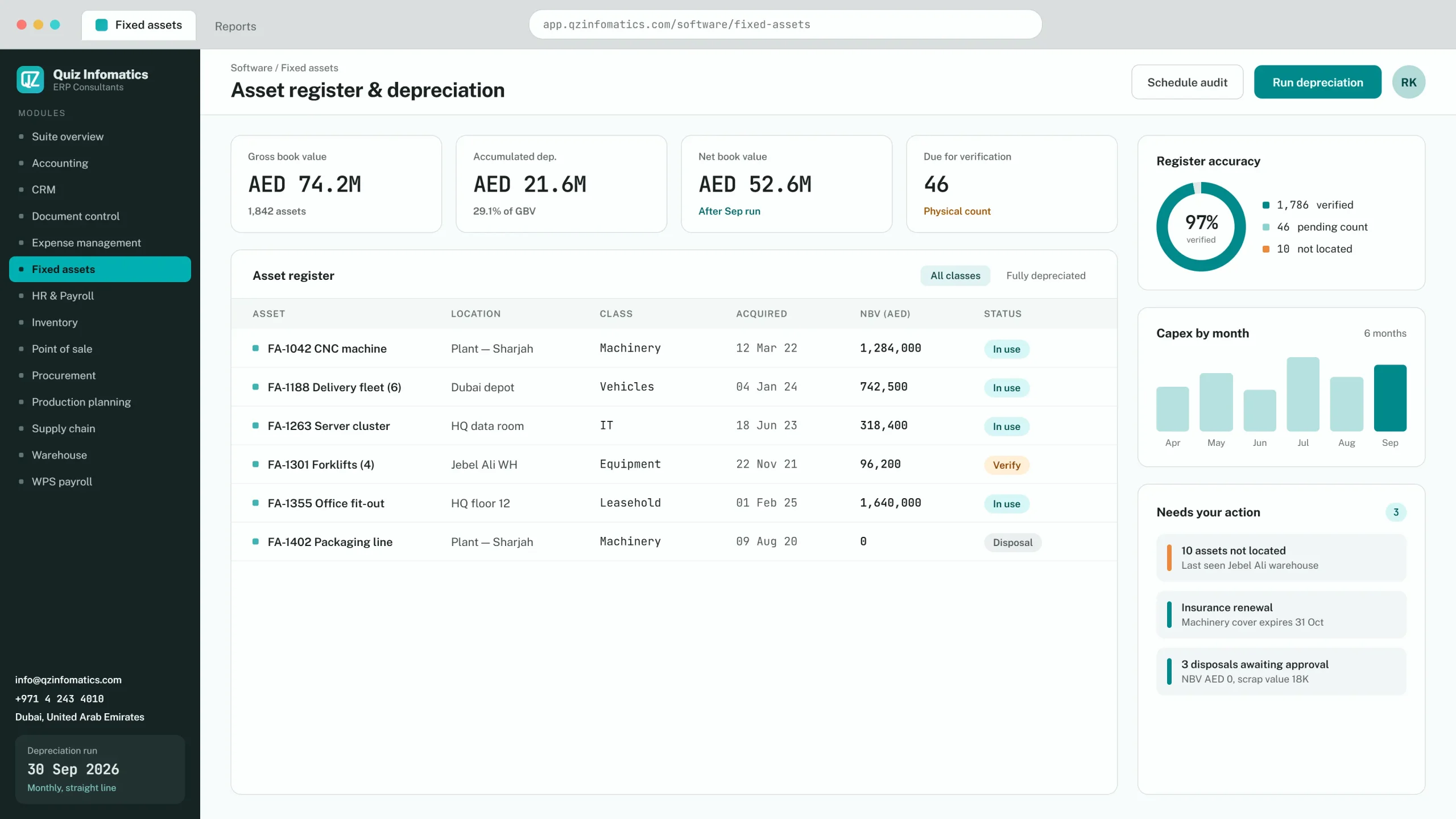
Fixed asset management software maintains a register of every capital asset with its cost, location, custodian, depreciation method and net book value. It automates depreciation postings, tracks transfers and disposals, and produces the asset schedule your auditors ask for — from records maintained during the year rather than reconstructed at the end of it.

✓ Depreciation posted, not calculated✓ Verification by scan, not by list✓ Plant charged to the project that used it✓ IFRS and corporate tax schedules
Fixed Asset & Equipment Management

The confusion

Two different jobs, one register

They describe the same physical objects and, in most UAE businesses, are maintained in two places that disagree.

Finance owns this

Fixed asset management

The financial view: acquisition cost, depreciation method, useful life, net book value, disposal, and the schedules that support your financial statements and corporate tax computation.

  • › Acquisition cost and capitalisation
  • › Depreciation method and useful life
  • › Net book value and disposal
  • › Schedules for the accounts and the tax computation
Accounting →
Operations owns this

Equipment management

The operational view: where the machine is, who is using it, when it was last serviced, how many hours it has run, and whether it is available for the next job.

  • › Location and current custodian
  • › Last service and hours run
  • › Availability for the next job
  • › Linked to maintenance history
Maintenance →

Contractors with plant and facility managers with building systems need both, linked. That link is what produces total cost of ownership: purchase cost, cumulative maintenance, downtime cost and current book value in one place.

Depreciation

Depreciation without the spreadsheet

By method and useful life

Straight line, reducing balance or units of production, per asset category, posting monthly to the correct expense and accumulated depreciation accounts.

Without manual proration

Component depreciation, mid-year additions, part disposals and revaluations all handled by the system rather than by a formula somebody maintains.

The schedule your auditor asks for

Additions, disposals and net book value, produced in minutes rather than assembled from a spreadsheet that has been copied forward for six years.

Where the accounting and tax bases diverge, separate books carry different treatments against the same asset.

Verification

Tagging and physical verification

01Tag and assign

Barcodes, QR codes or RFID, with each asset assigned to a location, department and custodian, and every transfer logged.

02Verify by scanning

Physical verification is done by scanning rather than by walking around with a printed list and a pen.

03Read the exception report

Assets found that are not on the register, assets on the register that cannot be found, and assets in a different location or with a different custodian than recorded. The first one is usually uncomfortable, and the most valuable thing the software does in year one.

Contractors

Plant and machinery for contractors

Charged, not absorbed

Plant allocated to the project

Plant is charged at an internal hire rate for the period used, so project cost reflects the equipment consumed rather than absorbing it into overhead.

  • › An internal hire rate per machine, per period
  • › A job that used the crane for six weeks carries that cost
  • › Project profitability becomes honest
  • › Owned plant stops looking free to the people deciding to keep it on site
Contracting →
The buy-or-hire decision

Utilisation is the data

Utilisation reporting shows which machines sit idle — almost always a larger cost than it appears, since idle owned plant is invisible in a way that idle hired plant is not.

  • › Which machines sit idle, and for how long
  • › Idle owned plant is invisible; idle hired plant is a line on an invoice
  • › The buy-or-hire decision is made repeatedly, usually without data
  • › Utilisation history is that data
Project costing →

Compliance

UAE compliance requirements

IFRS schedules

Additions, disposals, depreciation charge and closing net book value by category, produced for the financial statements.

Two bases, one asset

Where accounting and tax depreciation differ, both are maintained against the same asset rather than in a parallel calculation nobody reconciles.

Corporate tax made it urgent

For businesses that never maintained a proper register, the computation now depends on figures that have to be defensible. Corporate tax.

Three to six weeks for the software; the register itself sets the real timeline. Businesses that have not physically verified their assets recently need a count and tagging exercise first, and reconciling that count back to the general ledger is often the most revealing part of the project. Expect to write off assets that no longer exist and capitalise ones that were expensed.

Fixed asset FAQs

What buyers ask us about asset management

What is fixed asset management software?

Fixed asset management software maintains a register of every capital asset with its cost, location, custodian, depreciation method and net book value. It automates depreciation postings, tracks transfers and disposals, and produces the asset schedule your auditors request at each year end.

How does it calculate depreciation?

Depreciation runs by method and useful life per asset category — straight line, reducing balance or units of production — and posts monthly to the correct expense and accumulated depreciation accounts. Component depreciation and mid-year additions or disposals are handled without manual proration in a spreadsheet.

What is the difference between fixed asset and equipment management?

Fixed asset management is the financial view: cost, depreciation, book value and disposal. Equipment management is operational: where the machine is, who is using it, when it was last serviced and how many hours it has run. Contractors and facility managers generally need both, linked together.

Can it track asset location and custody?

Yes. Assets are tagged with barcodes, QR codes or RFID and assigned to a location, department and custodian, with every transfer logged. Physical verification is done by scanning, producing an exception list of assets not found — often the first honest picture a business gets of its register.

Does it link to maintenance?

Yes. Connecting the asset register to maintenance means service history, downtime and parts cost accumulate against the same asset that carries the depreciation. Total cost of ownership then becomes visible, which is the basis for deciding whether to keep repairing a machine or replace it.

How does it handle plant and machinery for contractors?

Plant is allocated to projects and charged at an internal hire rate for the period used, so project cost reflects equipment consumption instead of absorbing it into overhead. Utilisation reporting also shows which machines sit idle, which is usually a larger cost than it first appears.

Does it support UAE corporate tax and IFRS requirements?

Yes. Separate books can carry different depreciation treatments where accounting and tax bases diverge, and the register produces the additions, disposals and net book value schedules needed for financial statements and corporate tax computation. Revaluation is supported where your accounting policy requires it.

How long does fixed asset implementation take?

Three to six weeks for the software, but the register itself sets the real timeline. Businesses that have not physically verified assets recently usually need a count and tagging exercise first, and reconciling that count back to the general ledger is often the most revealing part of the project.

Talk to a consultant

Talk to an ERP consultant, not a salesperson

Book a free 30 minute call with QZ Infomatics in Dubai. You will leave it with a platform recommendation, the reasoning behind it, a realistic timeline and an indicative budget band — before you commit to anything.

  • ✓ A consultant who delivers projects, not a sales desk
  • ✓ Odoo, Microsoft Dynamics 365 and Oracle NetSuite compared honestly
  • ✓ Licence cost and implementation cost quoted as separate numbers
  • ✓ If we are not the right fit for you, we will say so

Book a free call

We reply within one working day.

Or WhatsApp us on +971 4 243 4010

Request a demo