E-invoicing compliance connected directly to your ERP. No manual steps, No separate portal
We implement ClearTax for businesses across the GCC that need e-invoicing compliance integrated directly with their ERP. Once set up, every invoice your system generates is automatically formatted, signed, submitted and cleared without your finance team changing how they work.
Saudi Arabia’s ZATCA mandated e-invoicing in two phases. Phase 1 required all VAT-registered businesses to generate structured electronic invoices. Phase 2 requires real-time submission to ZATCA’s Fatoorah platform with cryptographic signing and QR codes.
✓ Phase 1 compliance: structured e-invoice generation with mandatory fields
✓ Phase 2 compliance: real-time ZATCA clearance for B2B invoices
✓ Simplified invoices for B2C transactions with QR code
✓ Credit note and debit note e-document generation
✓ ZATCA-certified solution with pre-approved integration
02
UAE and wider GCC expansion
The UAE Federal Tax Authority has signalled the introduction of mandatory e-invoicing following the ZATCA model. Other GCC member states are at various stages of e-invoicing regulatory development. ClearTax’s platform is designed to adapt to each market’s requirements as they come into effect.
✓ UAE FTA e-invoicing readiness and early compliance preparation
✓ Multi-country compliance from a single platform instance
✓ Regulatory update management: ClearTax maintains compliance as rules evolve
✓ Arabic-language invoice support across all document types
✓ Multi-currency and multi-entity invoice management
Integration
How the ERP integration works
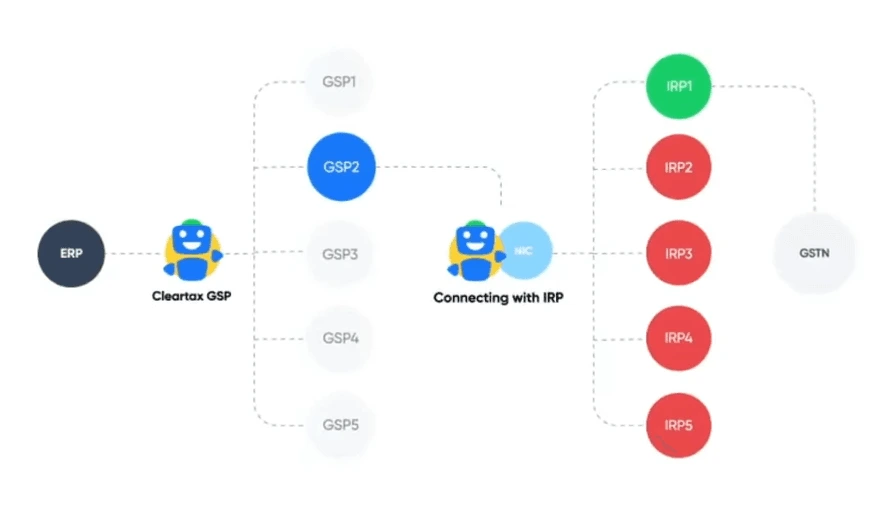
When a sales invoice is confirmed in your ERP, the integration automatically extracts the invoice data, formats it to the required XML schema, applies cryptographic signing, generates the QR code and submits the document to the tax authority portal — all within seconds. The cleared invoice comes back to your ERP with the ZATCA reference stamped on the record.
Step by step
How the integration works
✓ Invoice confirmed in the ERP (Odoo, Microsoft Dynamics, SAP, Oracle)
✓ Data extracted and mapped to the e-invoice XML schema automatically
✓ Cryptographic signing and QR code generation via ClearTax
✓ Real-time submission to ZATCA (Phase 2) or local storage (Phase 1)
✓ Cleared invoice returned to the ERP with its compliance reference
Connectors
Supported ERP platforms
✓ Odoo — native ClearTax module with full Phase 1 and Phase 2 support
✓ Microsoft Dynamics 365 Finance & Operations — certified connector
✓ SAP — middleware-based integration with the ZATCA API
✓ Oracle ERP Cloud — API integration via Oracle Integration Cloud
✓ Custom ERP or billing systems — REST API integration
Scope
What ClearTax covers
Documents
Document types
✓ Standard tax invoices (B2B)
✓ Simplified invoices (B2C)
✓ Credit notes and debit notes
✓ Self-billed invoices
✓ Prepayment invoices
Compliance
Compliance features
✓ ZATCA-certified cryptographic signing
✓ UBL 2.1 XML schema generation
✓ QR code embedding (TLV format)
✓ UUID and IRN assignment
✓ Error handling and resubmission
Records
Archiving and audit
✓ Seven-year compliant invoice archiving
✓ Searchable invoice repository
✓ Audit trail for all submissions
✓ Bulk invoice retrieval and export
✓ Tax authority audit support reports
Outcomes
Key benefits for finance teams
Accuracy
No more manual VAT filing risk
Automated invoice generation and submission removes the human-error risk in manual VAT processes. Every invoice is validated against the required schema before submission, preventing errors from reaching the tax authority.
Adoption
No change to how your team works
Your finance team continues to work in the ERP exactly as before. E-invoicing happens automatically in the background — no additional steps, no separate portal to manage, and no change to the invoice approval process.
Visibility
Real-time compliance visibility
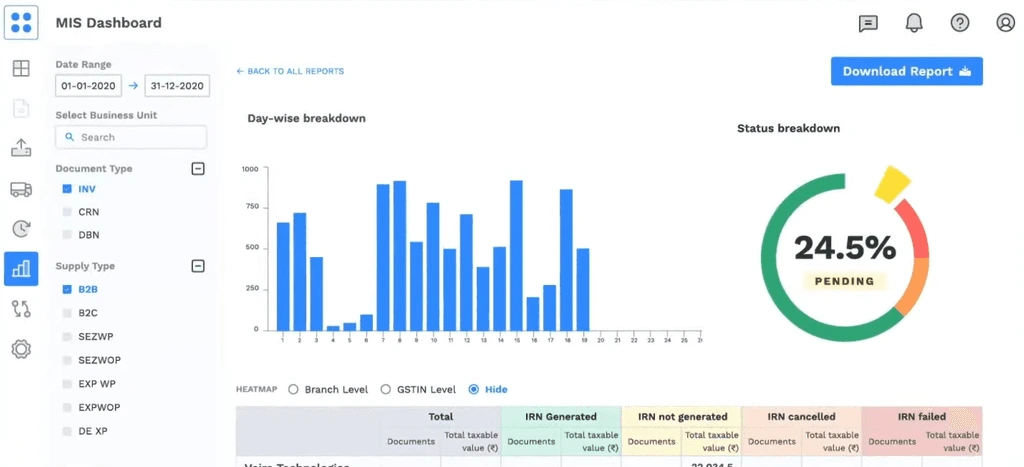
A live compliance dashboard shows the status of every invoice across all your entities and every country where you are VAT-registered. Cleared, pending, rejected or error — all in one view.
Continuity
Protection against regulatory change
ClearTax maintains the compliance layer for all clients, updating schemas, API endpoints and signing requirements as regulations change. You are never exposed to a rule change that breaks your invoicing.
Proof
ClearTax customers
Why
Compliance has moved faster than finance systems
What changed
Three obligations, three workarounds
Tax compliance in the GCC has changed faster than most finance systems have. VAT arrived, then corporate tax, and e-invoicing is phasing in through 2027.
› A spreadsheet for the return
› A manual analysis for the tax computation
› And a plan to deal with e-invoicing later
› Each handled separately, by a different person, in a different tool
ClearTax sits between your ERP and the tax authority. The point is that none of it changes how your finance team works — the compliance happens in the system they already use.
› Returns prepared from transaction data
› Corporate tax data structured as the computation requires
› E-invoices formatted, signed, submitted and cleared
VAT-registered businesses file to the FTA for their assigned tax period. The return itself is not the difficult part — the difficult part is being confident the figures are right, and being able to prove it eighteen months later.
Prepared from transaction data
Rather than from a manual export, so the numbers trace back to individual invoices rather than to a summary somebody assembled.
Treatment validated per transaction
Standard-rated, zero-rated, exempt, out of scope, reverse charge on imports, designated zone supplies. Errors surface before filing rather than during an audit.
Non-recoverable input VAT flagged
Missing tax registration numbers, simplified receipts where a full tax invoice was required, invoices made out to an individual. Employee expense claims are the highest-risk category.
Reconciled to your books
So the VAT control account and the filed return agree, which is the first thing an auditor checks.
Supporting detail retained
Against the transaction rather than in a folder, in the form an FTA audit would request it.
Catching an error at preparation costs nothing. Correcting it later through a voluntary disclosure costs considerably more, and errors are usually found long after filing.
Corporate tax
What corporate tax needs from your systems
What it requires
Structure, not a button
Corporate tax is less about a software feature than about how your books are structured. There is no button that produces the computation.
› Reliable financial statements
› Allowable and disallowable expenses separated without manual analysis
› Related-party transactions identifiable
› Transfer pricing documentation where thresholds apply
› And disciplined period closing, so the statements are actually final
A software vendor structuring your data and a tax adviser interpreting your obligations are two different engagements, and any provider suggesting otherwise is overstating.
Missing tax registration numbers, inconsistent customer addresses, incomplete item descriptions. The longest task in almost every compliance implementation, and it can begin now regardless of platform.
Start this today
02
Connect to the ERP
Using the method appropriate to your platform — native module, certified connector, middleware or REST API.
Per platform
03
Map fields and validate
Against the required schema, with test transactions covering each document type you issue.
Every document type
04
Run in parallel, then go live
Through the voluntary window, so failures happen while they are free. Businesses that wait for their mandatory date lose the ability to fail safely, which is the entire value of the voluntary phase.
Yes. ClearTax is a ZATCA-approved e-invoicing solution provider for both Phase 1 (generation) and Phase 2 (integration), which is why the connection to the Fatoorah platform is pre-approved rather than something each client has to certify themselves.
What information is required on a ZATCA-compliant e-invoice?
Beyond the usual invoice fields, a compliant document carries the seller’s and buyer’s VAT registration numbers, a UUID, the invoice timestamp, the previous invoice hash, a cryptographic stamp and a QR code in TLV format, all in the UBL 2.1 XML schema. The integration fills these from the ERP record, so nothing is typed by hand.
How long does the ClearTax implementation take?
For a standard connector (Odoo or Dynamics 365 Finance & Operations) with clean master data, two to four weeks from kick-off to cleared invoices in production. SAP, Oracle or custom billing systems, and multi-entity groups, run longer because the mapping and testing cover more ground. We fix the scope and date before starting.
What happens if an invoice is rejected by ZATCA?
The rejection reason comes back to the ERP against the invoice, the document is flagged on the compliance dashboard, and the finance team corrects the source record and resubmits from the ERP. Nothing leaves the system, and the audit trail keeps both attempts.
Does ClearTax support Arabic-language invoices?
Yes. Invoices, simplified invoices, credit notes and debit notes can be produced in Arabic, English or both, with the Arabic content carried in the XML as the regulation requires, not only on the printed layout.
What is ClearTax used for in the UAE?
ClearTax provides tax compliance software for UAE businesses, covering VAT return preparation and filing, corporate tax computation support and e-invoicing readiness. It works alongside your accounting system, taking transaction data and producing the returns and reconciliations the Federal Tax Authority requires.
How does VAT return filing work in the UAE?
VAT-registered businesses file returns to the FTA for their assigned tax period, reporting output tax on sales and recoverable input tax on purchases. Software prepares the return from transaction data, flags exceptions such as missing tax registration numbers, and reconciles the figures back to the ledger.
What does VAT software actually do?
It validates transaction-level tax treatment, identifies invoices that do not qualify for input recovery, reconciles the return against your books, and retains the supporting detail an FTA audit would request. The value sits in catching errors before filing rather than in the submission itself.
Can it help with UAE corporate tax?
It supports the computation by structuring financial data, separating allowable and disallowable expenses and maintaining related-party records. It does not replace tax advice on your specific position, and the general corporate tax rules are better covered in a guide than on a software page.
Is ClearTax relevant to e-invoicing?
Yes. E-invoicing readiness overlaps heavily with tax compliance: master data quality, mandatory field completeness and correct tax treatment. Confirm whether your chosen provider appears on the Ministry of Finance accredited list, since only an Accredited Service Provider can transmit invoices under the mandate.
Book a free 30 minute call with QZ Infomatics in Dubai. You will leave it with a platform recommendation, the reasoning behind it, a realistic timeline and an indicative budget band — before you commit to anything.
✓ A consultant who delivers projects, not a sales desk
✓ Odoo, Microsoft Dynamics 365 and Oracle NetSuite compared honestly
✓ Licence cost and implementation cost quoted as separate numbers
✓ If we are not the right fit for you, we will say so