Skip to content

Five industries worked hands on, so we arrive knowing where the gaps usually are.

All industries →Request a demo

Four ERP platforms in house, and fifteen capability modules. The recommendation is never tied to a licence quota.

All solutions →Request a demo

One team from platform selection through to the reports on your desk.

All services →Request a demo

Learning Centre

Guides, how-tos, comparisons and a plain-English glossary, written by the consultants who deliver the projects. No form in front of any of it.

Free toolsNo gate before you use them
Plain EnglishBOQ, retention, WIP and IPC explained
Written in houseBy the people who run the projects
Browse all resources →

Nobody in UAE ERP publishes their tools or their pricing. We do both.

Free tools →Request a demo

Consultants in the UAE, technical team in South Asia. Cost stays sharp without cutting corners.

About QZ Infomatics →Request a demo
Request a demo +971 4 243 4010

Zuper Field Service & Work Order Management

Zuper the field service platform that connects your office and your field team in real time

Quiz Infomatics implements Zuper for facilities management companies, contracting businesses, maintenance service providers, and any organization that dispatches field teams to customer sites configuring the platform around their specific workflows, SLA structures, and billing models.
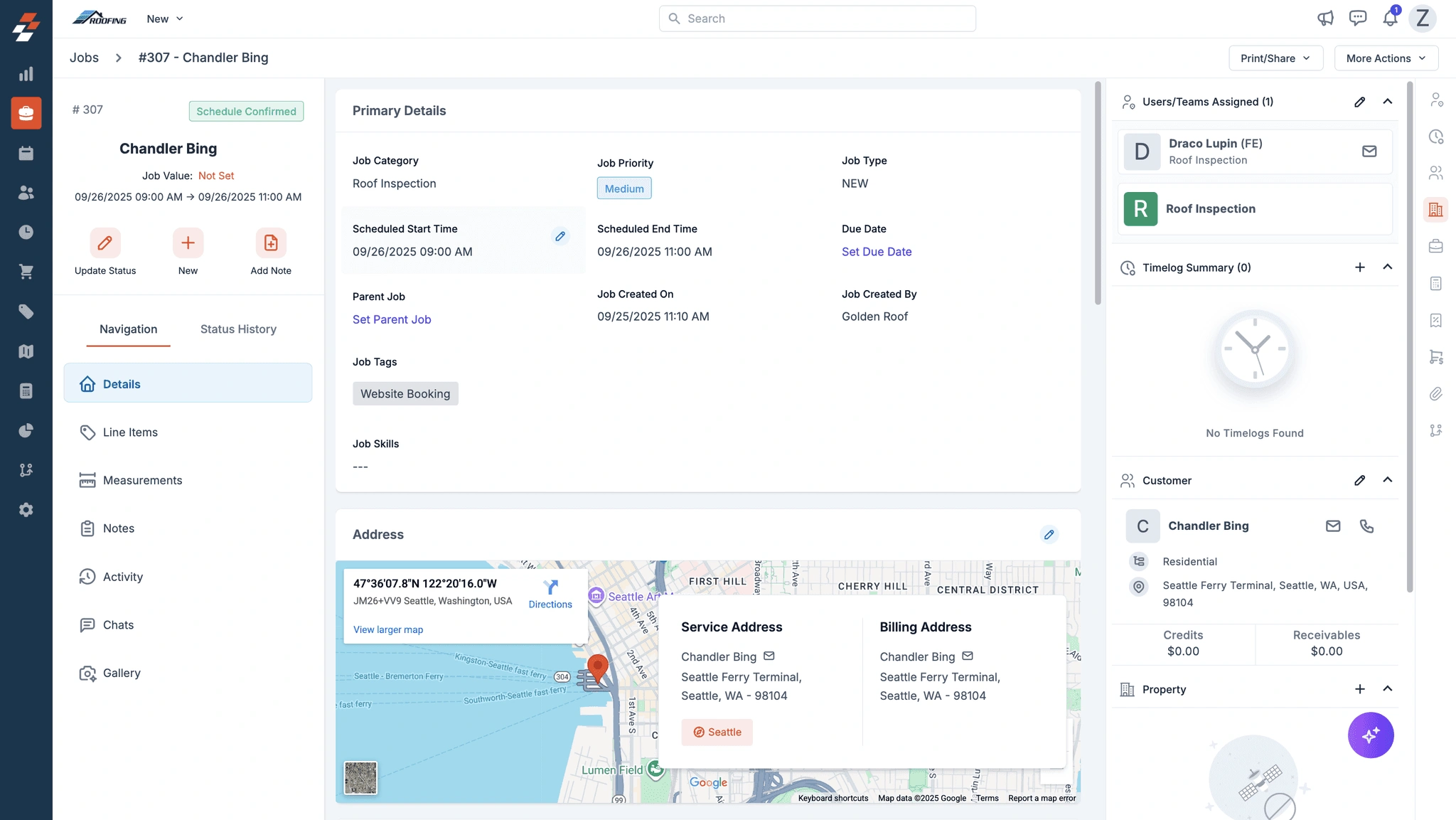
✓ Offline mobile app✓ SLA compliance tracking✓ Invoice on job completion✓ Odoo & Dynamics sync

Partner rationale

Why we partner with Zuper

We evaluated multiple FSM platforms before selecting Zuper as our primary delivery partner. Zuper stood out for three reasons: the depth of its ERP integration capability (which eliminates the double-entry that plagues most FSM deployments), the quality of its mobile application (which drives genuine field technician adoption), and its flexibility in supporting the varied SLA and billing models that characterise GCC facilities management businesses.

Reason one

ERP integration depth

Eliminates the double entry that plagues most FSM deployments: completed jobs, parts and time flow straight into the ERP.

Reason two

A mobile app technicians actually use

The quality of the field application is what drives genuine technician adoption, offline or on site.

Reason three

Flexible SLA and billing models

Supports the varied SLA structures and billing models that characterise GCC facilities management businesses.

Capability

What Zuper does

01

Intelligent scheduling engine

AI-powered job assignment that matches the right technician to the right job based on skill, location, availability and priority. Less travel time, better SLA compliance and more jobs completed per day.
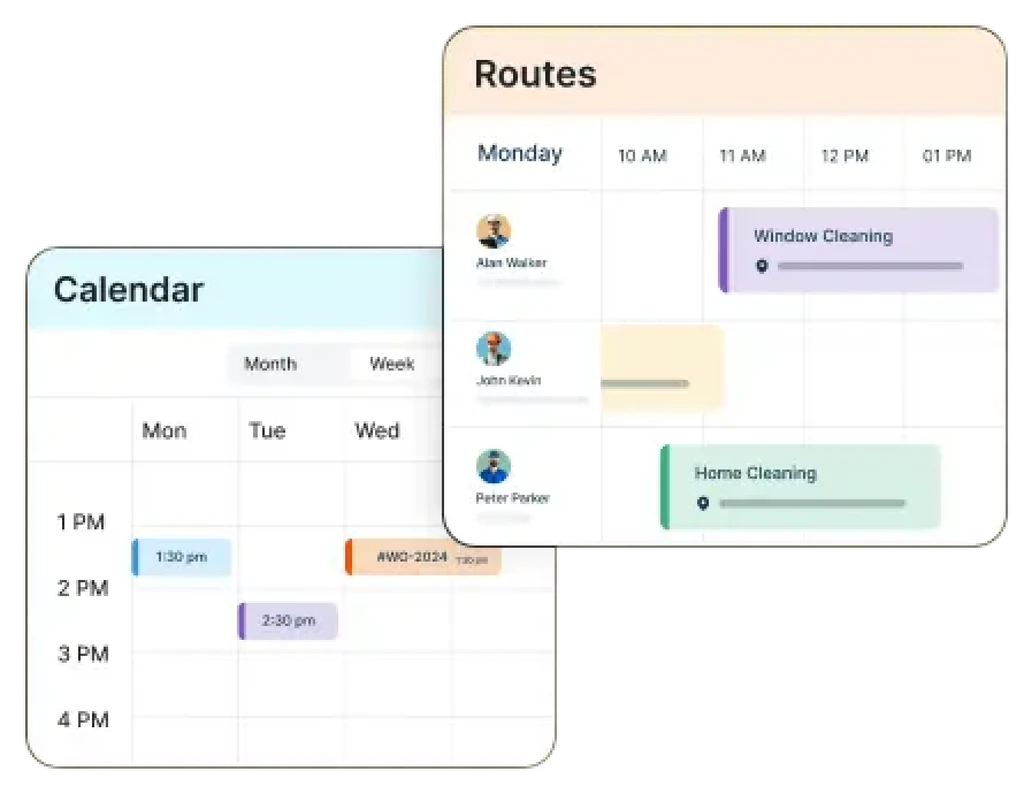
  • ✓ Skill-based technician matching
  • ✓ Geographic clustering and route optimisation
  • ✓ Drag-and-drop schedule board
  • ✓ Automated conflict resolution
Intelligent scheduling engine in Zuper

02

Mobile technician app

A full-featured iOS and Android application that gives field technicians everything they need to complete jobs professionally, with offline capability for areas with poor connectivity.
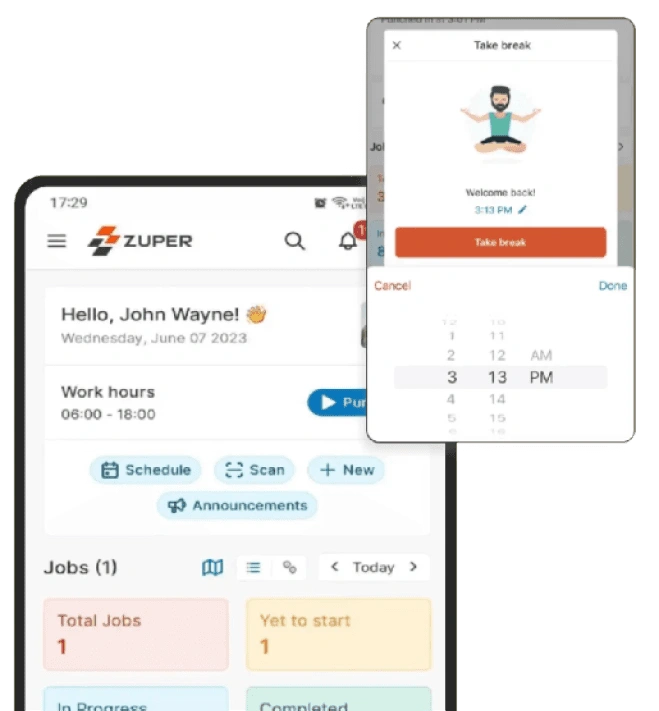
  • ✓ Job details and customer history
  • ✓ Photo and document capture
  • ✓ Digital signature collection
  • ✓ Parts and materials recording
  • ✓ Offline sync on reconnection
Mobile technician app in Zuper

03

Customer experience

Every customer touchpoint automated throughout the service cycle, so clients stay informed without your team having to do it manually.
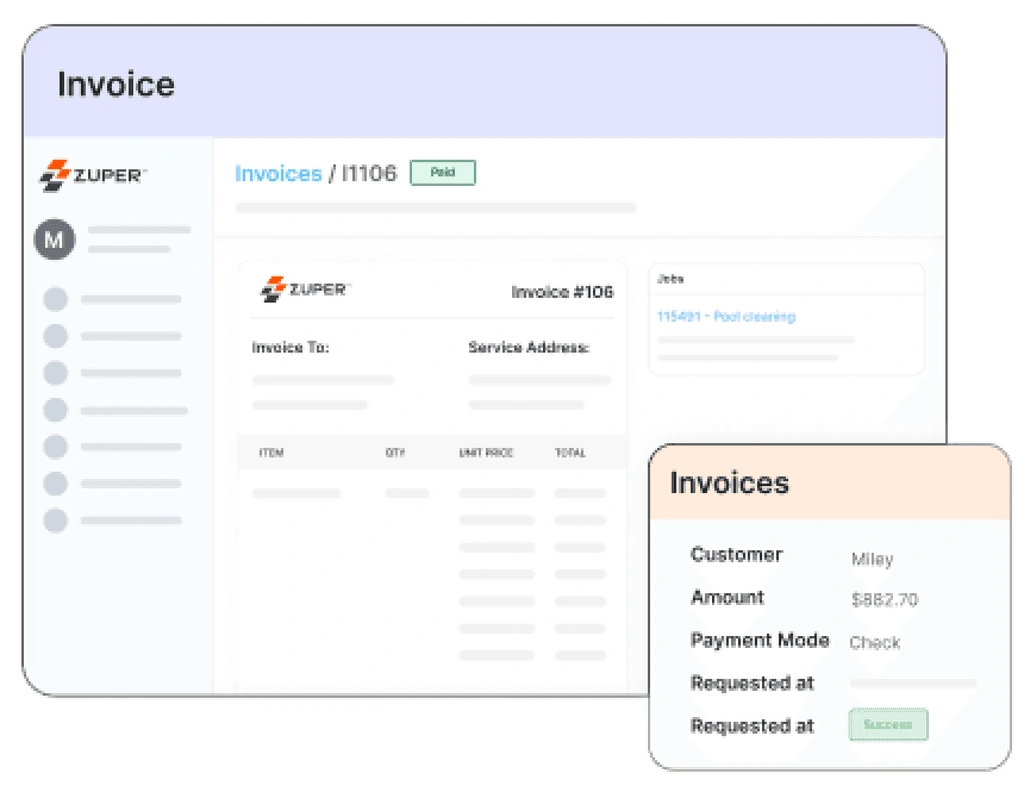
  • ✓ Appointment confirmation automation
  • ✓ Technician ETA notifications
  • ✓ Post-service satisfaction survey
  • ✓ Customer self-service portal
Customer experience in Zuper

04

Analytics and reporting

The numbers a service business is actually run on, straight from the jobs as they close.
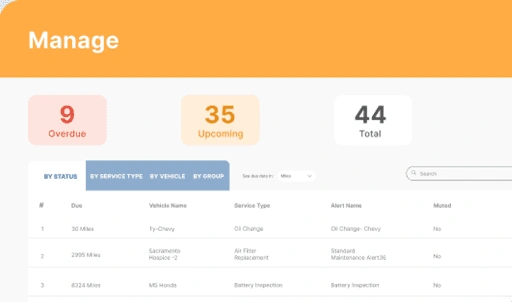
  • ✓ First-time fix rate tracking
  • ✓ SLA compliance reporting
  • ✓ Technician utilisation and productivity
  • ✓ Revenue per job and per technician
  • ✓ Customer satisfaction trends
Analytics and reporting in Zuper

05

ERP integration

Completed jobs automatically flow into your ERP. No double entry. No billing delays.
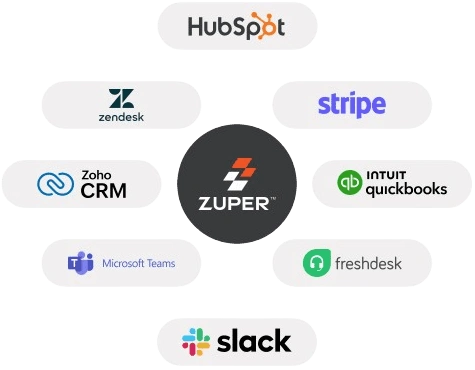
  • ✓ Automatic invoice generation on job completion
  • ✓ Parts consumed updated in ERP inventory
  • ✓ Technician time fed into payroll
  • ✓ Contract billing and recurring job automation
  • ✓ Bidirectional sync with Odoo and Dynamics
ERP integration in Zuper

Proof

Zuper customers

The problem

Field service businesses lose money in one gap

Where the money goes

Between the job and the invoice

A technician completes the work. The job card goes in a van, or a WhatsApp photo, or nowhere. Parts used are remembered rather than recorded.

  • › The office chases the paperwork
  • › Then chases the customer for a signature
  • › Then raises an invoice three weeks later
  • › For an amount somebody has estimated
What closes it →
What closes it

The phone becomes the record

Job accepted, asset scanned, work completed, parts logged, photos captured, signature taken — and the invoice generated from what was actually done, on the day it was done.

  • › For UAE facilities management providers
  • › Maintenance contractors
  • › And equipment service businesses
  • › Integrated with the ERP they already run
Facility management →

Who it is for

Three businesses that run on this

Facility management companies

Delivering hard and soft services across a portfolio, against SLAs, for multiple clients. Reactive jobs, PPM visits and contract billing in one queue. Facility management.

Maintenance and AMC contractors

HVAC, MEP, lifts, generators, fire systems — where technician time is the product and unbilled work is the largest source of margin loss. CAFM and CMMS.

Equipment suppliers with service obligations

Where warranty, service contracts and chargeable call-outs need distinguishing at the point the job is closed rather than at month-end.

The common test: if technician time is what you sell, and scheduling currently happens on WhatsApp, this is the category.

The boundary

FSM, CAFM or CMMS — which do you need?

Field service management compared with CMMS and CAFM
CategoryOrganising unit
Field service management (Zuper) — scheduling, dispatch, routing, mobile capture, customer communication and invoicingThe visit
CMMS — maintenance schedules, work orders, spare parts, service history and equipment lifecycleThe machine
CAFM — CMMS plus the wider facility: space, occupancy, soft services, contracts and helpdeskThe building and the contract

If most of your work is dispatching people to customer sites, start with FSM. If most of it is maintaining a defined asset base, start with CMMS or CAFM. Many UAE FM providers need both — asset-based PPM scheduling feeding jobs into a field service platform that dispatches and bills them.

Contracts

Where service contracts make or lose money

Where margin is decided

Contract versus chargeable

Work covered by the AMC, work outside scope, and work under warranty are three different billing outcomes — and deciding which at month-end, from memory, is how contractors give away chargeable hours.

  • › Distinguished at job closure, not afterwards
  • › Preventive jobs generated to the contract schedule
  • › Rather than remembered
  • › Recurring billing for contract value, ad-hoc for chargeable jobs
  • › Both flowing to the same ERP ledger
Cost by contract →
SLA

The clock runs from the moment it is logged

With escalation triggering before breach rather than after. SLA performance per customer is what supports a renewal conversation and defends against penalty deductions.

  • › Response targets per contract and priority
  • › Escalation before breach, not a report after it
  • › Contract-level profitability — labour, parts, travel and subcontractor cost against revenue
  • › The report most FM businesses cannot produce and most need before pricing a renewal
Facility management →

Implementation

What implementation involves

01Four to eight weeks for a single operation

Mapping job types and workflows, configuring SLA rules per contract, loading the technician skills matrix and territories, setting up parts and price lists, and building the ERP integration.

02Two groups to train, not one

Dispatchers and field technicians use the system completely differently, and training built for one does not serve the other.

03Technician adoption is the risk

Not the configuration. Field teams that experience the app as surveillance rather than as a faster way to close a job will find ways around it. The deployments that work are the ones where the technician gets something back — job history on arrival, no paperwork afterwards, no phone calls asking where they are.

Zuper FAQs

What service businesses ask us about Zuper

What is Zuper?

Zuper is a field service management platform for businesses with technicians working at customer sites: job scheduling and dispatch, work order management, a technician mobile app, parts and inventory, customer communication, and invoicing on completion. It is built around the job rather than the office.

What is work order management software?

Work order management software creates, assigns, tracks and closes service jobs from request through completion and invoicing. Each work order carries the customer, location, asset, fault description, assigned technician, parts used and time taken, producing a complete record instead of scattered job cards.

What is field service management?

Field service management covers the whole operation of sending people to customer sites: scheduling against skills and location, routing, real-time job status, mobile data capture, parts availability, SLA tracking and billing. The core problem it solves is getting the right technician to the right job with the right parts.

Which businesses need field service software?

AMC and maintenance contractors, HVAC and MEP service companies, equipment suppliers with service obligations, IT support providers, and facility management teams handling reactive work. Any business where technician time is the product and scheduling currently happens on WhatsApp is a candidate.

How does scheduling and dispatch work?

Jobs are assigned by skill, location, availability and SLA priority, either manually on a dispatch board or through automated suggestions. Technicians receive jobs on mobile with location, history and instructions, and status updates flow back so the office answers customer queries without phoning the technician.

Can technicians use it offline?

Yes. The mobile app holds job details and allows completion notes, photographs, parts recording and customer signature offline, then syncs when connectivity returns. This matters for plant rooms, basements and remote sites where mobile coverage across the UAE is unreliable.

Does it handle contracts, SLAs and recurring maintenance?

Yes. Service contracts define entitlements, response times and scheduled visits, with preventive maintenance jobs generated automatically to the contract schedule. SLA performance reporting per customer supports renewals and shows where response commitments are consistently missed before the client raises it.

Does it integrate with accounting and ERP?

Yes. Completed jobs generate invoices covering parts and labour, posting to your accounting system with the correct tax treatment, and parts consumed deduct from stock. Without that link, service businesses routinely lose margin through unbilled parts and labour nobody recorded.

Talk to a consultant

Talk to an ERP consultant, not a salesperson

Book a free 30 minute call with QZ Infomatics in Dubai. You will leave it with a platform recommendation, the reasoning behind it, a realistic timeline and an indicative budget band — before you commit to anything.

  • ✓ A consultant who delivers projects, not a sales desk
  • ✓ Odoo, Microsoft Dynamics 365 and Oracle NetSuite compared honestly
  • ✓ Licence cost and implementation cost quoted as separate numbers
  • ✓ If we are not the right fit for you, we will say so

Book a free call

We reply within one working day.

Or WhatsApp us on +971 4 243 4010

Request a demo