
Skip to content

Five industries worked hands on, so we arrive knowing where the gaps usually are.

All industries →Request a demo

Four ERP platforms in house, and fifteen capability modules. The recommendation is never tied to a licence quota.

All solutions →Request a demo

One team from platform selection through to the reports on your desk.

All services →Request a demo

Learning Centre

Guides, how-tos, comparisons and a plain-English glossary, written by the consultants who deliver the projects. No form in front of any of it.

Free toolsNo gate before you use them
Plain EnglishBOQ, retention, WIP and IPC explained
Written in houseBy the people who run the projects
Browse all resources →

Nobody in UAE ERP publishes their tools or their pricing. We do both.

Free tools →Request a demo

Consultants in the UAE, technical team in South Asia. Cost stays sharp without cutting corners.

About QZ Infomatics →Request a demo
Request a demo +971 4 243 4010

Procurement Software UAE

Every purchase your business has committed to should be visible
before the invoice arrives, not after.

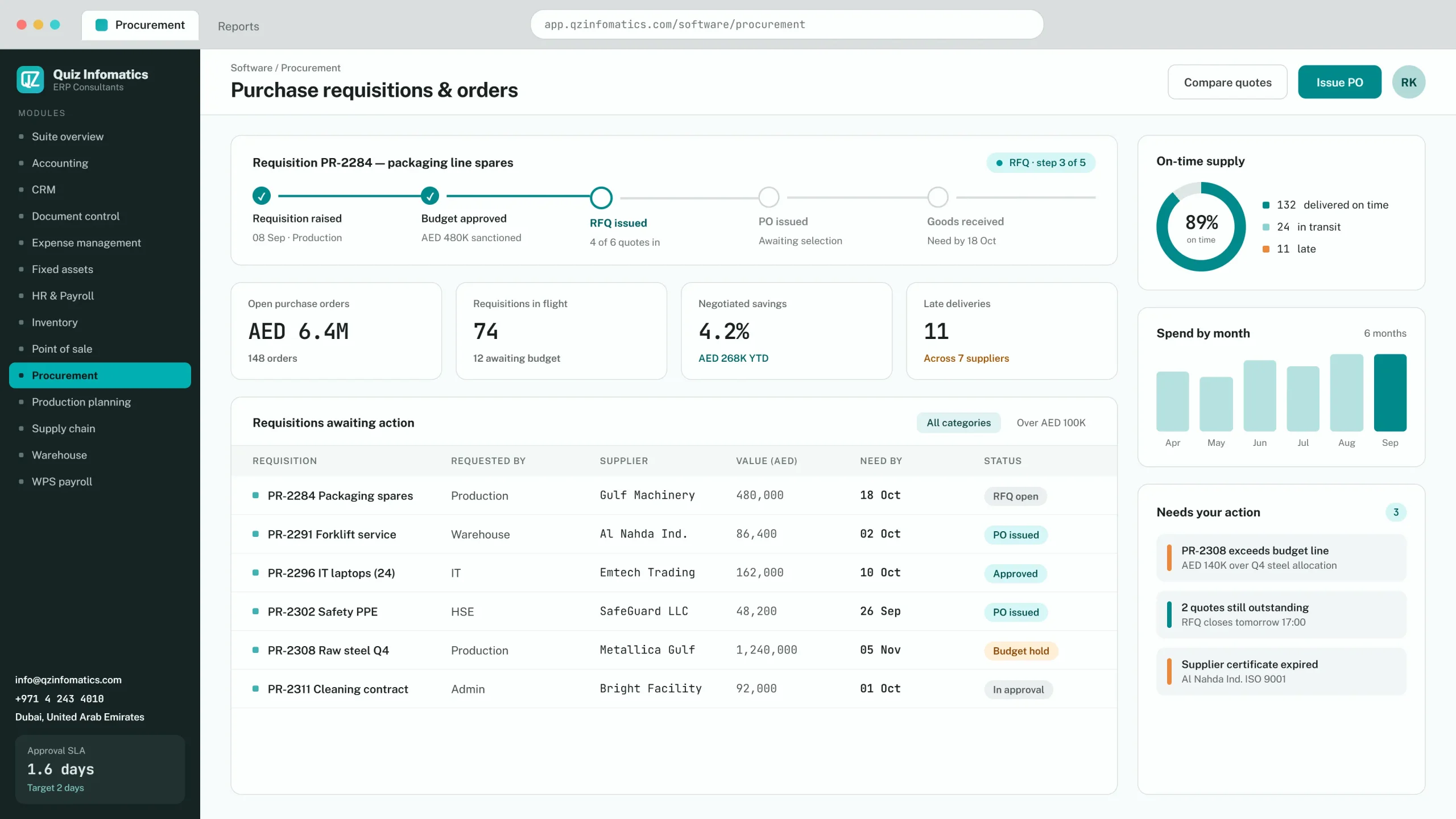
Procurement software manages the full purchasing cycle in one system — requisitions, approvals, requests for quotation, supplier comparison, purchase orders, goods receipt and three-way invoice matching. It replaces email approval chains with an auditable workflow, so every commitment is recorded against a budget before the money is spent.

✓ Commitment recorded at order, not invoice✓ Budget checked before approval✓ Three-way matching before payment✓ Project cost coding for contractors
Procurement Software UAE

The problem

What procurement software controls

The purchasing cycle in most UAE businesses runs across four systems.

The usual arrangement

Four systems and somebody's memory

  • × Email for approvals, with no audit trail
  • × Excel for quotation comparison, rebuilt each time
  • × An accounting package for the purchase order
  • × Someone's memory for what has actually been ordered
  • × A project over budget because three commitments landed in one week
One auditable record

The order becomes the record

  • ✓ Requisition, approval and order in one place
  • ✓ Budget checked at requisition, not at invoice
  • ✓ Quotations captured side by side, timestamped
  • ✓ No purchase order issued without recorded approval
  • ✓ Committed cost visible the moment the order is raised

That works until it does not. Two people order the same item. A supplier delivers against a verbal instruction with no order behind it. An invoice arrives for goods nobody can confirm were received. Procurement software closes those gaps by making the order the record, not the invoice.

The cycle

The procurement cycle, step by step

  1. 01

    Requisition

    A department or site raises a request with quantity, specification, delivery date and cost coding.

    Raised by the person who needs it
  2. 02

    Approval

    Routed by value, department, project or cost centre. Small purchases clear in one step; large commitments follow a longer path. Budget is checked at this point, not later.

    Budget checked here
  3. 03

    RFQ and comparison

    Requests issued to approved suppliers, responses captured side by side with price, lead time and terms visible together.

    One comparison record
  4. 04

    Purchase order

    Issued only once approval is recorded. Committed cost updates immediately, rather than when the invoice arrives six weeks later.

    Commitment starts here
  5. 05

    Goods receipt

    Quantity and quality recorded on delivery. Stock and the accrual update automatically.

    Stock and accrual, automatically
  6. 06

    Three-way matching

    Order, receipt and supplier invoice compared before payment is released. This closes the most common leak in UAE purchasing — invoices paid in full for deliveries that were short.

    Before the money leaves

Approvals

Approval workflows

How it routes

A matrix, not a mailing list

Approval matrices route each requisition by value, department, project or cost centre, so a small site purchase and a major subcontract follow entirely different paths.

  • › Routed by value, department, project or cost centre
  • › Approvers act from email or mobile
  • › No purchase order issued until every approval is recorded
  • › Delegation covers leave and travel
Where it sits →
The hard part

An organisational exercise, not a technical one

Configuring the matrix is usually the longest part of implementation. Deciding who approves what, at which value, is a conversation most businesses have never formally had.

  • › Who signs off at each value band
  • › What happens when that person is away
  • › Which projects have their own approver
  • › Where a second approval is genuinely needed
Work it out first →

E-procurement

E-procurement and supplier portals

E-procurement moves the cycle out of email entirely, and two things improve immediately.

Out of email entirely

Suppliers receive RFQs through a portal, submit quotations directly, and see purchase orders and payment status without phoning accounts.

A shorter RFQ round

Chasing quotes by email is what makes an RFQ round slow. Removing that step is the change suppliers notice first.

A clean comparison record

Every response captured in the same format and timestamped, with no risk of a late quote being quietly accepted. For businesses running regular tenders, the audit trail matters as much as the speed.

Construction

Construction and project procurement

Construction

Every order carries a cost code

Contractors have requirements a general purchasing module does not cover, and this page is where they are handled — there is no separate construction procurement page, deliberately.

  • › Every purchase order links to a project, cost code and BOQ line
  • › Committed cost updates the project budget the moment the order is raised
  • › Site material requests convert into requisitions without re-keying
  • › Subcontract orders carry retention, advance recovery and their own terms
  • › Plant hire coded to the project for the period used
Contracting →
What it produces

A live committed-cost position

The gap between raising an order and seeing it in the accounts is the difference between catching an over-run and reporting one.

  • › Committed cost per project, updated as orders are raised
  • › The number a commercial manager needs weekly
  • › And almost never has, in a manual system
  • › Variations traceable back to the instruction that caused them
Project costing →

Spend control

Spend control and supplier performance

Full quotation history also shows what the same item cost last quarter, and from whom.

Budget checks at requisition

Over-commitment is stopped before it happens rather than reported after it has.

An approved-vendor list

Keeps buyers inside negotiated agreements, and makes an exception a decision rather than an accident.

Spend analysis

By category, supplier and project. It shows where consolidating orders would earn materially better pricing — usually the first concrete saving a business finds, and often larger than the software cost.

Cost

Cost and implementation

01Usually a module, not a platform

Procurement is normally licensed within an ERP rather than bought standalone, so the incremental cost is modest if you already run one. Dedicated e-procurement platforms are priced per user or by transaction volume and suit larger organisations running formal tenders.

02Three to six weeks to go live

Once the approval matrix, vendor master and item categories are agreed. The agreement takes longer than the configuration.

03Construction adds a little

Mostly to align cost codes across estimating, procurement and finance, which is worth doing regardless of the software.

Procurement FAQs

What buyers ask us about procurement software

What is procurement software?

Procurement software manages the full purchasing cycle in one system: requisitions, approvals, requests for quotation, vendor comparison, purchase orders, goods receipt and three-way invoice matching. It replaces email approval chains with an auditable workflow, so every commitment is recorded against a budget before the money is spent.

What is e-procurement and how is it different?

E-procurement is the digital version of the same cycle, where requisitions, quotations and purchase orders move electronically between your business and your suppliers rather than by email or paper. Suppliers submit quotes through a portal, which shortens each RFQ round and leaves a clean comparison record for audit.

How does procurement software handle approvals?

Approval workflows route each requisition by value, department, project or cost centre, so a small site purchase and a major subcontract follow different paths. Approvers act from email or mobile, and the system blocks a purchase order from being issued until every required approval has been recorded.

Can procurement software manage construction and project purchasing?

Yes. For contracting businesses, every purchase order is linked to a project, cost code and BOQ line, so committed cost updates the project budget the moment the order is raised. Material requests from site, subcontractor orders and retention terms run through the same workflow as general purchasing.

Does procurement software integrate with inventory and accounts payable?

Yes. Goods receipt against a purchase order updates stock and raises the accrual automatically, then three-way matching compares the order, the receipt and the supplier invoice before payment is released. This closes the most common leak in UAE purchasing: invoices paid for goods never fully received.

How does procurement software control spend?

It enforces budget checks at requisition stage, maintains an approved-vendor list, and keeps full quotation history so buyers can see what the same item cost last quarter. Reporting on spend by category, vendor and project shows where consolidating orders would earn materially better pricing.

How much does procurement software cost in the UAE?

Procurement is usually licensed as a module within an ERP rather than bought separately, so the incremental cost is modest if you already run one. Standalone e-procurement platforms are priced per user or by transaction volume. Implementation cost is driven mainly by how many approval matrices need configuring.

How long does procurement implementation take?

A standard procurement module goes live in three to six weeks once the approval matrix, vendor master and item categories are agreed. Most of the effort is organisational — deciding who approves what at which value — rather than technical. Construction procurement with project cost coding takes slightly longer.

Talk to a consultant

Talk to an ERP consultant, not a salesperson

Book a free 30 minute call with QZ Infomatics in Dubai. You will leave it with a platform recommendation, the reasoning behind it, a realistic timeline and an indicative budget band — before you commit to anything.

  • ✓ A consultant who delivers projects, not a sales desk
  • ✓ Odoo, Microsoft Dynamics 365 and Oracle NetSuite compared honestly
  • ✓ Licence cost and implementation cost quoted as separate numbers
  • ✓ If we are not the right fit for you, we will say so

Book a free call

We reply within one working day.

Or WhatsApp us on +971 4 243 4010

Request a demo