
Skip to content

Five industries worked hands on, so we arrive knowing where the gaps usually are.

All industries →Request a demo

Four ERP platforms in house, and fifteen capability modules. The recommendation is never tied to a licence quota.

All solutions →Request a demo

One team from platform selection through to the reports on your desk.

All services →Request a demo

Learning Centre

Guides, how-tos, comparisons and a plain-English glossary, written by the consultants who deliver the projects. No form in front of any of it.

Free toolsNo gate before you use them
Plain EnglishBOQ, retention, WIP and IPC explained
Written in houseBy the people who run the projects
Browse all resources →

Nobody in UAE ERP publishes their tools or their pricing. We do both.

Free tools →Request a demo

Consultants in the UAE, technical team in South Asia. Cost stays sharp without cutting corners.

About QZ Infomatics →Request a demo
Request a demo +971 4 243 4010

Production Planning & MRP Software

A production plan the shop floor cannot deliver is not a plan.
It is a wish with dates on it.

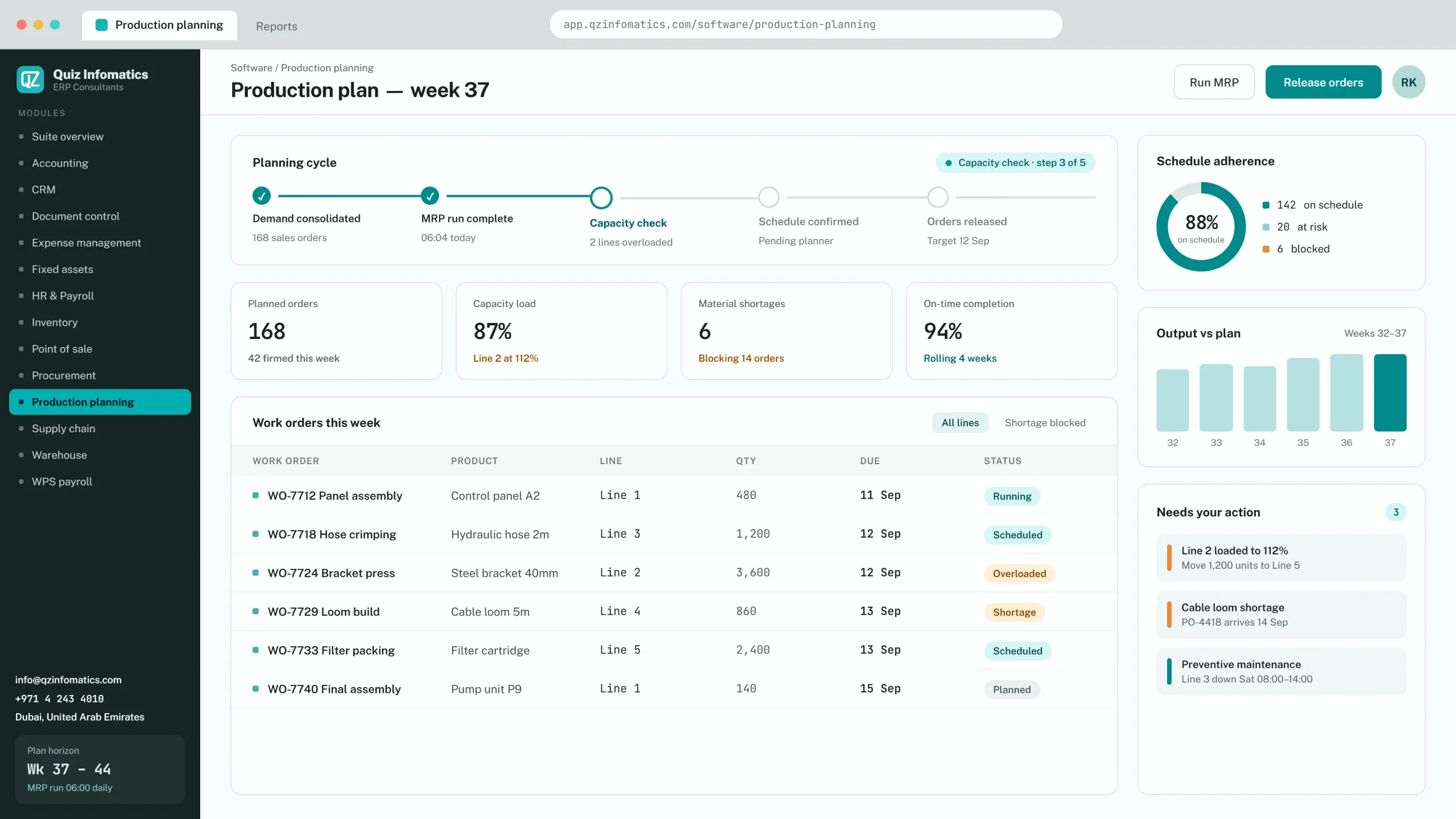
Production planning software schedules manufacturing work against available capacity, materials and due dates. It converts sales orders and forecasts into a production plan, then into work orders carrying the routing, machines and labour each requires — so the shop floor knows what to make, in what sequence, and with what.

✓ Purchase suggestions before a line stops✓ Finite scheduling, not optimistic dates✓ Variance split by cause✓ Traceability in both directions
Production Planning & MRP Software

MRP

What MRP software does

What it calculates

What you need, how much, by when

MRP — material requirements planning — works backwards from the production schedule, using the bill of materials, current stock, open purchase orders and supplier lead times.

  • › Backwards from the schedule, not forwards from a guess
  • › Bill of materials, stock and open orders together
  • › Purchase and production suggestions generated
  • › The point is to stop a line halting for one missing component
Where the suggestion becomes an order →
Why it matters here

Eight to twelve week lead times

For UAE manufacturers importing raw material, MRP is not an optimisation. It is the difference between planning and reacting.

  • › Raw material arriving from Asia or Europe
  • › Lead times that force the decision months early
  • › The most common and most expensive production failure is a stopped line
  • › And it is almost always one component
Manufacturing →

The foundation

The bill of materials is the foundation

A bill of materials lists every component, sub-assembly, quantity and operation required to produce one unit of a finished item.

What it drives

Material planning, production costing, and stock deduction when the work order is completed. Three things from one structure.

Multi-level and versioned

Multi-level BOMs handle sub-assemblies produced in-house. Versioning tracks engineering changes, so a batch produced last year can still be costed against the specification in force at the time.

The implementation reality

Almost every implementation finds the same problem: the BOMs either do not exist formally, or they exist and are outdated, because the actual production method lives in the knowledge of two experienced people on the floor. Rebuilding them accurately is the project.

Capacity

Capacity planning and scheduling

Infinite scheduling

A plan that looks achievable

  • × Assumes unlimited capacity at every work centre
  • × Promises more than the floor can physically produce
  • × Which is exactly what a spreadsheet does
  • × Bottlenecks discovered on the day they bite
  • × The plan is quietly abandoned by Wednesday
Finite scheduling

A plan the floor can deliver

  • ✓ Work centres carry available hours
  • ✓ Operations scheduled against that capacity
  • ✓ Refuses to promise more than the floor can produce
  • ✓ A bottleneck visible before the week starts
  • ✓ Less comfortable, and considerably more useful

Confirmed sales orders drive the plan, material issues deduct from stock, and finished goods receive into inventory ready for dispatch — so sales can quote a realistic promise date rather than an optimistic guess.

Costing

Production cost and variance

Standard against actual

Standard cost is set from the bill of materials and routing. Actual material, labour and machine time are recorded against each work order.

Variance split by cause

Material price variance, material usage variance, labour efficiency variance. Three different problems with three different owners — procurement, production and supervision — and a single "our margin dropped" figure identifies none of them.

What persistent variance means

Persistent negative usage variance on one product almost always means the BOM no longer matches how the item is actually made.

Quality

Quality, traceability and subcontracting

Quality

Checkpoints and non-conformance

Quality checkpoints can be set at goods receipt, in process and before dispatch, with results recorded against the batch and non-conformances routed for disposition.

  • › Checkpoints at receipt, in process and before dispatch
  • › Results recorded against the batch, not on a clipboard
  • › Non-conformances routed rather than filed
  • › The practical test is whether a recall trace takes minutes or days
Food & beverage →
Traceability

Both directions, from one record

Full traceability links finished goods back to raw material batches and suppliers, in both directions. For food, pharmaceutical and regulated industrial manufacturers in the UAE this is a compliance requirement.

  • › Given a finished batch, identify every input
  • › Given a raw material lot, identify every finished batch and customer
  • › Material issued to a subcontractor stays your stock at their location
  • › Untracked material at a third-party site is a persistent source of unexplained inventory differences
Stock and batches →

Implementation

What it takes to go live

01Two to four months, set by data

Building or verifying BOMs and routings is the critical path. Most manufacturers underestimate it because the information feels like it already exists — it does, but in people rather than in a system.

02Finance, inventory and purchasing first

Almost every successful deployment goes live with those, then adds production as a second phase once the item master and stock are clean.

03Production on bad stock data fails

It produces plans nobody trusts and a system nobody uses. That is the whole reason for the phasing.

MRP FAQs

What manufacturers ask us about production planning

What is production planning software?

Production planning software schedules manufacturing work against available capacity, materials and due dates. It converts sales orders and forecasts into a production plan, then into work orders carrying the routing, machines and labour each requires, so the shop floor knows what to make and in what sequence.

What is MRP software?

MRP — material requirements planning — calculates what materials you need, in what quantity and by when, using the bill of materials, current stock, open purchase orders and the production schedule. It generates purchase and production suggestions, which is what stops a line halting for one missing component.

What is a bill of materials?

A bill of materials lists every component, sub-assembly, quantity and operation needed to produce one unit of a finished item. It drives material planning, production costing and stock deduction. Multi-level BOMs handle sub-assemblies made in-house, and versioning tracks engineering changes over time.

Does it handle capacity planning and scheduling?

Yes. Work centres carry available hours, and the system schedules operations against that capacity so a bottleneck is visible before the week starts. Finite scheduling stops the plan promising more than the shop floor can physically deliver, which is the usual failure of spreadsheet-based planning.

Can it track work-in-progress and production cost?

Yes. Material issues, labour hours and machine time post against each work order, giving actual production cost per batch against standard cost. Variance analysis then shows whether a margin problem came from material price, material usage or labour efficiency — three issues with different remedies.

Does it manage quality control and traceability?

Yes. Quality checkpoints can be set at receipt, in process and before dispatch, with results recorded against the batch. Full traceability links finished goods back to raw material batches and suppliers, which is a requirement for food, pharmaceutical and regulated industrial manufacturers operating in the UAE.

How does it connect to inventory and sales?

Confirmed sales orders drive the production plan, material issues deduct from stock, and finished goods receive into inventory ready for dispatch. Because it sits in one database, sales can quote a realistic promise date based on the actual production schedule rather than an optimistic guess.

How long does production planning implementation take?

Two to four months, and the timeline is set by BOM and routing data rather than software. Most manufacturers find their BOMs are outdated or held informally by production staff, and rebuilding them accurately becomes the real project. Configuration is straightforward once that data exists.

Talk to a consultant

Talk to an ERP consultant, not a salesperson

Book a free 30 minute call with QZ Infomatics in Dubai. You will leave it with a platform recommendation, the reasoning behind it, a realistic timeline and an indicative budget band — before you commit to anything.

  • ✓ A consultant who delivers projects, not a sales desk
  • ✓ Odoo, Microsoft Dynamics 365 and Oracle NetSuite compared honestly
  • ✓ Licence cost and implementation cost quoted as separate numbers
  • ✓ If we are not the right fit for you, we will say so

Book a free call

We reply within one working day.

Or WhatsApp us on +971 4 243 4010

Request a demo