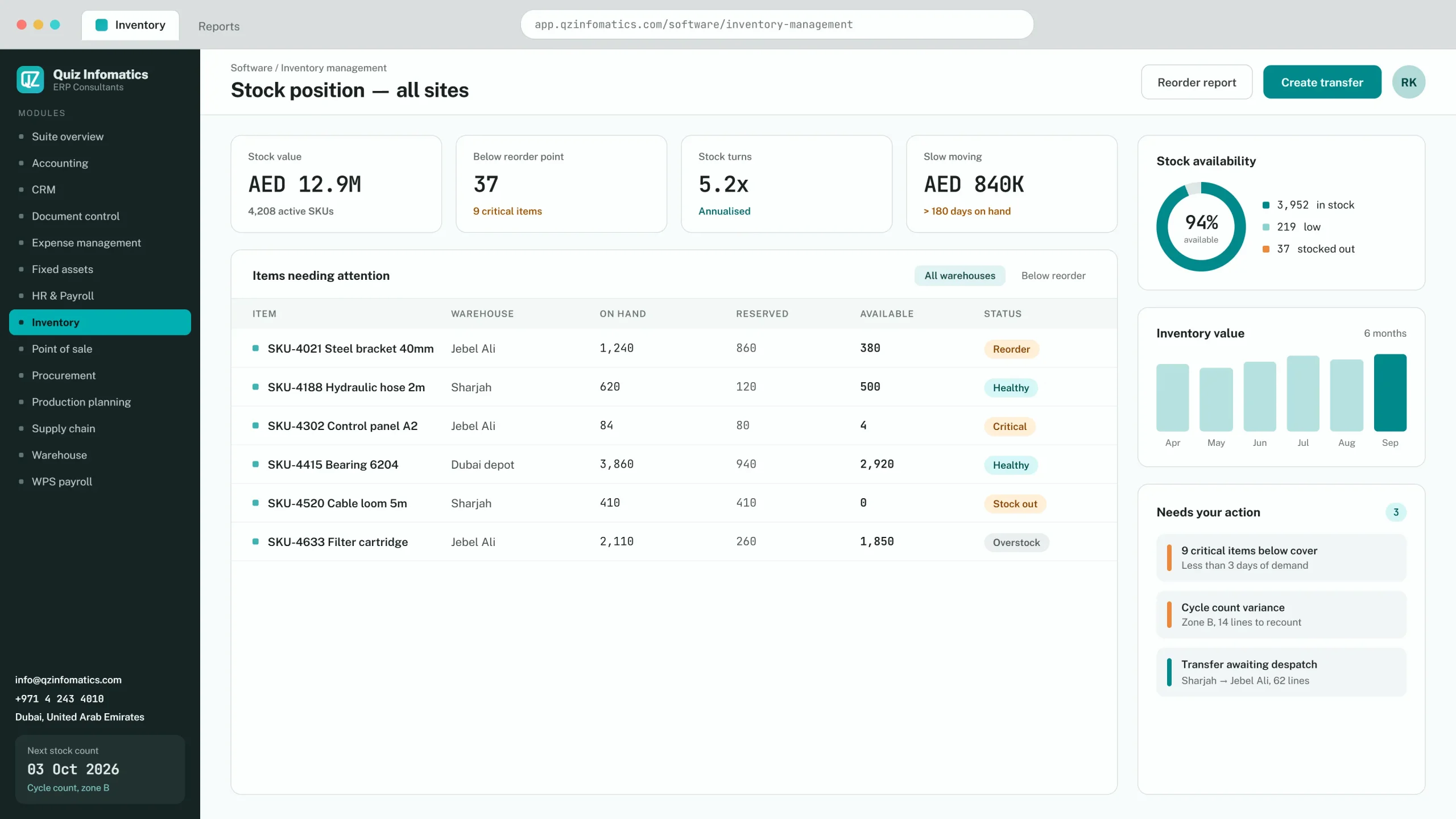
Know what you actually have, not what the spreadsheet said you had last Thursday.
Inventory management software tracks stock quantities, locations, movements and valuation in real time across every warehouse, showroom and outlet. QZ Infomatics implements it as part of an ERP, so a goods receipt updates stock, accounts payable and cost of goods sold at the same moment — no month-end reconciliation between systems that disagree.
✓ Live stock across every location✓ Landed cost applied at receipt✓ Batch, lot and serial traceability✓ Valuation that ties to the ledger
The problem
Three symptoms, one cause
Almost every UAE business running stock on spreadsheets has the same three symptoms, and none of them are counting problems.
01Sales promise stock that has already gone
The order is confirmed against a figure that was true this morning, and the apology goes out two days later.
02Someone drives to the warehouse to check
Before confirming anything large, a person physically verifies what the system already claims to know.
03The annual count produces a variance nobody can explain
It gets quietly written off, and the same conversation happens again twelve months later.
They are timing problems. A spreadsheet records what happened after someone remembers to record it, which means the number is always describing the past. Inventory software records the movement as the movement happens.
Capabilities
What the software does
Six things, and the last two are the ones businesses most often discover they needed only after going live without them.
Real-time stock across every location
Quantities by warehouse, zone, bin, van or consignment site, updated on every receipt, issue, transfer and sale.
Reorder automation
Minimum and maximum levels, lead times and reorder quantities per item and per location, generating purchase suggestions before you run out rather than after.
Batch, lot and serial tracking
Expiry dates, batch numbers and unique serials, with full traceability from supplier receipt to customer delivery.
Inventory valuation
FIFO, average cost or standard cost, posting automatically to the general ledger so closing stock in your accounts matches the warehouse.
Landed cost
Freight, duty, insurance and clearing allocated across received items, giving true unit cost rather than supplier invoice price.
Stock counts and cycle counting
Rolling counts by category or location instead of shutting the warehouse for a full annual count.
UAE specifics
Why UAE businesses need more than basic stock software
Four requirements come up in almost every UAE deployment and are handled badly by generic international products.
Free zone and mainland separation
Bonded and duty-paid stock has to be held and reported separately for customs purposes, as distinct locations with their own documentation rules.
Landed cost on imports
With most stock arriving from Asia or Europe, the gap between supplier price and true cost is large enough to turn an apparently profitable SKU into a loss-maker. Allocation has to happen at receipt, not as an annual adjustment.
5% VAT on stock transactions
Purchases, sales, returns and write-offs each carry their own treatment, and the valuation feeding your financial statements has to reconcile to the VAT return.
Multi-currency purchasing
Buying in dollars and euros while reporting in AED, with revaluation handled rather than manually adjusted.
The boundary
Inventory management or warehouse management?
These are different products solving adjacent problems, and buying the wrong one is a common and expensive mistake.
Inventory management software compared with a warehouse management system
Inventory management
Warehouse management
What you own, how much, what it is worth
Where exactly it is and how to pick it fastest
Quantities by location and valuation
Bin locations, put-away rules, picking routes
Suits one storeroom or a few simple locations
Suits racking, multiple aisles, a picking team
If your warehouse has fewer than a few hundred locations and stock is found by someone who knows where it is, inventory management is enough. Once picking accuracy and walk time start costing money, you need both working together. Warehouse management.
Scanning
Barcode scanning and mobile
Barcode and QR scanning on handheld devices or phones covers receiving, transfers, picking, dispatch and counting.
Recorded by hand
Accuracy that degrades all year
× A transfer done on Tuesday and written down on Thursday
× A pick substituted at the shelf with no record
× A return put back in the wrong place
× Counts that reconcile to a number nobody trusts
× The divergence only ever discovered at the annual count
Confirmed by scan
Accuracy that holds between counts
✓ Receiving, transfers, picking, dispatch and counting, all scanned
✓ Each movement confirmed as it happens, not typed in afterwards
✓ Barcode and QR on handheld devices or phones
✓Label printing at goods-in for stock that arrives unlabelled
✓ Cycle counts that agree with the system more often than not
A scanned warehouse and a manually recorded one diverge steadily over a year, and the divergence is only ever discovered at the count. That single change is what makes stock accuracy hold.
Platform
Which platform
The right answer depends on SKU count, number of locations, whether you need batch or serial traceability, and how stock connects to manufacturing or projects.
Odoo Inventory
Suits SMEs and mid-market businesses with straightforward to moderately complex stock, and is the fastest of the three to go live.
NetSuite and Finance & Operations
Handle multi-entity operations with heavier financial requirements, consolidation and tighter audit expectations.
Specialist WMS platforms
Sit above all three for high-throughput distribution, cross-docking and third-party logistics.
QZ Infomatics reviews the actual stock workflow before recommending a platform, rather than starting from the product. Independent selection →
Implementation
What it takes to go live
Timeline
Four to eight weeks for one warehouse
Two to three months for multi-location or multi-company setups. The software configuration is rarely what sets the date.
› Single warehouse, standard process: 4–8 weeks
› Multi-location or multi-company: 2–3 months
› Barcode hardware procurement runs in parallel
› Go-live timed against a count, not a trading peak
Units of measure, barcodes, costing method, supplier codes, reorder levels and opening quantities. Getting opening stock right before go-live is the single thing that determines whether people trust the system in month one.
› Units of measure and conversion factors
› Barcodes, and printing them where they are missing
› Costing method agreed with finance before loading
› Opening quantities counted, not carried across
› Trust, once lost in an inventory system, is very hard to rebuild
Inventory management software is a system that tracks stock quantities, locations, movements and valuation in real time across every warehouse and outlet. It replaces spreadsheets with live stock balances, automates reorder points, records batch and serial numbers, and gives finance an accurate inventory valuation at any moment.
How does inventory software help a Dubai trading business?
For a Dubai trading or distribution business, inventory software removes the gap between what the system says you hold and what is physically in the warehouse. It handles multi-location stock, landed-cost allocation on imports, consignment and back-to-back orders, and shows sales staff live availability before they commit to a customer.
What is the difference between inventory management and warehouse management?
Inventory management tracks what you own, how much of it and what it is worth. A warehouse management system manages how goods physically move — put-away rules, bin locations, picking routes and barcode scanning. Smaller operations run on inventory alone; a busy multi-aisle warehouse needs both working together.
Does inventory software support barcode and batch tracking?
Yes. Modern stock management software supports barcode and QR scanning on handheld devices, plus batch numbers, serial numbers and expiry dates. Batch and expiry tracking matters for food, pharmaceutical and chemical distributors in the UAE, where recall traceability and shelf-life control are regulatory expectations rather than optional extras.
Can inventory software connect to accounting and VAT?
Yes. Inside an ERP, inventory and accounting share one database, so goods receipts, stock adjustments and cost of goods sold post automatically to the general ledger. Sales invoices carry the correct 5% VAT treatment and closing stock valuation flows into your financial statements without a manual reconciliation.
How much does inventory management software cost in the UAE?
Cost depends on user count, the number of warehouse locations, and whether you need barcode hardware and mobile scanning. Cloud subscriptions are usually billed per user per month, with implementation quoted separately based on data migration and process configuration. A scoping call produces a firm figure rather than a range.
How long does it take to implement inventory software?
A single-warehouse rollout usually goes live in four to eight weeks. Most of that time goes on cleaning the item master — units of measure, barcodes, costing method and opening balances — not on configuring the software. Multi-location or multi-company setups typically take two to three months.
Which inventory system is best for my business?
The right system depends on SKU count, number of locations, whether you need batch or serial traceability, and how stock connects to manufacturing or projects. Odoo suits SMEs with straightforward inventory; NetSuite and Dynamics 365 handle multi-entity complexity. QZ Infomatics recommends a platform after reviewing your actual stock workflow.
Book a free 30 minute call with QZ Infomatics in Dubai. You will leave it with a platform recommendation, the reasoning behind it, a realistic timeline and an indicative budget band — before you commit to anything.
✓ A consultant who delivers projects, not a sales desk
✓ Odoo, Microsoft Dynamics 365 and Oracle NetSuite compared honestly
✓ Licence cost and implementation cost quoted as separate numbers
✓ If we are not the right fit for you, we will say so