Industry-Specific ERP Software in the UAE: Why Generic Systems Fall Short
Why generic ERP fails and industry-specific ERP wins. A UAE guide to choosing sector-fit ERP for construction, trading, manufacturing & facility firms.
ERP Technology AdvisorPublished 10 min read
Last updated: November 2026 · By the QZ Infomatics Team
Most ERP projects do not fail because the software is bad. They fail because a generic system was forced to fit a business it was never built for. A contractor runs on progress billing and retention; a distributor runs on stock turns and margins; a facilities company runs on work orders and assets, and a one-size-fits-all platform serves none of them well. This guide explains what industry-specific ERP is, why it matters in the UAE, and how to choose the right system for your sector rather than bending your business to fit the software.
What is industry-specific ERP software?
Industry-specific ERP software is an enterprise resource planning system designed, configured, or extended around the processes of a particular sector, such as construction, distribution, or manufacturing. Instead of generic modules, it speaks the language and workflows of that industry out of the box.
A generic ERP gives you finance, inventory, and sales in a neutral form. An industry-specific ERP gives you those same foundations plus the things your sector actually lives on, whether that is a bill of quantities, a batch recipe, or a preventive-maintenance schedule, without heavy custom development.
This matters because the gap between generic and industry-fit is where most ERP pain lives. The closer the system already is to how you work, the less you have to customise, the faster you go live, and the more your team actually uses it.
Why do generic ERP implementations fail so often?
Generic ERP implementations fail often because the software does not match the business, forcing expensive customisation, workarounds, and poor adoption. The statistics are sobering.
Research consistently shows that most ERP projects disappoint. Gartner has found that more than 70 percent of ERP initiatives fail to fully meet their business-case goals, with many running over budget and months behind schedule. A large share of that failure traces back to a simple mismatch: the chosen system was never built for the industry it was asked to run.
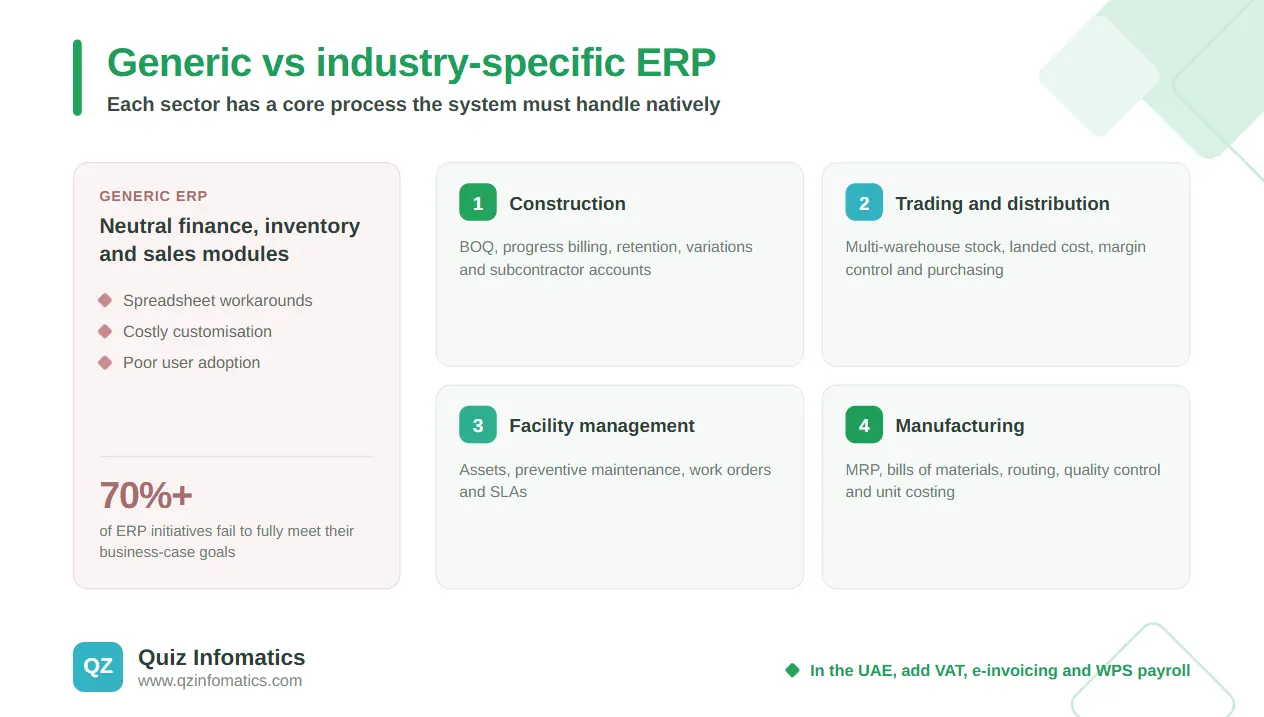
When an ERP does not fit, three things happen. Teams invent spreadsheet workarounds that defeat the purpose, the business pays for costly customisation to bridge the gap, and users quietly resist a system that makes their job harder. Choosing for industry fit from the start avoids all three, which is why working with an experienced ERP Software Company that knows your sector matters as much as the software brand itself.
What does industry-specific ERP look like in construction?
In construction, industry-specific ERP replaces generic accounting with tools built for how contractors actually earn and spend money: bills of quantities, progress billing, retention, variations, and subcontractor accounts. A standard ERP simply cannot model these.
A contractor’s revenue is recognised over time, retention is held back for months, and costs are tracked against a budget built from measured quantities. A construction-fit system handles all of this natively, connecting the BOQ to the budget, to subcontractor packages, and to interim payment certificates. Generic finance software treats a construction project like any other sale, which is where the numbers start to drift from reality.
This is why a purpose-built construction erp is one of the clearest examples of industry fit paying off. When the software already understands variations, retention, and progress claims, the contractor controls cost and cash flow instead of rebuilding them in spreadsheets every month.
What does industry-specific ERP look like in trading and distribution?
In trading and distribution, industry-specific ERP centres on inventory, margins, and multi-location stock rather than project accounting. The whole business turns on buying, holding, and selling goods efficiently.
A distributor needs real-time stock across warehouses, landed-cost tracking, margin control, fast order processing, and tight purchasing, often across thousands of SKUs. An industry-fit system makes these the core of the platform, not an afterthought bolted onto a generic ledger. The result is fewer stockouts, better margins, and cash that is not trapped in slow-moving inventory.
For UAE importers and wholesalers, working with a distribution erp solution provider uae that understands local trade, customs, and VAT is what turns an ERP from a glorified accounting package into a genuine engine for a trading business.
What does industry-specific ERP look like in facility management?
In facility management, industry-specific ERP is built around assets, maintenance, and work orders rather than production or stock. The business delivers a service across buildings, not a product off a shelf.
A facilities company needs to track assets across sites, schedule preventive maintenance, dispatch technicians, manage work orders and SLAs, and control the cost of each contract. A generic ERP has none of this; a facility-fit platform makes maintenance and service delivery the heart of the system. That means fewer missed SLAs, longer asset life, and clear visibility of whether each contract is actually profitable.
This is exactly the gap that dedicated facility management software uae closes, giving CAFM and maintenance teams the work-order and asset tools their operation runs on, connected to the finance and procurement behind them.
What about manufacturing and other sectors?
Manufacturing is one of the strongest cases for industry-specific ERP, because production planning, bills of materials, and shop-floor control simply do not exist in generic systems. Other asset-heavy and project-based sectors face the same reality.
A manufacturer needs material requirements planning, work orders, routing, quality control, and costing down to the finished unit. This is why searches for erp software for manufacturing carry such high commercial value, and why forcing a trading or finance ERP onto a factory almost always ends in workarounds. Our manufacturing ERP page covers how production-fit systems handle this.
The same logic applies to real estate, retail, food and beverage, and professional services. Each has a core process, whether that is lease management, point of sale, batch traceability, or project delivery, that a generic ERP treats as an edge case. Industry fit turns that core process into the centre of the system.
Which ERP products suit industry-specific needs?
The right ERP product depends on your industry, size, and complexity, and the major platforms each have sectors where they excel. The key is matching the platform to your needs rather than chasing the biggest brand name.
For larger, multi-entity, or fast-scaling businesses, a cloud ERP like Oracle NetSuite offers deep finance and multi-subsidiary strength. Working with experienced netsuite erp consultants dubai ensures the platform is shaped to your sector rather than deployed generically. For businesses that want tight integration with the Microsoft ecosystem and strong finance and operations capability, a microsoft dynamics partner in uae can align Dynamics 365 to industry workflows. For SMEs wanting flexibility and value, open platforms like Odoo adapt well to many verticals.
There is no single “best” ERP, only the best fit for your industry and stage. A platform that is perfect for a global distributor may be overkill for a 30-person contractor, and the reverse is just as true.
How do you choose the right industry-specific ERP?
You choose the right industry-specific ERP by starting from your own processes, not the software’s feature list, and matching a platform to how your business actually runs. A structured selection process prevents an expensive mismatch.
A practical approach looks like this:
Map your core processes. Identify the handful of workflows your business truly runs on, your industry’s non-negotiables.
Separate must-haves from nice-to-haves. Be clear on what the system must do natively versus what can wait.
Assess industry fit first. Favour platforms that already handle your core processes with minimal customisation.
Check local fit. Confirm UAE VAT, e-invoicing, WPS payroll, and Arabic support where relevant.
Evaluate the partner, not just the product. The implementer’s industry experience often matters more than the badge on the software.
Plan the implementation. A realistic erp implementation process, phased and properly scoped, is what turns a good choice into a working system.
The last two points are where most projects are won or lost. Even the best-fit software fails with a weak implementation, which is why specialist erp consulting dubai is often the difference between a system people use and one they resent.
Why does the implementation partner matter as much as the software?
The implementation partner matters as much as the software because industry fit is delivered as much through configuration and expertise as through the product itself. The same platform can succeed or fail depending on who implements it.
A partner who knows your sector asks the right questions, configures the system to your real workflows, and warns you before you make expensive mistakes. One who treats every project as generic will deliver a technically working system that still does not fit how you operate. This is especially true for complex platforms, where skilled netsuite erp implementation uae expertise shapes the system around your industry from day one.
The lesson from thousands of ERP projects is consistent: the software gets the headlines, but the implementation decides the outcome. Budget for expertise, not just licences.
How does AI extend industry-specific ERP?
AI is increasingly extending industry-specific ERP beyond record-keeping into real-time monitoring and automation, especially on construction and facility sites. It adds a layer of intelligence that traditional ERP never had.
On a construction or industrial site, computer vision can monitor safety compliance automatically, flagging when a worker is missing a helmet or vest. Tools like ppe detection software gcc bring this kind of AI-vision monitoring to GCC sites, and when connected to the wider system, the data feeds into the same operational picture as cost and progress. The result is safety and compliance managed with the same rigour as the finances.
This is where industry-specific ERP is heading: not just recording what happened, but using AI to watch operations as they unfold. For asset-heavy and site-based sectors, that combination of a sector-fit core and intelligent monitoring is becoming a real advantage.
Let’s talk about your businessStart with a free 30 minute call. We’ll ask the right questions, listen carefully, and give you an honest view of what’s possible.
In the UAE, industry-specific ERP matters doubly, because the system must fit both your sector and the local regulatory environment. A platform that handles your industry but not UAE compliance is only half a solution.
Any ERP used here has to handle 5 percent VAT, the move to mandatory e-invoicing, WPS payroll for the workforce, and increasingly corporate tax, on top of your industry’s core processes. The strongest systems combine deep sector fit with built-in UAE compliance, so a contractor gets retention and progress billing and FTA-ready invoicing, and a distributor gets margin control and correct VAT on every transaction.
For UAE businesses, this dual fit, industry plus local, is the real test of an ERP. Getting both right is what separates a system that drives the business from one that merely records it.
How QZ Infomatics helps
Choosing and implementing an industry-fit ERP comes down to matching the right platform to your sector and configuring it around how you actually work. That is precisely where sector expertise pays off.
A practical path is to start from your industry’s core processes, select a platform that already handles them, and work with a partner who has implemented for your sector before, so the system fits from day one rather than after years of costly customisation. This turns ERP from a risk into an advantage.
QZ Infomatics is a Dubai-based ERP and IT consultancy that implements construction, trading, manufacturing, facility management, and food and beverage systems across the UAE and GCC, aligning platforms like Oracle NetSuite, Microsoft Dynamics 365, and Odoo to each industry and to UAE compliance. If you are evaluating ERP for your sector, that sector-first approach is where the conversation should start.
Industry-specific ERP, in a nutshell
To recap the essentials:
Industry-specific ERP is built around the core processes of a sector, so it fits your business out of the box rather than through heavy customisation.
Generic ERP fails often because the mismatch forces workarounds, custom development, and poor adoption, with over 70 percent of projects missing their goals.
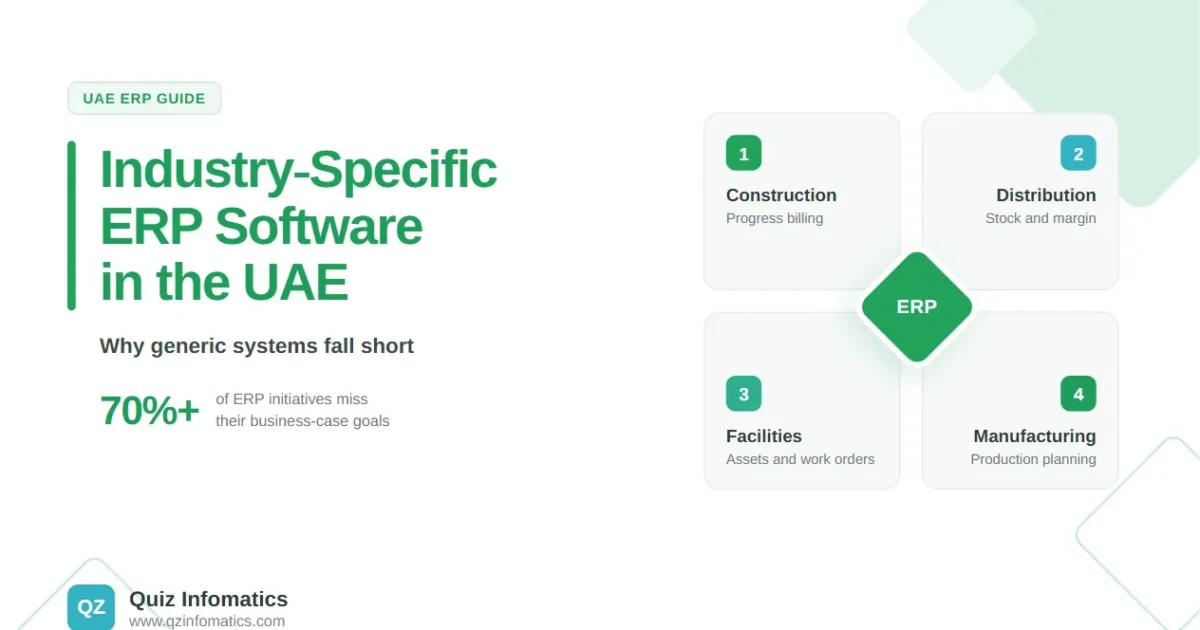
Each sector has a core process the system must handle natively: progress billing in construction, stock and margin in distribution, assets and work orders in facility management, production in manufacturing.
Product and partner both matter, and the implementer’s industry experience often decides the outcome more than the software brand.
In the UAE, the system must fit both your industry and local rules, VAT, e-invoicing, WPS, so dual fit is the real test.
Industry-specific ERP is not about buying more software; it is about buying the right software for how your business actually runs. Get that fit right, and the system becomes the backbone of the business rather than a cost you have to work around.
Share this article
Frequently asked questions
Frequently asked questions
What is industry-specific ERP software?
Industry-specific ERP is an ERP system designed or configured around the processes of a particular sector, such as construction, distribution, or manufacturing, so it fits those workflows natively rather than through heavy customisation.
How is industry-specific ERP different from generic ERP?
Generic ERP provides neutral finance, inventory, and sales modules. Industry-specific ERP adds the core processes a sector runs on, such as progress billing, batch recipes, or maintenance scheduling, without extensive custom development.
Why do so many ERP implementations fail?
Most failures come from a mismatch between the software and the business, which forces costly customisation, spreadsheet workarounds, and poor user adoption. Research shows more than 70 percent of ERP projects fail to fully meet their goals.
Which ERP is best for construction?
A construction-fit ERP that handles bills of quantities, progress billing, retention, variations, and subcontractor accounts natively. The best platform depends on your size and complexity, but industry fit matters more than brand.
Does industry-specific ERP work for small businesses?
Yes. Flexible platforms like Odoo adapt well to smaller businesses in many sectors, while larger or multi-entity firms may need NetSuite or Dynamics 365. The key is matching the platform to your size and industry.
How important is the implementation partner?
Very. Industry fit is delivered largely through configuration and expertise, so a partner who knows your sector often determines success more than the software itself. The same platform can succeed or fail depending on who implements it.
Does an ERP need to handle UAE compliance?
Yes. Any ERP used in the UAE must handle VAT, e-invoicing, and WPS payroll alongside your industry's processes. The strongest systems combine sector fit with built-in local compliance.
Can AI be added to industry-specific ERP?
Yes. AI tools such as computer-vision PPE and safety monitoring can extend ERP on construction and facility sites, feeding real-time operational data into the same system that tracks cost and progress.
Continue reading
Related articles
ERP Fundamentals
Five Process Fixes Before You Touch Your ERP
1. Shadow Systems: The ERP Killer If your teams still rely on spreadsheets outside the ERP, you have a shadow system problem. This...
ERP Technology Advisor · 7 April 2026 · 2 min read
In today’s fast-moving digital economy, businesses face growing pressure to be more agile, efficient, and data-driven. Customers expect faster service,
ERP Technology Advisor · 7 April 2026 · 3 min read
Book a free 30 minute call with QZ Infomatics in Dubai. You will leave it with a platform recommendation, the reasoning behind it, a realistic timeline and an indicative budget band — before you commit to anything.
✓ A consultant who delivers projects, not a sales desk
✓ Odoo, Microsoft Dynamics 365 and Oracle NetSuite compared honestly
✓ Licence cost and implementation cost quoted as separate numbers
✓ If we are not the right fit for you, we will say so