
Skip to content

Five industries worked hands on, so we arrive knowing where the gaps usually are.

All industries →Request a demo

Four ERP platforms in house, and fifteen capability modules. The recommendation is never tied to a licence quota.

All solutions →Request a demo

One team from platform selection through to the reports on your desk.

All services →Request a demo

Learning Centre

Guides, how-tos, comparisons and a plain-English glossary, written by the consultants who deliver the projects. No form in front of any of it.

Free toolsNo gate before you use them
Plain EnglishBOQ, retention, WIP and IPC explained
Written in houseBy the people who run the projects
Browse all resources →

Nobody in UAE ERP publishes their tools or their pricing. We do both.

Free tools →Request a demo

Consultants in the UAE, technical team in South Asia. Cost stays sharp without cutting corners.

About QZ Infomatics →Request a demo
Request a demo +971 4 243 4010

CRM Software Dubai

When a salesperson leaves a UAE business, the customer relationship
usually leaves with them. It does not have to.

CRM software manages every interaction with prospects and customers — leads, contacts, opportunities, quotations, follow-up activities and post-sale service. It replaces individual notebooks, personal phones and separate inboxes with a shared record, so the relationship belongs to the company rather than to whoever built it.

✓ A shared record, not a personal phone✓ Quotations with approval and version history✓ Live stock and credit before you promise✓ Five numbers that explain a weak month
CRM Software Dubai

Scope

What a CRM does for a UAE B2B business

Lead capture and routing

Enquiries from the website, email, phone and exhibitions logged with a source, assigned by territory, product or rotation, and followed up on a schedule rather than when someone remembers.

Pipeline management

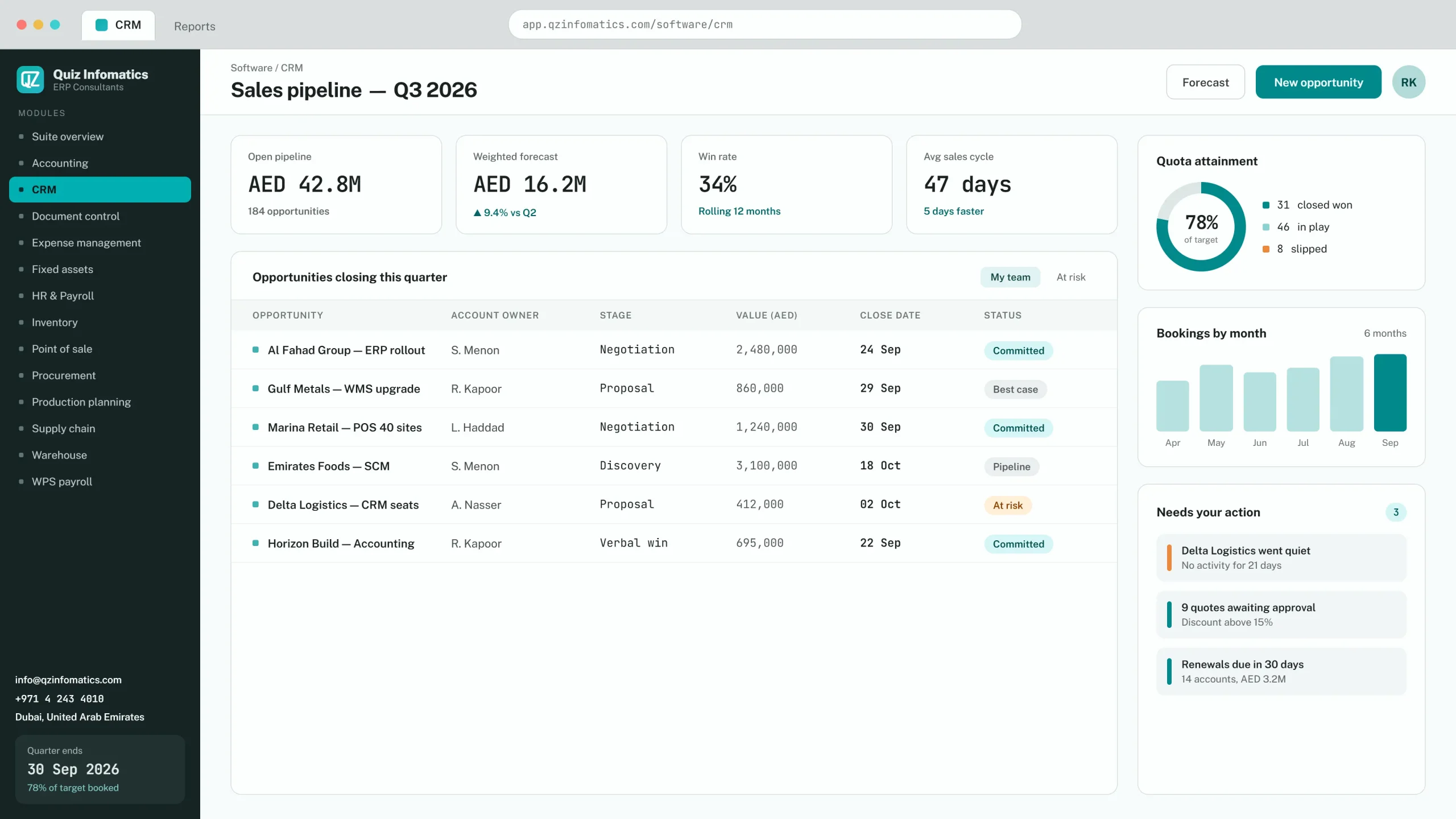
Opportunities moving through defined stages with value, probability and expected close date, so the forecast is a calculation rather than an estimate.

Quotations

Built from the product catalogue with agreed price lists and discount rules, versioned, and converted to a sales order on acceptance.

Activity management

Calls, meetings and follow-ups scheduled against each opportunity, so nothing lapses in the gap between a good meeting and a slow month.

Customer service

Post-sale tickets, complaints and service history attached to the same customer record the sale was made against.

UAE specifics

The WhatsApp problem

The problem

The relationship lives on a personal phone

A large share of UAE B2B conversation happens on WhatsApp. Quotes are discussed, terms are agreed, and relationships are maintained on an individual salesperson's personal phone. None of it is visible to the business.

  • › What was promised, and by whom
  • › What was quoted before the formal quotation
  • › What the customer objected to
  • › Who at the customer actually makes the decision
What a shared record gives you →
What to require

Logging, not just integration

Modern CRMs log email automatically and offer WhatsApp Business integration, so conversations attach to the contact record.

  • › Email logged against the contact automatically
  • › WhatsApp Business conversations attached to the record
  • › Treat it as a requirement, not a feature, during selection
  • › Retrofitting it later does not recover the history already lost
Call analytics too →

When that person leaves, the company keeps the customer's name and loses everything else.

Quotations

Quotations and pricing control

Built from the catalogue

Agreed price lists, volume breaks and discount rules, rather than a Word document with last quarter's numbers in it.

Discounts approved before sending

Anything beyond a set threshold routes for approval before the quote goes out, not after the customer has already seen the number.

Version history settles disputes

What was offered and when, recorded. A recurring source of margin loss in businesses where quotes are produced in Word.

Acceptance converts the quotation into a sales order, then a delivery and an invoice, without re-entry.

Integration

CRM connected to ERP

This is where a CRM inside your ERP earns its place over a standalone platform.

A CRM that only knows conversations

Promises made without the facts

  • × A delivery date promised against stock that was allocated this morning
  • × An order taken from a customer already over their credit limit
  • × A quote priced without the customer's previous pricing in view
  • × Margin calculated after the fact, if at all
  • × Two systems, and a nightly sync somebody maintains
A CRM inside the ERP

The facts are on the same screen

  • ✓ Live stock availability before promising a date
  • ✓ Credit limit and outstanding balance before taking the order
  • ✓ Order history and previous pricing before quoting
  • ✓ No integration to build, and none to maintain
  • ✓ Quotation to sales order to invoice, without re-entry

The practical result is that you stop selling to customers who are already over their limit, and stop promising stock that was allocated to someone else that morning. Both are common, both are avoidable.

Reporting

Sales reporting that answers something

Five numbers do most of the work: pipeline value by stage, conversion rate at each stage, average deal size, sales cycle length, and activity volume per salesperson.

01Too few leads at the top

Pipeline value by stage shows it immediately. The fix is marketing and prospecting, and no amount of sales coaching substitutes for it.

02Poor conversion in the middle

Conversion rate at each stage and average deal size locate where opportunities are being lost, which is usually one stage rather than all of them.

03A lengthening cycle at the end

Sales cycle length and activity volume per salesperson show a deal set that is aging. Three different problems, three different fixes, and a revenue figure alone distinguishes none of them.

Dashboards built on the same data give management the view without opening the CRM, which matters because senior people rarely log in.

Comparison

What is the best CRM software?

It depends on what the CRM has to connect to.

Standalone CRM platforms compared with a CRM inside your ERP
Standalone CRM platformsCRM inside your ERP
HubSpot, Zoho CRM, SalesforceOdoo, Finance & Operations, NetSuite
Deeper marketing automation and richer reportingNative access to stock, credit, order history and margin
Better out-of-the-box user experienceLower incremental cost if you already run the ERP
Best where the sales process is the businessBest where you sell physical goods with stock constraints
An integration to build and maintainNo integration at all

The honest rule: if you sell physical goods with stock constraints, credit exposure and complex pricing, take the ERP-native option. If you sell services or subscriptions and your bottleneck is marketing and pipeline volume, take the standalone platform. Businesses that buy a standalone CRM and then spend two years integrating it back into their ERP usually needed the ERP module.

Adoption

Getting sales staff to use it

Most CRM implementations do not fail technically. They fail because nobody uses them.

Keep required fields minimal at first

So entering an opportunity is faster than the spreadsheet it replaces. Fields can be added once the habit exists.

Give the salesperson something back

Stock visibility, quote generation, a follow-up reminder. A system that only feeds reports upward gets used the way you would expect.

Run pipeline reviews from the CRM only

If management will accept a figure from a spreadsheet, the data will live in the spreadsheet.

Adoption fails when the system is experienced as reporting overhead. It succeeds when it is the fastest way to do the job. Implementation takes two to four weeks; the main effort is agreeing stage definitions, because a pipeline applied inconsistently produces a forecast nobody believes.

CRM FAQs

What buyers ask us about CRM software

What is CRM software?

CRM software manages every interaction with prospects and customers: leads, contacts, opportunities, quotations, follow-up activities and post-sale service. It replaces individual notebooks and inboxes with a shared record, so a customer relationship survives the salesperson who built it leaving the company.

What should a CRM do for a UAE B2B business?

Track leads from source through to won or lost, manage quotations with version history and approval, schedule follow-ups so nothing lapses, and report pipeline by stage and value. WhatsApp integration matters in the UAE, where much of the B2B conversation happens there rather than over email.

Does CRM integrate with ERP and accounting?

Yes. A quotation accepted in CRM becomes a sales order, then a delivery and an invoice, with no re-entry. Sales staff see credit limits, outstanding balances and order history before promising anything, which prevents the familiar problem of selling to a customer already over their limit.

Can it handle quotations and pricing approvals?

Yes. Quotations are built from the item catalogue using agreed price lists and discount rules, and discounts beyond a set threshold route for approval before the quote is sent. Version history records what was offered and when, which settles most later disputes about what was actually agreed.

How does CRM help with sales reporting?

It provides pipeline value by stage, conversion rate at each stage, average deal size, sales cycle length and activity levels per salesperson. Those five figures tell you whether a weak month came from too few leads, poor conversion or a slow cycle. Dashboards built on the same data give management the picture without opening the CRM.

Does it support WhatsApp and email tracking?

Most modern CRMs log email automatically and offer WhatsApp Business integration, so conversations attach to the contact record instead of living on one person’s phone. This matters in the UAE specifically, where losing a salesperson can otherwise mean losing the entire history with their accounts.

How much does CRM software cost in the UAE?

CRM is priced per user per month, with tiers reflecting feature depth. Where CRM is a module of your ERP the incremental cost is usually lower and integration comes as standard. Standalone platforms tend to offer richer marketing automation at a higher price point.

How do we get sales staff to actually use a CRM?

Keep required fields minimal at first, make it faster than the spreadsheet it replaces, and have management run pipeline reviews from the CRM only. Adoption fails when the system is treated as reporting overhead rather than as the place a salesperson does their actual work.

Talk to a consultant

Talk to an ERP consultant, not a salesperson

Book a free 30 minute call with QZ Infomatics in Dubai. You will leave it with a platform recommendation, the reasoning behind it, a realistic timeline and an indicative budget band — before you commit to anything.

  • ✓ A consultant who delivers projects, not a sales desk
  • ✓ Odoo, Microsoft Dynamics 365 and Oracle NetSuite compared honestly
  • ✓ Licence cost and implementation cost quoted as separate numbers
  • ✓ If we are not the right fit for you, we will say so

Book a free call

We reply within one working day.

Or WhatsApp us on +971 4 243 4010

Request a demo