What is a BOQ?
A BOQ, or bill of quantities, is a document that lists and measures every item of work required to complete a construction project, so that contractors can price the same scope on the same basis.
It breaks the project into individual items — excavation, concrete, blockwork, plaster, tiling, doors, electrical points, air handling units — states the quantity of each in a defined unit of measurement, and leaves a blank column for the contractor to enter a rate. Multiply quantity by rate, sum the lines, and you have a tender price.
That is the mechanical description. The purpose is more interesting: a BOQ exists so that competing tenders can be compared like for like. Without one, three contractors pricing the same drawings will each make different assumptions about scope, and the cheapest number will usually belong to whoever assumed the least. The BOQ removes that variable. Everyone prices the same measured quantities, and the difference between tenders becomes a difference in rates rather than a difference in interpretation.
Once the contract is awarded, the BOQ stops being a tender document and becomes the financial spine of the project. It sets the budget, drives the cost coding, provides the basis for measuring progress, and determines how interim payments are valued. On a well-run project, every purchase order, subcontract and timesheet traces back to a BOQ line.
What does BOQ stand for?
BOQ stands for bill of quantities. You will also see it written as BoQ or B.O.Q., and occasionally as “bills of quantities” in the plural, because a large project’s BOQ is genuinely a set of separate bills — one per trade or per building section — bound together.
The term is British in origin and travelled with the British quantity surveying tradition into the Gulf, South Asia, Africa and Australia. In the United States the equivalent function is usually performed by a schedule of values or a detailed estimate, which is why American construction software often handles BOQs poorly. It is not a document that market grew up with.
In Arabic the document is commonly referred to as جدول الكميات (jadwal al-kammiyat), literally “table of quantities”. On bilingual UAE projects, BOQ headers are frequently issued in both languages, and any system that will hold BOQ data on a government or semi-government project needs to support Arabic item descriptions properly rather than as an afterthought.
What is inside a BOQ?
A BOQ is not a flat list. It has a structure, and understanding that structure is what separates someone who can read a BOQ from someone who can only look at one.
Preliminaries
The first bill in almost every BOQ, and the one most frequently misunderstood.
Preliminaries are the costs of running the project that cannot be attributed to any single item of measured work. Site establishment and offices. Site management and supervision staff. Temporary works — hoardings, scaffolding, access roads. Cranes and site-wide plant. Temporary power and water. Insurance and bonds. Safety provision. Site cleaning and final handover.
They are typically priced as a lump sum or as a time-related charge, and on a UAE building project they commonly run 8% to 12% of the construction value — though on a constrained city-centre site with difficult access, considerably more.
Preliminaries matter disproportionately because they are time-related. If the project runs three months late through no fault of the contractor, the measured work has not increased but the preliminaries have. That is the arithmetic behind most extension-of-time cost claims.
Measured works
The main body of the BOQ, organised by trade or by element. Each item follows a consistent structure:
The fields that make up a single item in a bill of quantities
| Field |
Example |
| Item reference |
3.14 |
| Description |
Reinforced concrete grade C40 to columns, including formwork and finishing |
| Unit |
m³ |
| Quantity |
486 |
| Rate |
(blank at tender) |
| Amount |
(quantity × rate) |
The description is the contractual heart of the item. It defines what is included, and by omission what is not. A dispute over whether formwork was in the concrete rate or priced separately is a dispute about a description, and it is one of the most common arguments on any construction project.
Provisional sums
Amounts included for work that is known to be required but cannot yet be measured — because the design is incomplete, or because a specialist package has not been let.
A provisional sum is a placeholder. It is expended against actual instructed work and adjusted at final account. A BOQ heavy with provisional sums is a signal that the design was not complete at tender, and it usually predicts a variation-heavy project.
Prime cost sums
Allowances for materials or specialist work to be supplied by a nominated supplier or subcontractor. The contractor prices their profit and attendance separately, and the PC sum itself is adjusted to actual cost.
Dayworks
A schedule of hourly labour rates, plant rates and material percentages, used to value work that cannot sensibly be measured — typically small, unforeseen items instructed on site. Dayworks are the most expensive way to buy construction work and a well-run project uses them sparingly.
Contingency
A sum held by the employer for the unexpected. It belongs to the employer, not the contractor, and it is expended by instruction. It is not the contractor’s risk allowance — that is priced into the rates.
How is a BOQ prepared?
The process is called taking off, and it is the core skill of the quantity surveying profession.
1. Read the drawings and specification together. The drawings show geometry; the specification defines quality. An item measured from the drawing without reading the spec will have the right quantity and the wrong description.
2. Measure the quantities. Historically by hand, with a scale rule and a dimension sheet. Now almost always in software — CCS Candy, Cubicost, Bluebeam, or measurement tools working directly from a BIM model.
3. Apply a measurement standard. This is the step that makes a BOQ contractual rather than merely informative.
4. Write the descriptions. The genuinely skilled part. A good description is unambiguous about what is included, references the specification clause, and states the qualifying conditions.
5. Bill and structure. Group items into bills by trade or element, number them consistently, add preliminaries, provisional sums and dayworks.
6. Issue for pricing. Usually as an Excel workbook, occasionally in a structured exchange format.
For a mid-sized UAE building project this is several weeks of work by an experienced QS, and it is the reason BOQ preparation is a service in its own right rather than something a contractor does on a Sunday afternoon.
Measurement standards, and why they matter
A quantity is only meaningful if both parties agree how it was measured. Is a wall measured over openings or with openings deducted? Is excavation measured net or with working space? Is formwork included in the concrete rate?
A standard method of measurement answers those questions in advance, in writing, for every class of work. The contract states which standard applies, and that statement is what makes the quantities enforceable.
Standard methods of measurement and where each one is used
| Standard |
Where used |
| POMI — Principles of Measurement International |
The most widely used standard on GCC building projects. Concise, familiar to Middle East contractors and consultants. |
| NRM2 — RICS New Rules of Measurement |
The current UK standard for detailed measurement. Increasingly seen on UAE projects with UK-based consultants. |
| CESMM4 — Civil Engineering Standard Method of Measurement |
Infrastructure and civil engineering works. |
| SMM7 |
Superseded by NRM2 but still encountered on older UAE contracts and in legacy rate libraries. |
POMI is the one to know if you work in the UAE. It is the default on a large share of Gulf building contracts, and a rate built against NRM2 assumptions applied to a POMI-measured bill will be wrong — not dramatically, but consistently, and in a direction the contractor discovers at final account.
Any BOQ should state its measurement standard on the cover. If it does not, that is the first question to ask.
BOQ vs BOM — what is the difference?
These get confused constantly, and the confusion is understandable because both are itemised schedules of things needed to build something.
How a bill of quantities differs from a bill of materials
|
BOQ — bill of quantities |
BOM — bill of materials |
| Industry |
Construction |
Manufacturing |
| Describes |
Work to be performed |
Components to make one unit |
| Includes labour |
Yes — rates cover labour, plant and material |
No — materials and sub-assemblies only |
| Unit basis |
The whole project |
One finished item |
| Purpose |
Tendering, valuation, payment |
Production planning, material requirements |
| Governed by |
A standard method of measurement |
Engineering specification |
The clearest distinction: a BOQ item is a job to be done; a BOM line is a thing to be consumed. “Supply and fix 100 mm blockwork including mortar and reinforcement, measured net, per square metre” is work. “Steel bracket, part 4471-B, quantity 2” is a component.
A manufacturer building a modular construction product will have both — a BOM for the units produced in the factory, and a BOQ for the site work that installs them. Getting the boundary right between the two is one of the harder configuration decisions in a construction-plus-manufacturing business, and it is where production planning software and construction cost control meet.
Types of BOQ
Firm BOQ. Prepared from complete drawings and a full specification. Quantities are contractually fixed and the contractor prices with confidence. The best outcome for both parties and increasingly rare, because it requires the design to be finished before tender.
Approximate or provisional BOQ. Prepared from incomplete design, with quantities subject to remeasurement on completion. Common where the employer wants to start early. It shifts scope risk to the employer and it guarantees a busy final account.
Elemental BOQ. Organised by building element — substructure, frame, envelope, finishes, services — rather than by trade. Useful for cost planning and for comparing against benchmark cost models.
Operational BOQ. Organised by the sequence of operations rather than by trade. Rare, but valuable on projects where programme and cost need to be read together.
Fit-out and interiors BOQ. A distinct discipline in the UAE, where fit-out is a large market in its own right. Typically lighter on structure and services, far heavier on finishes, joinery, loose furniture and specialist items. Descriptions carry more weight because finish quality is subjective in a way that concrete strength is not — “polished plaster to approved sample” is a description that will be argued about unless the sample process is defined.
What a BOQ is for after the contract is signed
This is the part most explanations miss, and it is the part that matters most commercially.
It sets the budget. The priced BOQ, stripped of margin, becomes the project cost budget. Each item or group of items maps to a cost code, and that mapping is what allows actual spend to be compared against what was allowed.
It structures the work breakdown. On most construction projects the BOQ drives the work breakdown structure rather than the other way round, because the BOQ already divides the project into priced, measurable packages.
It values interim payments. Progress is measured against BOQ items — 60% of the blockwork, 100% of the substructure — and the interim payment application is built from those measurements. This is why the BOQ has to be structured in a way that can actually be measured monthly. A bill with one line reading “Complete the building — 1 no. — lump sum” is technically a BOQ and practically useless.
It prices variations. When the employer instructs a change, the first question in the valuation hierarchy is whether a BOQ rate applies. If it does, that rate governs. Contract rates are the cheapest and least contentious way to price a variation order, which is why a well-structured BOQ with a wide range of rates protects both parties.
It drives procurement. Material quantities come from the BOQ, and a purchase order raised against a BOQ line updates committed cost against that line immediately. That link is what makes procurement software useful on a project rather than merely administrative.
Five things that go wrong with BOQs
Quantities that do not match the drawings. Errors happen. On a remeasurable contract they get corrected. On a lump-sum contract based on an agreed design, they are usually the contractor’s risk — which is why contractors re-measure the bill during tender rather than accepting it.
Descriptions that do not match the specification. The BOQ says “concrete grade C30”, the specification says C40. The contractor prices C30 and builds C40. Somebody pays the difference and it will not be settled amicably.
No stated measurement standard. Without one, every measurement convention is arguable.
A bill structure nobody can measure against monthly. BOQs prepared purely for tender comparison, with items too coarse to assess progress against, force the QS to invent a parallel valuation structure — and then the two never reconcile.
The BOQ never leaves Excel. This is the most common and most expensive failure. The bill is priced in Excel, the budget is set in Excel, and then the project runs in an accounting system that knows nothing about BOQ lines. Cost is captured against accounts rather than against items, and by month three nobody can say which BOQ lines are over-running. Everything the BOQ was supposed to enable — line-level cost control, measured valuation, variation pricing from contract rates — is lost.
From BOQ to live cost control
The gap between a priced BOQ and a system that controls cost against it is where most UAE contractors lose margin.
The BOQ is prepared in estimating software — most commonly CCS Candy in this market. The project then runs in an ERP. If those two are not connected, someone re-keys the budget, and the cost codes in the ERP end up structured differently from the bill they came from. From that point on, cost-to-date against budget at line level is impossible.
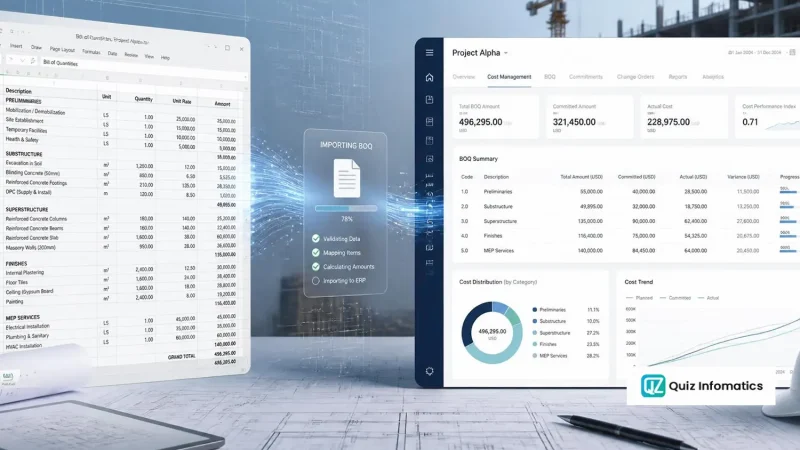
Importing the BOQ into the ERP as the project’s cost structure closes it. Every purchase order, subcontract, timesheet and plant charge codes to a BOQ line, which gives cost against the priced rate at item level — the point at which over-runs actually become visible, weeks before they reach the monthly profit and loss. The mechanics of that handover are covered in importing a Candy BOQ into your ERP.
That structure also feeds everything downstream. Measured progress against BOQ items produces the interim payment application. Cost incurred against total forecast cost drives earned value management and the work-in-progress calculation. Variations reference BOQ rates. It is one chain, and it starts with the bill.
For contractors running this properly, construction ERP software in the UAE holds the BOQ as the project’s native cost structure rather than as an imported attachment.
Two tools on this site work directly from a BOQ: the construction cost calculator for early feasibility, and the project profitability calculator for forecasting margin on a live job.
Part of our complete guide to ERP for construction.