What is a GRN?
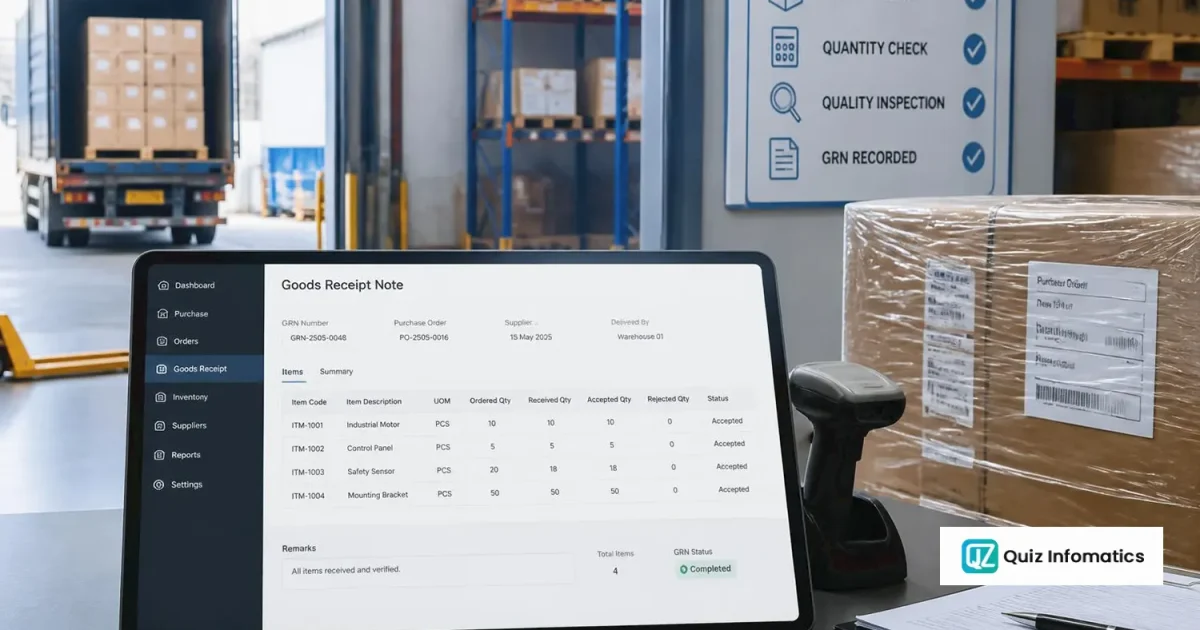
A GRN, or goods receipt note, is the document that records what was physically delivered to a business, in what condition, and on what date — checked against the purchase order that requested it.
It is created at the point of receipt, by the person receiving the goods, and it is the only document in the purchasing cycle that records reality rather than intention. The purchase order says what you asked for. The supplier’s invoice says what they are charging for. The GRN says what actually turned up.
That distinction is the entire reason the document exists. Without it, a business has no independent record of receipt, and the only evidence that goods arrived is the supplier’s own paperwork. Paying against a supplier invoice with no GRN behind it means paying on the supplier’s word — which works until it does not.
What does GRN stand for?
GRN stands for goods receipt note. You will also encounter:
- GRV — goods received voucher, common in South Africa and parts of Asia
- GR — goods receipt, the standard term in SAP environments
- Receiving report — the usual North American equivalent
- MIGO — not the document but the SAP transaction code used to post one, which is why “MIGO” appears in searches from people who mean GRN
All describe the same control: a dated, referenced record of what was received.
What is on a GRN?
A GRN is short by design. It is filled in at a loading bay, often under time pressure, sometimes by someone whose primary job is not administration.
The fields on a goods receipt note and why each is recorded
| Field |
Why it is there |
| GRN number |
Unique sequential reference for audit trail |
| Date and time of receipt |
Establishes the accounting period and the delivery performance record |
| Purchase order reference |
Links receipt to the original commitment |
| Supplier name and delivery note number |
Ties to the supplier’s own documentation |
| Item code and description |
Identifies what arrived |
| Quantity ordered |
From the PO |
| Quantity received |
The critical field |
| Quantity accepted / rejected |
Separates delivered from usable |
| Unit of measure |
Where mismatches cause the most confusion |
| Condition on arrival, damages, shortages |
Free-text or coded |
| Batch, lot or serial numbers |
Required for traceability in food, pharma and regulated goods |
| Expiry date |
Perishable and dated stock |
| Storage location or bin |
Where it was put away |
| Received by — name and signature |
Accountability |
| Inspected by — where QC applies |
Separates receipt from acceptance |
The three quantity fields are the point of the document. Ordered, received, accepted. When all three match, the transaction is clean. When they do not, the GRN is the evidence that determines who absorbs the difference — and that evidence is worth nothing if it is recorded a week later from memory.
Where the GRN sits in the purchasing cycle
The GRN is the fourth step of a six-step chain, and its position explains its importance.
1. Purchase requisition. A department requests something. Internal, no commitment yet.
2. Purchase order. Approved and issued to the supplier. This is the point of commitment — money is now contractually promised, whether or not anything has arrived or been invoiced. Tracking commitment from here rather than from the invoice is what separates a business that sees over-runs early from one that discovers them at month-end.
3. Delivery. Goods arrive with the supplier’s delivery note.
4. Goods receipt note. Your record of what arrived. Stock increases. An accrual is raised.
5. Supplier invoice. The supplier asks to be paid.
6. Three-way match and payment. PO, GRN and invoice compared. Where they agree, payment is released.
The GRN is the hinge. Everything before it is intention; everything after it is settlement. It is also the point at which two things happen simultaneously — the stock record changes and the accounting record changes — which is why a GRN posted late or wrongly causes problems in two systems at once.
Three-way matching
Three-way matching is the control that makes accounts payable defensible, and the GRN is one of its three legs.
Before an invoice is paid, the system compares:
The three documents compared in a three-way match, and where each comes from
|
Says |
Source |
| Purchase order |
What we agreed to buy, at what price |
Procurement |
| Goods receipt note |
What actually arrived |
Warehouse or site |
| Supplier invoice |
What we are being charged |
Supplier |
Where all three agree within tolerance, the invoice is approved automatically. Where they do not, it routes as an exception to someone who can investigate.
The four exceptions this catches:
Quantity variance. Ordered 500, received 480, invoiced 500. Without a GRN this is paid in full and nobody ever knows. It is the most common leak in purchasing and it is almost never deliberate — it is a short delivery that was noted on a paper docket and never followed up.
Price variance. Ordered at AED 12 per unit, invoiced at AED 13.50. Sometimes a legitimate price increase not communicated; sometimes an error. Either way it should be a decision, not an automatic payment.
Invoice with no order. Someone ordered by phone, the supplier delivered, and now there is an invoice with nothing behind it. Common in businesses where site staff order directly, and the root cause of most uncontrolled spend.
Duplicate invoices. The same invoice arriving twice — once by email, once with the delivery. Paid twice more often than most businesses believe, and almost never discovered, because nothing in a manual process compares an incoming invoice against what has already been settled.
A practical caution: three-way matching only works if purchase orders are raised before goods arrive. In a business where site or production staff order by phone and paperwork follows, there is nothing to match against, and the control is theatre. Fixing the ordering discipline has to come before implementing the match.
GRN in accounting
This is the part that generates the most confusion.
When a GRN is posted, before any supplier invoice arrives, the accounting entry is:
Dr  Inventory / Expense                          (the goods now exist and belong to you)
Cr  GRN suspense / Goods received not invoiced   (a liability - you owe for them)
When the supplier invoice is subsequently posted and matched:
Dr  GRN suspense / Goods received not invoiced   (clearing the accrual)
Dr  Input VAT                                    (where recoverable)
Cr  Accounts payable                             (the supplier is now a creditor)
Why this matters. The goods-received-not-invoiced account — GRNI — is the bridge between the warehouse and the ledger. It should be small and it should clear quickly. An ageing GRNI balance is one of the most reliable diagnostics available in a purchasing operation, and it tells you one of three things:
- Goods received, invoice never arrived. The supplier has not billed you. Pleasant until they bill for eighteen months at once.
- GRN posted in error or for the wrong quantity. The receipt was overstated.
- Invoice received but not matched. It is sitting in an exception queue nobody is clearing.
Any month-end review of a purchasing operation should start with GRNI ageing. It is a small report that finds real money.
The period-cut question. Goods received on 31 March against an invoice dated 3 April belong in March. The GRN date, not the invoice date, determines the accounting period. Businesses that accrue from invoices rather than receipts consistently understate cost at period end — and it is always in the same direction.
GRN across different operations
The document is the same. What is checked at the point of receipt is not.
Retail. Volume is high and speed matters. Receipt is usually by barcode scan against the PO, with variances flagged for exception handling rather than every line being checked. Retail GRNs feed straight into shelf availability, so a delay in posting is a delay in the product being sellable. A warehouse management system that captures receipt at the dock is what makes this workable at volume.
Distribution and wholesale. Batch, lot and serial capture matter, and so does landed cost. A GRN on an imported shipment is the point at which freight, duty, insurance and clearing charges should be allocated across the received items — because that allocation is what produces true unit cost. Recording it against the shipment later, or not at all, is why so many distributors calculate margin from supplier invoice price and get it wrong.
Manufacturing. Receipt and acceptance separate. Goods arrive, a GRN is raised, and the material moves to quarantine pending inspection. Only inspected material moves to available stock. A GRN that automatically makes material available for production defeats incoming quality control entirely.
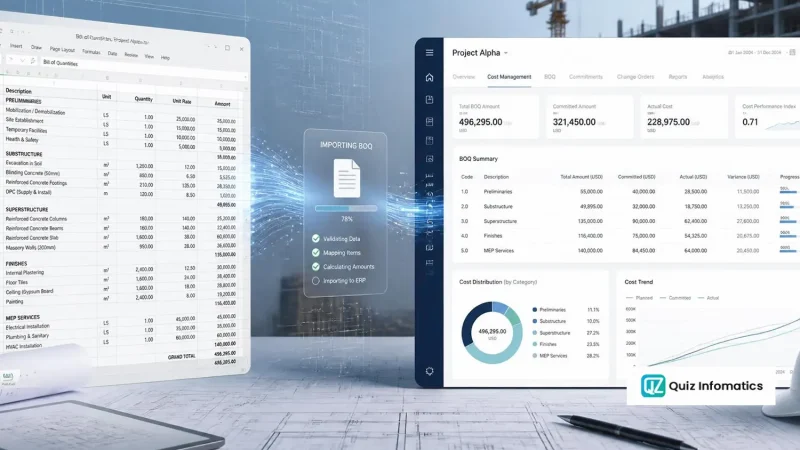
Construction. Delivery is to site, not to a warehouse, and the receiving party is a storekeeper or site engineer rather than a warehouse team. The GRN must carry the project and cost code, because that is what allocates the material to the right job. A delivery received without a project reference lands in general overhead, and the project it belonged to shows a margin it has not earned. This is where site-level receipt discipline directly determines whether project costing software produces meaningful numbers, and it is one reason construction ERP software in the UAE puts receipt on a phone at the gate rather than on a docket in an envelope.
Food and perishables. Expiry date and temperature on arrival become mandatory fields. A cold-chain delivery received without a temperature record is unevidenced, and that gap appears during an inspection rather than at the point it was created.
GRN, delivery note and packing list — the difference
Three documents arrive around the same delivery and they are not interchangeable.
How a packing list, a delivery note and a goods receipt note differ
| Document |
Prepared by |
States |
| Packing list |
Supplier |
What is in each carton or pallet |
| Delivery note |
Supplier |
What the supplier says they sent |
| Goods receipt note |
You |
What you say you received |
The delivery note is the supplier’s claim. The GRN is your record. Signing a delivery note “received unchecked” and raising no GRN leaves you with the supplier’s version of events as the only evidence — which is precisely the position you do not want when a shortage surfaces three weeks later.
Signing a delivery note is not the same as accepting the goods. The GRN, with its accepted and rejected quantities, is where acceptance is recorded.
GRN and UAE VAT
Two points worth knowing.
The GRN is not a tax document. Input VAT is recovered against a valid tax invoice, not against a goods receipt. A GRN with no corresponding tax invoice supports the accrual but not the VAT recovery.
Timing. Goods received in one tax period against a tax invoice issued in the next affects which return the input VAT falls into. The general position follows the tax invoice date, but the interaction with the accrual is where reconciliation between the ledger and the VAT return breaks down. Businesses whose GRNI account is not cleared regularly find the two disagree, and the disagreement is exactly what an audit examines.
If VAT treatment on purchases is causing reconciliation problems, that is usually a symptom of an incomplete purchase-to-pay process rather than a tax question. Accounting software in the UAE that posts receipts and invoices through the same chain resolves most of it structurally.
Common GRN problems
Posted late. Goods arrive Monday, GRN raised Thursday. For three days stock is understated, the material may already have been consumed, and the period cut is wrong if it crosses month-end.
Posted for the ordered quantity rather than the received quantity. The single most damaging error, because it defeats the entire control. Someone opens the GRN screen, sees the PO quantity pre-filled, and confirms without counting. Short deliveries then pay in full and the variance is invisible.
Unit of measure mismatch. Ordered in boxes, delivered in each, received in kilograms. Produces stock records that are wrong by orders of magnitude, and the error usually surfaces at a stock count months later.
No project or cost code on site deliveries. Material lands in overhead. Project cost is understated and overhead is unexplainable.
Raised against the wrong purchase order. Common where a supplier delivers against several open orders on the same day. Both orders then show incorrect completion status.
Not raised at all. Direct-delivery items, services and small purchases frequently skip the process entirely, which means the three-way match cannot run and the spend is uncontrolled.
The GRN in an ERP
In a spreadsheet-based operation the GRN is a piece of paper that travels from the loading bay to accounts, and its main failure mode is that it does not arrive.
In an ERP the GRN is a transaction that does several things at once:
- Increases stock at the receiving location, by batch and serial where tracked
- Raises the GRNI accrual in the ledger
- Updates the purchase order’s delivered quantity and completion status
- Records supplier delivery performance for the scorecard
- Allocates landed cost across received items where a shipment record exists
- Codes the receipt to a project, cost centre or work order
- Makes the material available for the three-way match
Because it happens in one transaction, none of those can drift out of step with the others. The reason a GRN posted on a handheld scanner at the point of receipt is worth so much more than a paper docket is not the scanning — it is that the record is made at the moment of the event by the person who witnessed it.
For businesses running this properly, procurement software handles the requisition-to-match cycle and inventory management software in Dubai handles the stock side, in the same system.
Part of our complete guide to ERP for construction.