How to Calculate End-of-Service Gratuity in the UAE (2026 Guide)
How to calculate UAE end-of-service gratuity: the 21 & 30-day rule, basic-salary basis, caps and resignation rules, with worked examples. Free calculator.
ERP Technology AdvisorPublished 10 min read
Last updated: November 2026 · By the QZ Infomatics Team
End-of-service gratuity is one of the most searched, and most misunderstood, parts of UAE employment. Employees want to know what they are owed when they leave, and employers need to calculate it correctly and pay it on time. Get the rules wrong and you risk underpaying staff, overstating liabilities, or facing a labour complaint. This guide explains exactly how UAE end-of-service gratuity works under the current labour law, with worked examples, so both sides know where they stand.
What is end-of-service gratuity in the UAE?
End-of-service gratuity is a lump-sum payment UAE private-sector employers must pay an eligible employee when their employment ends, based on their length of service and basic salary. It is a legal entitlement, not a bonus.
Often called the end-of-service benefit (EOSB) or simply gratuity, it rewards an employee for their service and is paid whether they resign or are terminated, provided they qualify. It is governed by the UAE Labour Law, specifically Federal Decree-Law No. 33 of 2021, which took effect in February 2022.
For most employees, gratuity is the largest single sum they receive when leaving a job, which is why calculating it correctly matters so much. For employers, it is a real and growing liability that has to be tracked and funded.
Who is entitled to gratuity in the UAE?
Any full-time foreign employee in the UAE private sector who completes at least one year of continuous service is entitled to end-of-service gratuity. Service of less than a year earns no gratuity.
A few points define eligibility. The employee must be a foreign national, as Emirati employees are covered instead by the national pension and social security scheme. Service must be continuous, and a probation period counts toward it provided the employee passes probation and continues in the role. Days of unpaid leave do not count as service.
Importantly, under the current law both resignation and termination entitle a qualifying employee to full gratuity. The old rule that reduced gratuity for employees who resigned early no longer applies, which is a significant change many people are still unaware of.
How is UAE gratuity calculated? The 21 and 30-day rule
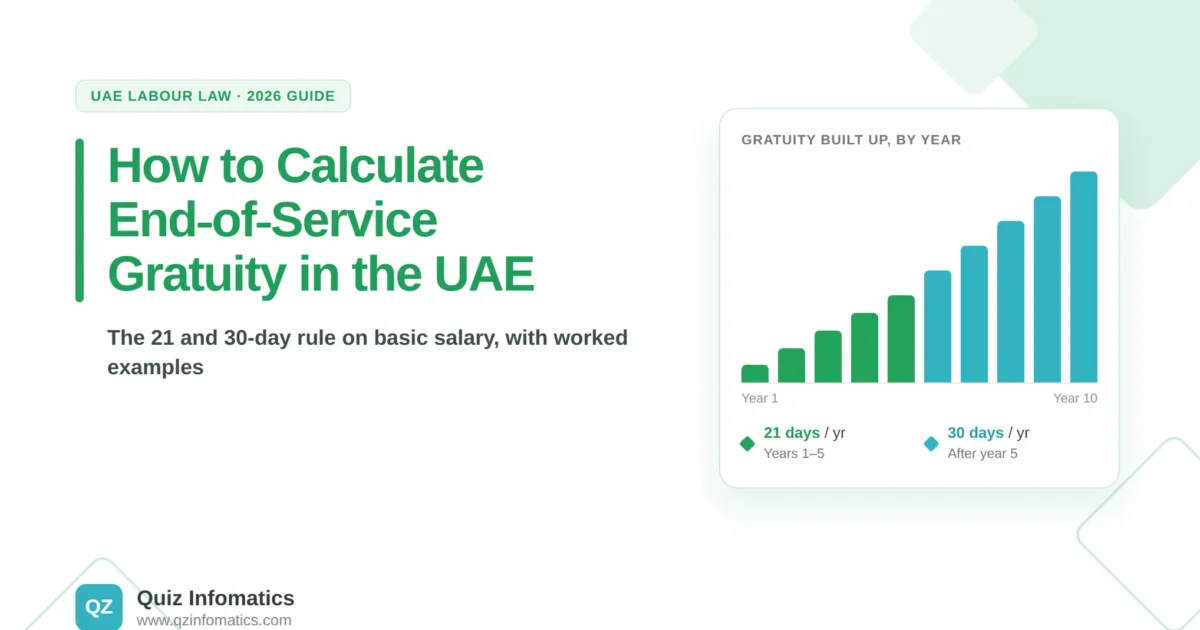
UAE gratuity is calculated at 21 days’ basic wage for each of the first five years of service, and 30 days’ basic wage for each year beyond five years. The calculation uses basic salary only, not the total package.
Here is the core formula in plain terms:
First 5 years: 21 days of basic pay for each year.
After 5 years: 30 days of basic pay for each additional year.
Part-years: counted pro rata once the first full year is complete.
The daily wage is worked out from the basic monthly salary. The law does not fix the conversion method, but common practice is to divide the monthly basic wage by 30 to get a daily rate. So an employee’s gratuity builds up faster after their fifth year, rewarding longer service.
You can work this out instantly with our UAE gratuity calculator, which applies the current rules automatically, or follow the worked examples below to do it by hand.
What counts as “basic salary” for gratuity?
Gratuity is calculated on the employee’s last basic salary only, excluding all allowances and benefits. This is the single most common source of confusion and disputes.
Basic salary is the core wage stated in the employment contract, before any additions. Allowances such as housing, transport, and utilities are excluded from the gratuity calculation, as are benefits in kind. For an employee whose package is heavily weighted toward allowances, this makes a large difference to the final figure.
Because the calculation uses the last basic wage rather than an average, a salary increase shortly before leaving raises the gratuity across all years of service. Employers structuring packages, and employees negotiating them, should both understand how the basic-to-allowance split affects this end-of-service liability.
A worked example of UAE gratuity calculation
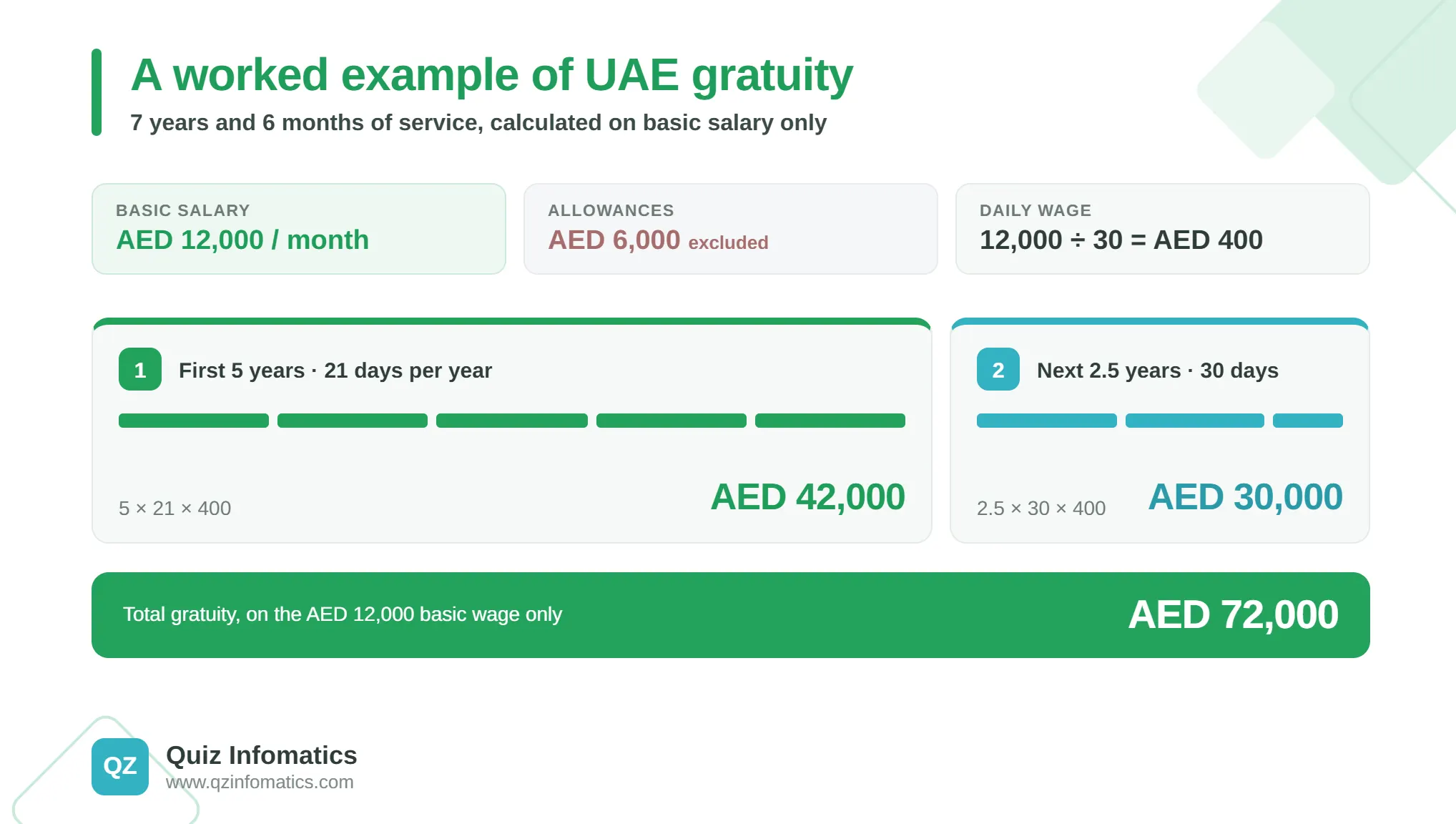
The clearest way to understand gratuity is to work through a real example. Consider an employee leaving after 7 years and 6 months of service.
Assume a basic salary of AED 12,000 per month, with a further AED 6,000 in allowances that are excluded. The daily wage is AED 12,000 divided by 30, which is AED 400.
First 5 years: 5 × 21 × 400 = AED 42,000
Remaining 2.5 years: 2.5 × 30 × 400 = AED 30,000
Total gratuity: AED 72,000
So the employee is owed AED 72,000, calculated only on the AED 12,000 basic wage. Had the AED 6,000 in allowances been included, the figure would have been half as large again, which is exactly why the basic-only rule matters so much to both sides.
Is there a maximum gratuity in the UAE?
Yes, total end-of-service gratuity is capped at two years’ worth of the employee’s wage. In practice, this cap is only reached by very long-serving employees.
Because gratuity accrues at 30 days per year after year five, the two-year cap is reached after roughly 25 years of service. For the vast majority of employees, who serve well under that, the cap never applies and the full 21-and-30-day calculation stands.
The cap exists to put an upper bound on the employer’s liability for extremely long service. It is worth knowing it exists, but for most calculations it simply does not come into play.
How does gratuity differ for resignation vs termination?
Under the current UAE labour law, gratuity is the same whether an employee resigns or is terminated, as long as they have completed one year of service. The previous penalties for early resignation have been removed.
This is a major change from the old law, which scaled down gratuity for employees who resigned before completing five years. Under Federal Decree-Law No. 33 of 2021, a qualifying employee receives full gratuity on the 21-and-30-day basis regardless of how the employment ends.
There are narrow exceptions where an employee may lose entitlement, such as dismissal for specific gross-misconduct grounds defined in the law, but these are limited and must meet strict legal tests. As a general rule, employers should assume full gratuity is payable once an employee passes one year.
What is included in the final settlement?
Gratuity is one part of a wider final settlement that an employer must pay when employment ends. The full settlement brings several amounts together.
A typical UAE final settlement includes:
End-of-service gratuity, calculated as above.
Unpaid salary up to the last working day.
Payment for accrued, untaken annual leave.
Any notice-period pay due under the contract.
Other contractual dues, such as a pending air ticket allowance, where applicable.
Less any lawful deductions, such as amounts the employee owes under the law or a court ruling.
The law requires the full settlement, including gratuity, to be paid within 14 days of the contract ending. Late payment can expose the employer to a labour complaint, so getting the numbers right and paying promptly is essential.
Do free zones like DIFC and ADGM follow the same rules?
Not always. The mainland gratuity rules apply across most of the UAE, but some financial free zones operate their own end-of-service regimes, so the right method depends on where the employee is based. This is a common trap for multi-entity employers.
Most free zones follow the federal gratuity rules described here. The notable exceptions are the financial centres: the DIFC in Dubai and ADGM in Abu Dhabi run their own employment laws. The DIFC in particular has replaced traditional gratuity with a funded savings scheme, the DIFC Employee Workplace Savings (DEWS) plan, where employers make monthly contributions into a managed fund instead of paying a lump sum at exit.
The practical point is to check which law governs each employee before calculating. An employer with staff on the mainland and in a financial free zone may be running two different end-of-service systems at once, and applying the wrong one creates both compliance and payroll errors.
What are the most common gratuity mistakes?
The most common gratuity mistakes are using the wrong salary figure, miscounting service, and paying late. Each is avoidable with clean data and the correct rules.
Frequent errors include:
Including allowances. Calculating on total salary instead of basic salary, which inflates the figure and the liability.
Using an average salary. The calculation uses the last basic wage, not an average over the years.
Miscounting service. Forgetting to deduct unpaid leave, or mishandling part-years after the first year.
Applying the old resignation penalty. Reducing gratuity for resignation, which the current law no longer allows.
Ignoring the accrual. Not provisioning for gratuity monthly, then facing a large unexpected payout.
Paying late. Missing the 14-day deadline for the final settlement, risking a labour complaint.
Each of these traces back to either outdated knowledge of the law or messy salary records. Keeping current with the rules and holding clean payroll data prevents almost all of them.
Why gratuity matters for employers: the accrual problem
For employers, gratuity is not just a payment at the end; it is a liability that builds up every day an employee works. Failing to account for it is a common and costly mistake.
Every month, each employee earns more gratuity, creating a growing obligation on the business. If that liability is not accrued and funded as it builds, the employer faces a large, lumpy cash outflow whenever several long-serving staff leave. On a big workforce, the accumulated gratuity liability can be substantial, and it must be reflected accurately in the accounts.
This is why gratuity should be tracked continuously, not calculated only at exit. Building the accrual into monthly HR and payroll software keeps the liability visible and funded, so there are no surprises. For contractors managing large, largely expatriate workforces, gratuity is a major component of total labour cost, as we cover in our guide to labour camp and manpower cost allocation.
How does gratuity connect to WPS and payroll?
Gratuity sits alongside the Wage Protection System (WPS) as part of a UAE employer’s payroll obligations, and both are easiest to manage in one connected system. Payroll accuracy underpins both.
WPS governs how monthly salaries are paid, through approved channels and on time, while gratuity governs the lump sum due at the end of service. Both depend on accurate records of each employee’s basic salary, start date, and service history, which is exactly the data a payroll system holds. When salary data is clean, gratuity calculation is straightforward; when it is scattered across spreadsheets, errors creep in.
Running payroll, WPS, and gratuity accrual together in WPS payroll software means the same salary and service data drives all three, keeping monthly pay compliant and end-of-service figures accurate. This is a core part of any UAE HR and payroll setup.
How can employers calculate and manage gratuity accurately?
Employers calculate and manage gratuity accurately by keeping clean salary and service records and automating the accrual rather than relying on manual spreadsheets. Automation removes the errors and surprises.
A practical approach is to record each employee’s basic salary and exact service dates, accrue gratuity automatically each month as a liability, and recalculate it whenever salaries change. At exit, the system produces the final gratuity and full settlement in minutes, correctly applying the 21-and-30-day rule, the basic-only basis, and the two-year cap.
This is where connected ERP and HR software earns its place. As the ERP software company behind many UAE payroll setups, we see the same pattern repeatedly: businesses that automate gratuity avoid both underpayment disputes and nasty cash-flow surprises. Employees, meanwhile, can always sense-check their figure with a simple online gratuity calculator.
UAE gratuity rules, in a nutshell
To recap the essentials:
Eligibility: foreign private-sector employees with at least one year of continuous service.
Rate: 21 days’ basic wage per year for the first five years, 30 days per year thereafter, pro rata after year one.
Basis: calculated on the last basic salary only, excluding all allowances.
Cap: total gratuity cannot exceed two years’ wage, reached around 25 years of service.
Resignation vs termination: both earn full gratuity under the current law, with no early-resignation penalty.
Payment: the full final settlement, including gratuity, must be paid within 14 days of the contract ending.
End-of-service gratuity is simple once the rules are clear: 21 days a year, then 30, on basic salary, for anyone past their first year. For employees, it is money they have earned; for employers, it is a liability to track and fund continuously. Getting it right protects both sides.
This guide is general information based on Federal Decree-Law No. 33 of 2021 and is not legal advice. Rules can change and individual cases vary, so confirm your specific situation with the Ministry of Human Resources and Emiratisation (MOHRE) or a qualified adviser. Figures in this article draw on published summaries of the UAE labour law, such as this end-of-service gratuity breakdown.
About the author
QZ Infomatics Team – QZ Infomatics is a Dubai-based ERP and IT consultancy (Business Bay) that implements HR, payroll, and WPS systems for businesses across the UAE and GCC. The team helps employers automate payroll, WPS compliance, and end-of-service gratuity accrual within connected ERP and HR software, drawing on hands-on experience with UAE labour-cost and compliance requirements. This guide reflects that practical experience helping UAE businesses handle gratuity and final settlements correctly.
How is end-of-service gratuity calculated in the UAE?
Gratuity is 21 days' basic salary for each of the first five years of service, and 30 days' basic salary for each year after that, calculated on the last basic wage only and paid to employees who complete at least one year.
Is gratuity calculated on basic salary or total salary?
Gratuity is calculated on basic salary only. Allowances such as housing, transport, and utilities, and all benefits in kind, are excluded from the calculation.
Do I get gratuity if I resign?
Yes. Under Federal Decree-Law No. 33 of 2021, employees who resign receive full gratuity on the same basis as those who are terminated, provided they have completed at least one year of service. The old early-resignation reduction no longer applies.
What is the minimum service period for gratuity in the UAE?
One year of continuous service. Employees who leave before completing a full year are not entitled to gratuity. After the first year, part-years are counted on a pro-rata basis.
Is there a maximum gratuity amount?
Yes. Total end-of-service gratuity cannot exceed two years' wage, a cap generally only reached after around 25 years of service.
How long does an employer have to pay gratuity?
The employer must pay the full final settlement, including gratuity, within 14 days of the end of the contract.
Does unpaid leave affect gratuity?
Yes. Periods of unpaid leave do not count as service, so they reduce the length of service used in the gratuity calculation.
Are Emirati employees entitled to gratuity?
No. UAE nationals are covered by the national pension and social security system instead of end-of-service gratuity, which applies to foreign private-sector employees.
Continue reading
Related articles
Guides
Shop Drawings, As-Built Drawings and the Submittal Process Explained
What are shop drawings and as-built drawings? A guide to submittals, RFIs and document control in construction.
ERP Technology Advisor · 4 November 2026 · 10 min read
Book a free 30 minute call with QZ Infomatics in Dubai. You will leave it with a platform recommendation, the reasoning behind it, a realistic timeline and an indicative budget band — before you commit to anything.
✓ A consultant who delivers projects, not a sales desk
✓ Odoo, Microsoft Dynamics 365 and Oracle NetSuite compared honestly
✓ Licence cost and implementation cost quoted as separate numbers
✓ If we are not the right fit for you, we will say so