FIDIC Contracts Explained: A Guide for UAE and GCC Contractors
What is FIDIC? A clear guide to the Red, Yellow and Silver Books and how FIDIC contracts work in the UAE.
ERP Technology AdvisorPublished 12 min read
Last updated: July 2026 · By the QZ Infomatics Construction Technology Team
If you build in the UAE or the wider Gulf, you work under FIDIC whether you have read it or not. These standard contracts govern how projects are priced, paid, varied, delayed, and disputed across the region, and a contractor who does not understand them gives away money and entitlement without realising it. This guide explains what FIDIC is, how the main FIDIC contracts differ, and the key clauses every contractor should know, so you can administer your contracts, and the construction ERP software behind them, with confidence.
What is FIDIC?
FIDIC is the International Federation of Consulting Engineers, and in everyday construction use the name refers to the suite of standard-form contracts that body publishes. When someone says a project is “on FIDIC,” they mean it uses one of these internationally recognised contract templates.
The acronym comes from the organisation’s French name, Fédération Internationale des Ingénieurs-Conseils. Founded in 1913, FIDIC is best known today for its contracts, which are published by FIDIC and used on infrastructure, building, and engineering projects around the world.
So FIDIC has two meanings: the federation itself, and, far more commonly in site offices, the contracts it produces. This guide is about the contracts, which have become the default standard for major construction across the UAE and GCC.
What are FIDIC contracts? The Rainbow Suite
FIDIC contracts are a family of standard construction and engineering agreements, each identified by a colour, which is why the set is nicknamed the “Rainbow Suite.” Each colour suits a different way of procuring and delivering a project.
Rather than drafting a contract from scratch for every job, the industry uses these tested templates and adapts them through Particular Conditions. Because all FIDIC contracts share the same structure, learning one makes the others far easier to understand.
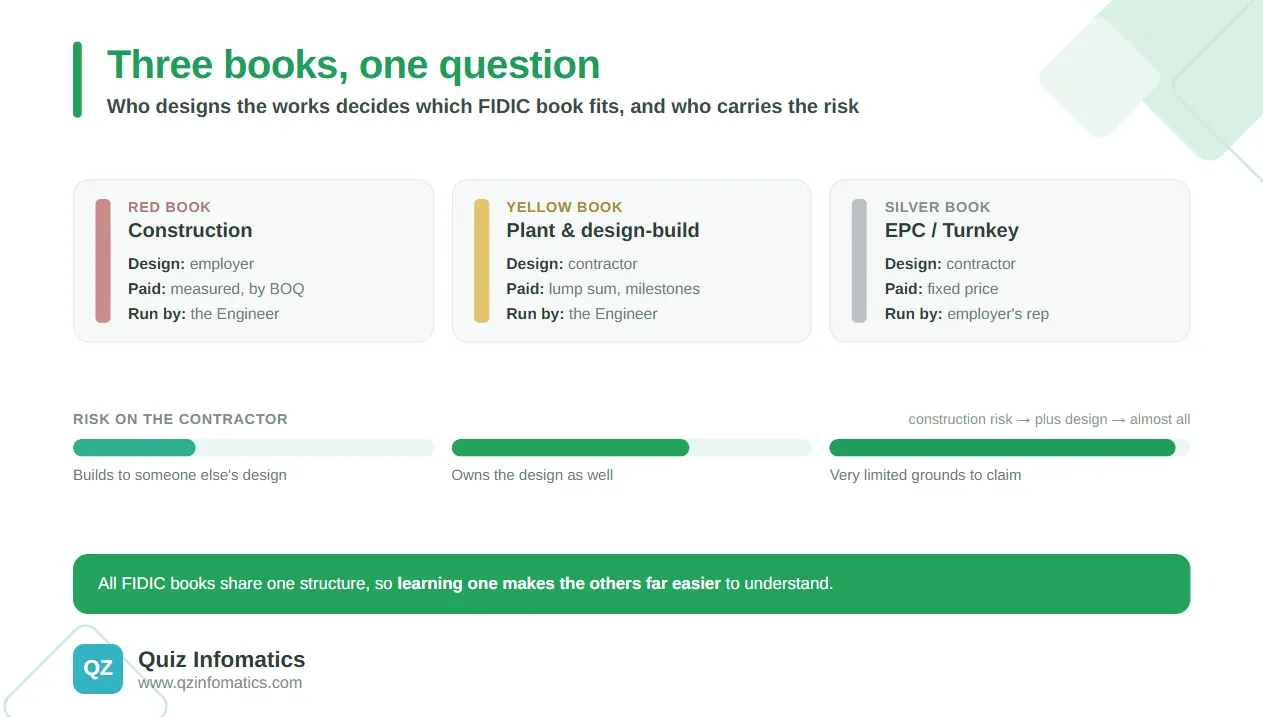
The most widely used are the Red, Yellow, and Silver Books, with several others covering specialised project types. The right choice depends mainly on one question: who is responsible for the design, the employer or the contractor?
What is the FIDIC Red Book?
The FIDIC Red Book is the Construction Contract, used for traditional projects where the employer (the client) is responsible for the design and the contractor builds to it. It is the most common FIDIC contract and the starting point for understanding the suite.
Under the Red Book, the employer’s consultants design the works, and the contractor is paid largely on a measured basis, with quantities taken from a bill of quantities. An independent Engineer administers the contract, certifies payment, and determines claims.
This model suits buildings and infrastructure where the design is well defined before construction. The contractor carries construction risk but not design risk, which is reflected in how variations and claims are valued.
What is the FIDIC Yellow Book?
The FIDIC Yellow Book is the Plant and Design-Build Contract, used where the contractor is responsible for designing and building the works to the employer’s requirements. It shifts design risk onto the contractor.
The Yellow Book suits electrical and mechanical plant, and building or engineering works that the contractor designs. Instead of a bill of quantities, payment is usually made against a lump sum broken into a schedule of milestones or activities, because the contractor controls the design.
This design-and-build approach gives the employer more price certainty and a single point of responsibility, in exchange for less control over the detailed design. The Engineer still administers the contract.
What is the FIDIC Silver Book?
The FIDIC Silver Book is the EPC/Turnkey Contract, used for projects where the contractor takes on almost all the risk and delivers a complete, ready-to-operate facility for a fixed price. It places the heaviest risk on the contractor.
The Silver Book suits engineer-procure-construct (EPC) projects such as power plants, process facilities, and turnkey developments, where the employer wants certainty of price and completion date above all. The contractor designs, procures, and builds, with very limited grounds for claiming more time or money.
Notably, the Silver Book has no independent Engineer. Instead, the employer’s own representative administers the contract, reflecting the fixed-price, low-intervention nature of turnkey delivery.
What are the other FIDIC books?
Beyond the main three, FIDIC publishes several specialised contracts for particular project types and delivery models. Most contractors meet these less often, but it helps to know they exist.
The wider FIDIC family includes:
Green Book. A Short Form of Contract for small or simple projects.
Gold Book. The Design-Build-Operate (DBO) contract, covering long-term operation as well as construction.
Pink Book. The MDB Harmonised version of the Red Book, used on projects funded by multilateral development banks.
Blue Book. For dredging and reclamation works.
Emerald Book. For underground and tunnelling works, sharing geotechnical risk.
White Book. The client/consultant services agreement, not a construction contract as such.
For most UAE building and infrastructure work, though, the Red, Yellow, and Silver Books cover the vast majority of projects.
FIDIC 1999, 2017, and the 2022 reprint: which edition applies?
FIDIC’s main contracts exist in a 1999 first edition and a 2017 second edition, with the 2017 editions reprinted in 2022 with amendments. Knowing which edition your contract uses matters, because the rules differ in important ways.
The Red, Yellow, and Silver Books were first published in 1999, then substantially revised in the second editions released in December 2017. In November 2022, FIDIC issued reprints of those 2017 books with corrections and amendments, and these amendments took effect from January 2023, making the 2022 reprints the definitive version of the 2017 suite.
Crucially, the 2017 changes do not apply automatically to a 1999 contract, and the 2022 amendments do not apply automatically to an original 2017 contract. The edition is whatever the contract specifies, so always check which version, and which amendments, your particular contract adopts.
Who is “the Engineer” in a FIDIC contract?
The Engineer is the party appointed to administer a FIDIC Red or Yellow Book contract, acting as certifier, instruction-giver, and the first decision-maker on claims. Understanding this role is central to understanding FIDIC.
Appointed and paid by the employer, the Engineer nonetheless has duties to act fairly when certifying payment, assessing variations, and making “determinations” on claims. The Engineer issues interim payment certificates, instructs variations, and grants extensions of time, making the role pivotal to a contractor’s cash flow and entitlement.
The Silver Book is the exception: because it is a turnkey contract, there is no independent Engineer, and the employer’s representative administers the works instead. Knowing who holds this role, and how fairly they exercise it, shapes how a project runs.
How are variations handled under FIDIC?
Variations are handled under Clause 13 of the FIDIC contracts, which lets the Engineer or employer instruct changes to the works, with the contractor entitled to adjustment of the price and, where justified, the time. This is one of the most used provisions on any project.
A FIDIC variation must generally be properly instructed, and it is valued using the contract’s rules, typically existing rates where work is similar, or fair rates where it is not. We cover the mechanics in depth in our guide to variation orders and construction contracts, including how to raise, approve, and cost them.
Handled properly, variations are routine. Handled loosely, with work done on verbal instruction and no proper valuation, they become the single biggest source of disputes, which is why disciplined administration matters so much under FIDIC.
How are claims and extensions of time handled?
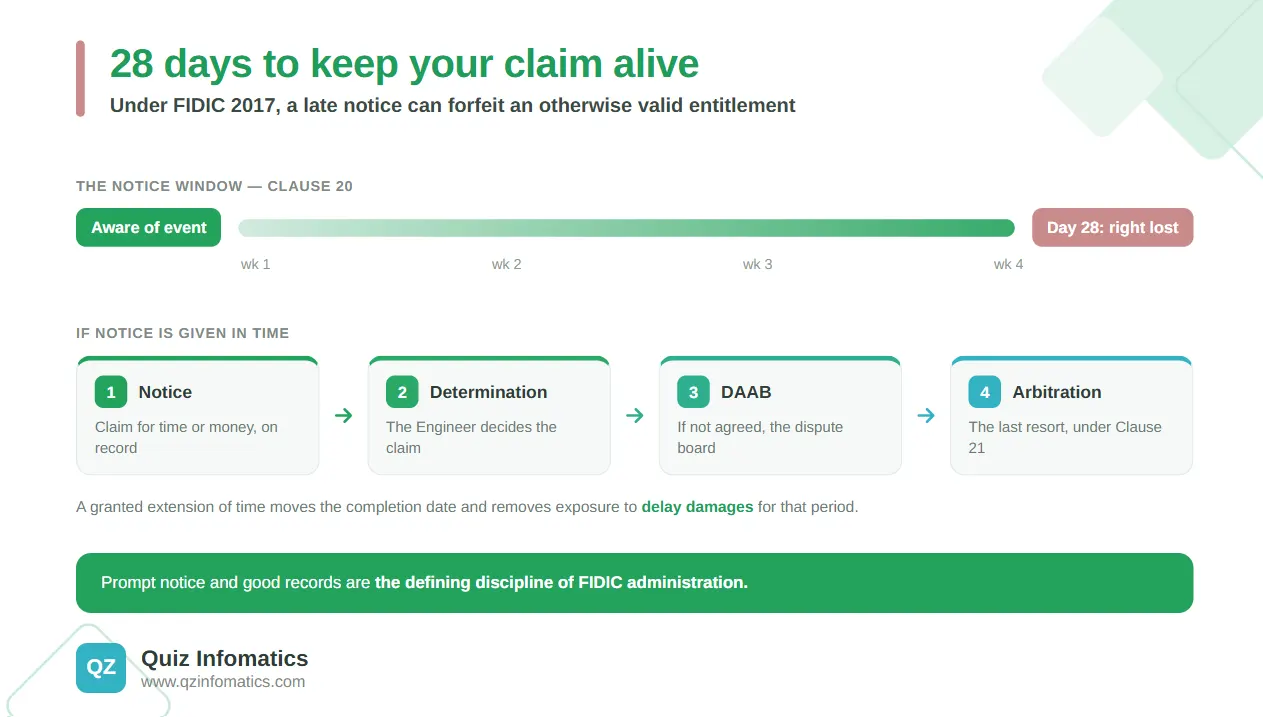
Claims and disputes are governed by strict notice and time-bar rules, with the 2017 editions separating claims (Clause 20) from formal disputes (Clause 21). Missing a deadline can forfeit an otherwise valid entitlement.
Under the 2017 suite, a party wishing to claim additional time or money must give notice within 28 days of becoming aware of the event, or lose the right to claim. The Engineer then makes a determination, and if the parties cannot agree, the matter goes to a Dispute Avoidance/Adjudication Board (DAAB) before any arbitration.
This emphasis on prompt notice and documentation is the defining discipline of FIDIC administration. Extensions of time protect the contractor from delay damages, but only if claimed correctly and on time, which makes good record-keeping essential.
What are liquidated (delay) damages in FIDIC?
Liquidated damages, which FIDIC calls Delay Damages, are a pre-agreed sum the contractor pays the employer for each day of delay beyond the completion date. They are set in the contract so the parties avoid arguing over actual losses.
Because the amount is fixed in advance, usually as a daily or weekly rate with an overall cap, both sides know the cost of delay from the outset. If the contractor finishes late without a valid extension of time, delay damages are deducted, often directly from payments due.
This is exactly why extensions of time matter so much: a properly granted extension moves the completion date and removes the contractor’s exposure to delay damages for that period. Managing the programme and the claims that protect it is therefore a direct financial issue, not just an administrative one.
What is a performance bond or security under FIDIC?
A performance security is a guarantee, usually a bank bond, that the contractor provides to protect the employer if the contractor fails to perform. FIDIC requires it under the performance security provisions, commonly for around 10 percent of the contract value.
If the contractor defaults, the employer can call on the bond to recover losses or complete the works. Alongside it, an advance payment guarantee secures any mobilisation advance the employer pays at the start, reducing the employer’s risk on money paid before work is done.
These securities tie up the contractor’s banking facilities and carry a cost, so they are a real part of the commercial picture. Understanding when they can be called, and when they should be released, protects the contractor’s finances.
What are provisional sums and prime cost sums?
A provisional sum is an amount included in the contract for work that cannot be fully defined when the contract is signed, while a prime cost sum covers materials or services from a supplier not yet chosen. Both are placeholders, adjusted once the actual scope and cost are known.
Under FIDIC’s Clause 13, provisional sums are only spent on the Engineer’s instruction, and the final account is adjusted to reflect what the work actually cost, up or down. These sums usually sit within the bill of quantities, where they are clearly identified.
Managing them well matters because provisional sums left unresolved distort the project’s forecast cost. Converting them into instructed, valued work promptly keeps the budget honest and avoids surprises at the final account.
What is the Defects Notification Period?
The Defects Notification Period (DNP) is the time after completion, typically one year, during which the contractor must return to fix any defects that appear. FIDIC uses this term for what is often informally called the defects liability period.
During the DNP, the employer notifies the contractor of defects, and the contractor is obliged to remedy them at its own cost. Only once this period ends and outstanding defects are cleared does the Engineer issue the Performance Certificate, which effectively signals the contractor has met its obligations.
The DNP is closely tied to money. The second half of retention is usually released only after it ends, which links defect clearance directly to cash flow, as we explain in our guide to retention and retainage in construction.
How is payment handled under FIDIC?
Payment under FIDIC is made through regular interim payment certificates based on the value of work done, with retention deducted and released in stages. It keeps cash flowing to the contractor across a long project.
Each period, the contractor applies for payment, the Engineer certifies the amount genuinely due, and the employer pays within the contractual timescale. A percentage is withheld as retention, and approved variations are included as they arise. This cycle is the financial engine of the project, and we cover it in detail in our guide to progress billing and interim payment certificates.
Getting valuations right is central to a contractor’s cash flow, which is why the quantity surveyor is so important on a FIDIC job. Accurate, timely certificates keep money moving; disputed ones choke it.
Why does FIDIC matter in the UAE and GCC?
FIDIC matters in the UAE and GCC because it is the default contract standard across the region’s construction market, from towers and malls to infrastructure and EPC projects. If you contract here, you contract on FIDIC.
The region’s reliance on international contractors, consultants, and funding made a recognised, balanced standard essential, and FIDIC filled that role. Public and private projects alike are routinely let on the Red, Yellow, or Silver Books, usually with Particular Conditions tailored to local law and the specific project.
This also means the region’s construction disputes frequently turn on FIDIC provisions, especially notices, variations, and extensions of time. There is also a tax dimension, since how and when you are paid under FIDIC interacts with VAT on construction contracts. Understanding the contract is therefore not optional for a UAE contractor; it is core to getting paid and protecting margin.
Managing FIDIC contracts with construction ERP
The practical challenge of FIDIC is administration: tracking notices, variations, certificates, retention, and claims across long projects without losing entitlement. This is where construction software earns its place.
A construction ERP keeps the moving parts of a FIDIC contract connected: variations flow into the contract value and the budget, interim certificates and retention are tracked automatically, and the records that protect a claim are captured as work happens rather than reconstructed later. For contractors running several FIDIC projects at once, that control is the difference between confident administration and constant firefighting.
FIDIC is the International Federation of Consulting Engineers, and in practice the name means its suite of standard construction contracts, the Rainbow Suite.
The main books are the Red Book (employer-designed construction), the Yellow Book (contractor design-build), and the Silver Book (EPC/turnkey).
Editions matter: the 1999 and 2017 versions differ, and the 2017 books were reprinted in 2022 with amendments effective from 2023.
Key clauses cover the Engineer’s role, variations, claims and extensions of time with strict notices, delay damages, performance security, provisional sums, and the Defects Notification Period.
In the UAE and GCC, FIDIC is the default standard, so understanding and administering it well is central to getting paid and avoiding disputes.
FIDIC can look intimidating, but its logic is consistent and learnable. Master the structure, respect the notice deadlines, and administer it in one connected system, and the contract stops being a risk and becomes a tool for protecting your time, your money, and your margin.
About the author
QZ Infomatics Construction Technology Team – QZ Infomatics is a Dubai-based ERP and IT consultancy (Business Bay) that implements construction and contracting software across the UAE and GCC. The team helps contractors administer FIDIC contracts in practice, tracking variations, claims, certificates, retention, and the records that protect entitlement, in one connected system, drawing on hands-on experience with construction ERP for UAE projects. This guide reflects that practical experience helping contracting businesses understand and control their contracts.
FIDIC stands for Fédération Internationale des Ingénieurs-Conseils, the French name of the International Federation of Consulting Engineers. In construction, the term usually refers to the standard contracts that body publishes.
What are the main FIDIC contracts?
The three main FIDIC contracts are the Red Book (construction, employer-designed), the Yellow Book (plant and design-build, contractor-designed), and the Silver Book (EPC/turnkey). Together with others, they form the colour-coded Rainbow Suite.
What is the difference between the Red, Yellow, and Silver Books?
The difference is mainly who designs the works and who carries the risk. The Red Book is for employer-designed construction, the Yellow Book for contractor design-build, and the Silver Book for fixed-price turnkey projects where the contractor carries most of the risk.
Which FIDIC edition is current?
The 2017 second editions of the Red, Yellow, and Silver Books are current, reprinted in 2022 with amendments effective from January 2023. The 1999 first editions are still used where a contract specifies them.
Who is the Engineer in a FIDIC contract?
The Engineer administers a Red or Yellow Book contract, certifying payment, instructing variations, and determining claims, with a duty to act fairly. The Silver Book has no independent Engineer; the employer's representative administers it instead.
What are delay damages in FIDIC?
Delay damages, also called liquidated damages, are a pre-agreed sum the contractor pays for each day of delay beyond the completion date, usually capped. A valid extension of time removes exposure to them for that period.
What is the Defects Notification Period?
The Defects Notification Period is the time after completion, typically one year, during which the contractor must fix defects that appear. It is FIDIC's term for the defects liability period, and the final retention is usually released after it ends.
Why is FIDIC used in the UAE?
FIDIC is the default construction contract standard in the UAE and GCC because it is internationally recognised and balanced, suiting a market that relies on international contractors, consultants, and funding. Most major projects are let on FIDIC forms.
Continue reading
Related articles
Guides
Shop Drawings, As-Built Drawings and the Submittal Process Explained
What are shop drawings and as-built drawings? A guide to submittals, RFIs and document control in construction.
ERP Technology Advisor · 4 November 2026 · 10 min read
A complete guide to ERP for construction companies in the UAE — what it does across the project lifecycle, UAE compliance, module order and how to choose one.
ERP Technology Advisor · 7 September 2026 · 11 min read
Book a free 30 minute call with QZ Infomatics in Dubai. You will leave it with a platform recommendation, the reasoning behind it, a realistic timeline and an indicative budget band — before you commit to anything.
✓ A consultant who delivers projects, not a sales desk
✓ Odoo, Microsoft Dynamics 365 and Oracle NetSuite compared honestly
✓ Licence cost and implementation cost quoted as separate numbers
✓ If we are not the right fit for you, we will say so