
Guides
FIDIC Contracts Explained: A Guide for UAE and GCC Contractors
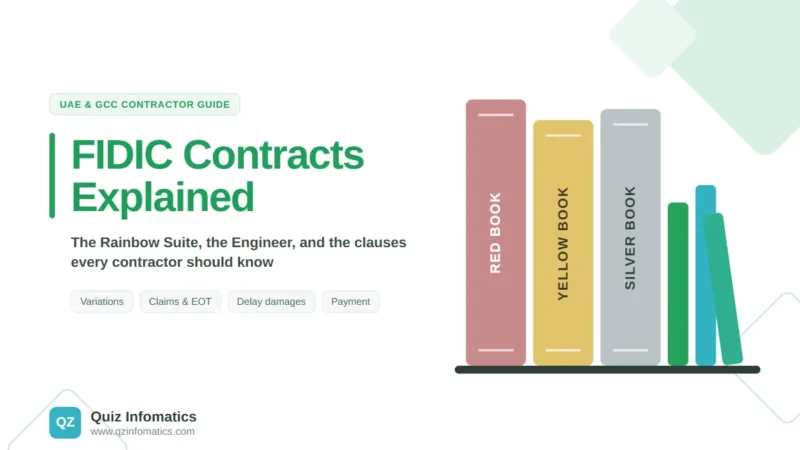
What is FIDIC? A clear guide to the Red, Yellow and Silver Books and how FIDIC contracts work in the UAE.
ERP Technology Advisor · 6 October 2026 · 12 min read
Read the article Five industries worked hands on, so we arrive knowing where the gaps usually are.
All industries →Request a demoFour ERP platforms in house, and fifteen capability modules. The recommendation is never tied to a licence quota.
All solutions →Request a demoOne team from platform selection through to the reports on your desk.
All services →Request a demoGuides, how-tos, comparisons and a plain-English glossary, written by the consultants who deliver the projects. No form in front of any of it.
Nobody in UAE ERP publishes their tools or their pricing. We do both.
Free tools →Request a demoAn ERP and IT consultancy in Business Bay, Dubai, implementing Oracle, Microsoft, Odoo and SAP across the UAE and GCC.
Consultants in the UAE, technical team in South Asia. Cost stays sharp without cutting corners.
About QZ Infomatics →Request a demoWhat is construction procurement? A guide to procurement methods, the process, and software for UAE contractors.

On most construction projects, more money flows through procurement than through any other function. Materials, subcontractors, plant, and services all have to be sourced, ordered, delivered, and paid for, and every inefficiency in that chain comes straight off the margin. Yet procurement is still run on spreadsheets and email at many UAE contractors. This guide explains what construction procurement is, the main procurement methods and process, and how the right construction ERP software turns purchasing from a cost centre into a source of control.
Construction procurement is the process of sourcing, purchasing, and managing everything a project needs to be built, from materials and plant to subcontractors and professional services. It covers the entire journey from identifying a need to paying the supplier.
In practice, procurement is far more than buying. It involves choosing how to deliver the project, selecting and managing suppliers and subcontractors, raising and tracking orders, receiving goods, and settling invoices, all while controlling cost, quality, and timing.
Because it touches cost, programme, and quality at once, procurement sits at the heart of a project’s success. Done well, it keeps work flowing and budgets intact; done badly, it causes delays, overspends, and disputes.
Construction procurement matters because it accounts for the majority of a project’s spend, so even small improvements have a large impact on profit. It is the single biggest financial lever most contractors have.
The numbers make the case plainly. According to analysis citing McKinsey, procurement typically accounts for 40 to 70 percent of a construction company’s total spending, and materials alone represent roughly 30 to 40 percent of total project cost, rising to 65 to 80 percent of direct construction costs. When so much money moves through procurement, controlling it is one of the highest-return activities a contractor can focus on.
There is also a timing dimension. Materials ordered late delay the programme, and materials ordered too early tie up cash and clutter the site. Good procurement is therefore not just about getting a good price; it is about getting the right thing, at the right price, at the right time.
The main construction procurement methods, or routes, define how design and construction responsibilities are split between the client and the contractor. Choosing the right route shapes risk, cost, and control for the whole project.
The common procurement methods are:
These routes map directly onto the contract used, which is why procurement and contract choice go hand in hand. Our guide to FIDIC contracts explains how the Red, Yellow, and Silver Books align with traditional, design-build, and EPC procurement respectively.

The construction procurement process is the cycle that turns a project need into a paid-for delivery, running from requisition through ordering and receipt to payment. It is often called the procure-to-pay or purchase-to-pay cycle.
The typical steps are:
Each step creates a document and a control point. When they are connected, the process is fast and auditable; when they live in separate spreadsheets, errors, delays, and duplicate payments creep in.
Material procurement is the sourcing and purchasing of the physical materials a project consumes, from concrete and steel to finishes and fittings. It is the largest single element of most procurement budgets.
Material procurement usually starts from the quantities in the bill of quantities, which tell the team what to buy and how much. From there, the challenge is timing: ordering early enough to meet the programme, given that some materials carry long lead times, without ordering so early that cash is tied up or materials deteriorate on site.
Once materials are delivered and received, they flow into the project and into stock records, which is why procurement connects closely to inventory management. Tracking what has been ordered, received, and consumed keeps both the budget and the site under control.
Subcontractor procurement is the process of selecting, awarding, and managing the specialist subcontractors who carry out large portions of the work. On many projects, subcontractors account for more of the spend than direct materials.
The process involves breaking the works into packages, prequalifying subcontractors, tendering each package, and awarding subcontracts. From there, the main contractor manages each subcontractor’s scope, payments, and retention throughout the project.
Managing this well is a major undertaking, because each subcontractor has its own order, valuations, and retention to track. Doing it in a connected system for subcontractor management keeps every package tied to the budget and the programme, which is far harder to achieve in spreadsheets.
Procurement management is the strategic side of procurement: planning what to buy, managing suppliers, controlling cost, and ensuring everything arrives on time and to specification. It raises procurement from transactional buying to a managed discipline.
Good procurement management includes building a reliable supplier base, negotiating framework terms, planning purchases against the programme, and monitoring spend against budget. It also means looking beyond the headline price to total cost, including delivery reliability, quality, and payment terms.
This strategic view is often where the quantity surveyor and the commercial team add real value, turning procurement from a series of one-off purchases into a coordinated plan that protects both cost and programme.
A purchase order (PO) is a formal document a buyer issues to a supplier confirming the goods or services ordered, their quantity, price, and terms. It is the backbone of controlled procurement.
The PO turns a verbal or email agreement into a documented commitment, creating a clear record of what was ordered and at what price. When the goods arrive, a goods receipt confirms delivery, and the supplier’s invoice is then checked against both.

This is the three-way match, comparing the purchase order, the goods receipt, and the invoice, and it is one of the most important controls in procurement. It ensures a contractor only pays for what was ordered and actually received, which is exactly why the goods receipt note is so central to the process. A mismatch flags an error before money leaves the business.
E-procurement is the digitisation of the procurement process, replacing paper and email with software that manages requisitions, orders, receipts, and invoices in one place. It is how modern contractors bring speed and control to purchasing.
Procurement software, usually part of a construction ERP, lets teams raise requisitions, issue purchase orders, record goods receipts, and match invoices electronically, with approvals routed automatically and spend visible in real time. It removes the manual re-keying and lost paperwork that slow traditional procurement down.
For a contractor, the payoff is both speed and control. Orders move faster, the three-way match is automatic, and every dirham of committed and actual spend is visible against the budget, which is the foundation of real cost control. Dedicated procurement software brings this together for construction businesses.
The common construction procurement challenges are price volatility, long lead times, manual processes, and poor spend visibility. Each one erodes margin or delays the programme.
Frequent problems include:
Each of these traces back to the same root cause: a disconnected, manual process. A connected system addresses all of them at once by making the whole cycle visible and controlled.
In the UAE, procurement carries particular weight because of the market’s reliance on imported materials, exposure to global price swings, and tax rules on purchases. Contractors here face a demanding procurement environment.
Many materials are imported, which lengthens lead times and adds shipping, customs, and currency considerations to the buying decision. Global price volatility and tariffs have made cost control harder, while VAT applies to purchases, so input VAT on procurement must be captured correctly, as covered in our guide to VAT on construction contracts.
For UAE contractors, a disciplined, well-planned procurement function is therefore a real competitive advantage. If you want the wider context on the systems behind this, our complete guide to construction ERP in the UAE sets the foundation.
A construction ERP handles procurement by connecting the whole procure-to-pay cycle, requisitions, orders, receipts, and invoices, to the project budget, the BOQ, and subcontractor accounts. It turns purchasing into controlled, visible spend.
In a well-configured system, requisitions draw on the BOQ, purchase orders are raised and approved digitally, goods receipts confirm delivery, and invoices are matched automatically through the three-way match. Every committed and actual cost flows into the project budget in real time, so overruns are visible early rather than at the final account.
This is central to modern construction software. Platforms such as Odoo, configured for construction, can bring procurement together with cost control, inventory, and accounting, and a well-run ERP implementation is what makes that integration reliable.
Controlling procurement comes down to connecting the whole buying cycle to your budget, inventory, and subcontractor accounts in one system. That connection is what protects margin on the largest part of your spend.
A practical step is to move requisitions, purchase orders, goods receipts, and invoice matching off spreadsheets and into a construction-specific system, so spend is visible, approvals are fast, and nothing is paid without being checked. This turns procurement from a margin risk into a source of control.
If you would like help with that, our construction ERP software for UAE contractors brings procurement, BOQ, cost control, budgeting, subcontractor management, and billing into one platform, built for how contracting businesses actually work.
To recap the essentials:
Procurement is where most of a construction project’s money is won or lost. Running it as a connected, controlled process, rather than a scatter of orders and invoices, is one of the most direct ways a UAE contractor can protect both programme and profit.
QZ Infomatics Construction Technology Team – QZ Infomatics is a Dubai-based ERP and IT consultancy (Business Bay) that implements construction and contracting software across the UAE and GCC. The team helps contractors connect procurement, from requisition to payment, with budgets, inventory, and subcontractor accounts in one system, drawing on hands-on experience with construction ERP for UAE projects. This guide reflects that practical experience helping contracting businesses control the largest part of their spend.
Running procurement on spreadsheets and email? See our construction ERP for UAE contractors.
Frequently asked questions
Construction procurement is the process of sourcing, purchasing, and managing everything a project needs to be built, including materials, plant, subcontractors, and services, from identifying a need through to paying the supplier.
The main methods are traditional (design-bid-build), design and build, management contracting, construction management, and EPC/turnkey. They differ mainly in how design and construction responsibilities and risk are divided.
It is the procure-to-pay cycle: requisition, sourcing, evaluation and award, purchase order, delivery and goods receipt, invoice matching, and payment. Each step creates a document and a control point.
Material procurement sources the physical materials a project consumes, usually from the bill of quantities. Subcontractor procurement selects and manages the specialist subcontractors who carry out packages of the work.
A purchase order is a formal document confirming the goods or services ordered, their quantity, price, and terms. It is matched against the goods receipt and the invoice in a three-way match to prevent overpayment.
E-procurement is the digitisation of procurement, using software to manage requisitions, orders, receipts, and invoices in one place, with automatic approvals and real-time spend visibility, usually as part of a construction ERP.
Procurement typically accounts for 40 to 70 percent of a construction company's total spend, with materials alone representing roughly 30 to 40 percent of total project cost and more of direct construction costs.
A purchase requisition is an internal request to buy something, raised when a project need is identified, often from the bill of quantities or the programme. Once approved, it becomes the basis for issuing a purchase order to a supplier.
Because materials ordered late delay the programme, while materials ordered too early tie up cash and risk damage or deterioration on site. Good procurement aligns ordering with the schedule and each item's lead time.
Yes. A construction ERP connects requisitions, purchase orders, goods receipts, and invoice matching to the project budget, BOQ, and subcontractor accounts, giving real-time control over committed and actual spend.
Continue reading
What is FIDIC? A clear guide to the Red, Yellow and Silver Books and how FIDIC contracts work in the UAE.

A complete guide to ERP for construction companies in the UAE — what it does across the project lifecycle, UAE compliance, module order and how to choose one.
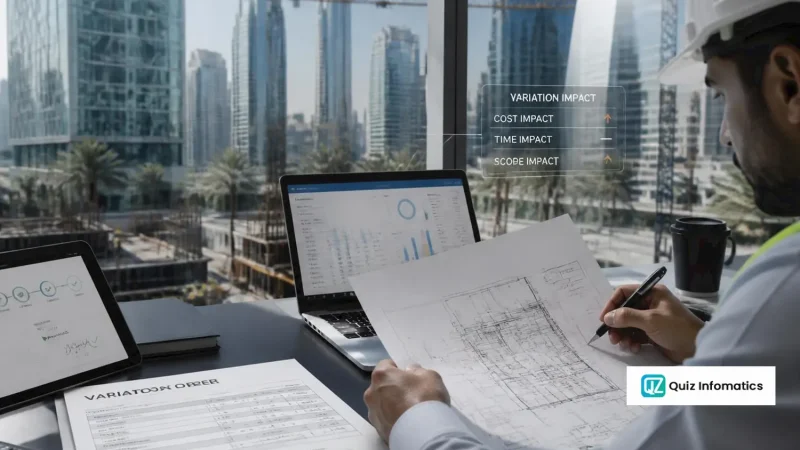
What a variation order is, how FIDIC Clause 13 and the UAE Civil Code treat them, how variations are valued, and why so many end up built but never billed.
Talk to a consultant
Book a free 30 minute call with QZ Infomatics in Dubai. You will leave it with a platform recommendation, the reasoning behind it, a realistic timeline and an indicative budget band — before you commit to anything.