
Guides
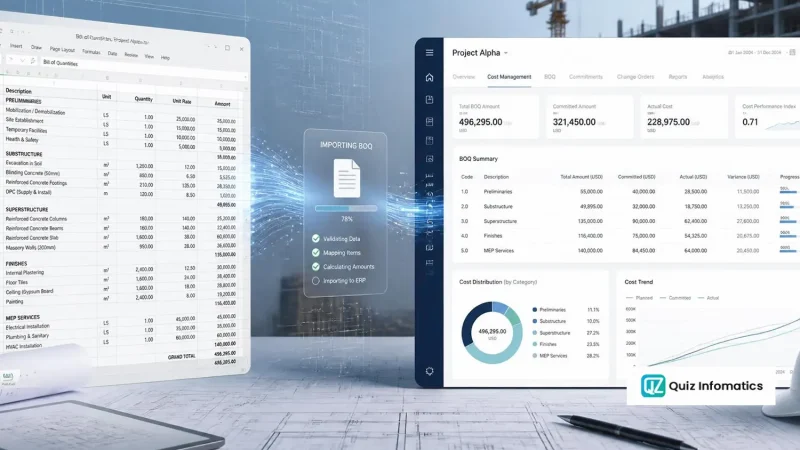
Importing a Candy BOQ Into Your ERP
How to move a priced BOQ from CCS Candy into an ERP as the project cost structure — mapping, validation, and what breaks at the estimating-to-execution handover.
Read the guideFive industries worked hands on, so we arrive knowing where the gaps usually are.
All industries →Request a demoFour ERP platforms in house, and fifteen capability modules. The recommendation is never tied to a licence quota.
All solutions →Request a demoOne team from platform selection through to the reports on your desk.
All services →Request a demoGuides, how-tos, comparisons and a plain-English glossary, written by the consultants who deliver the projects. No form in front of any of it.
Nobody in UAE ERP publishes their tools or their pricing. We do both.
Free tools →Request a demoAn ERP and IT consultancy in Business Bay, Dubai, implementing Oracle, Microsoft, Odoo and SAP across the UAE and GCC.
Consultants in the UAE, technical team in South Asia. Cost stays sharp without cutting corners.
About QZ Infomatics →Request a demoA complete guide to ERP for construction companies in the UAE — what it does across the project lifecycle, UAE compliance, module order and how to choose one.

ERP for construction is an integrated business system organised around projects rather than around accounting periods or products.
It links the bill of quantities, the budget, procurement, subcontracts, site labour, plant, progress billing and the general ledger to a single project ledger — so that committed cost, actual cost and forecast final cost are visible on every live job, continuously, rather than assembled monthly by hand.
That reorganisation is the whole difference. A standard ERP is built around products sold, customers invoiced and periods closed. It answers the question how did the business perform last month? A construction ERP answers a different and more urgent question: is this project going to finish profitably, and if not, what is causing it?
Both are legitimate questions. Only one of them can still be acted on.
This guide covers what construction ERP does across the project lifecycle, what UAE contractors specifically need from it, which parts to implement first, and how to evaluate one. Where a topic warrants proper depth — BOQs, earned value, variation orders — it links to a dedicated guide rather than summarising badly.
Most UAE contractors start with accounting software, because every business needs accounts and a contractor is a business. It works until the second or third concurrent project, and then it stops.
Five things break, and they break in a predictable order.
Cost cannot be traced to a job. The chart of accounts records what money was spent on — materials, subcontract, labour — not which project consumed it. A margin figure exists for the business and not for any individual job. Three profitable projects can absorb one loss-making one for a full financial year without anyone noticing.
Commitment is invisible. A purchase order raised on Monday is money spent. It appears in the accounts when the supplier invoices, typically four to six weeks later. During that gap the accounts show a comfortable position that no longer exists. On a project where procurement runs ahead of delivery — which is most projects — the gap is a full month of spend.
Revenue recognition does not fit. A trading business recognises revenue on delivery. A contractor recognises it as work progresses, against a contract running for years. That single difference generates work in progress, retention held in both directions, over- and under-billing, and percentage-of-completion accounting. General ledgers do none of it natively.
Retention has nowhere to live. Held at 5% on every certified payment, released in two tranches a year or more apart, in both directions with clients and subcontractors. Netted into receivables it becomes invisible, and aged retention is routinely the largest recoverable balance on a contractor’s balance sheet.
Variations are not tracked as a distinct object. Instructed, executed, and then either billed or forgotten. Unbilled variations are the single largest source of margin loss in UAE contracting, and the cause is almost always record-keeping rather than client refusal.
Each of these can be patched with a spreadsheet. Together they produce a business where the monthly accounts and the project reports never agree, and nobody is confident which is right.
A contracting business runs a repeating twelve-stage cycle. Understanding where the ERP does work — and where it does not — is the most useful frame for evaluating one.
Pipeline tracking, client details, opportunity value and status. Ordinary CRM work, but with the difference that a construction opportunity carries a location, a project type and a tender date rather than a product.
Usually outside the ERP. Take-off and rate build-up happen in specialist estimating software — most commonly CCS Candy in this market. The ERP does not price the tender.
The bill of quantities produced here becomes the financial spine of everything downstream. If you are unfamiliar with the document, what is a BOQ covers its structure, the measurement standards used in the Gulf, and why the description matters as much as the quantity.
Quotation, contract value, commercial terms, approval. Light ERP involvement.
Award decision, letter of award, contract value captured. This is where the ERP takes over, and where the handover from estimating happens.
The priced BOQ moves into the ERP as the project’s cost structure. Done properly it creates the budget, the cost codes and the reporting hierarchy in one operation. Done badly — retyped into a new structure invented by finance — it breaks the link between what was priced and what is being spent, permanently. Importing a Candy BOQ into your ERP covers the mapping decisions and what to validate before loading.
Cost codes defined, project plan created, budget baselined. The structure agreed here governs everything afterwards.
The organising framework is the work breakdown structure — a hierarchy of deliverables, decomposed to work packages small enough to own, price and measure. On construction projects it is usually BOQ-driven rather than built independently, which avoids maintaining two structures that have to be reconciled.
Where a Primavera programme is contractually required — as it is on most substantial UAE projects — the schedule and the cost structure need the same WBS. Primavera P6 ERP integration covers how the two systems share a coding structure, and when integrating them is and is not worth the effort.
Requisitions, purchase orders, goods receipt, vendor invoicing, all coded to the project and cost line.
The critical behaviour: committed cost updates the budget when the order is raised, not when the invoice arrives. That is the difference between catching an over-run and reporting one. Goods receipt at site is what makes it real — what is a GRN explains the document, three-way matching, and why site deliveries received without a project code land in overhead.
Subcontractor onboarding, agreements with their own retention terms, work orders linked to BOQ lines, claims, certification and payment. Committed subcontract value visible against amounts certified and paid.
Material issues and returns, labour time captured to cost codes, plant charged at internal hire rates, daily progress recorded. This is where cost accumulates, and where the quality of site discipline determines whether any of the reporting downstream means anything.
Budget against actual, variance analysis with drill-down to transactions, resource utilisation, and forecast final cost.
This is where earned value management belongs — comparing what was planned, what was earned and what was spent, to produce a defensible forecast of final cost at 20% complete rather than a report of past spend at 80%.
Interim payment certificates generated from measured progress, customer invoicing, retention calculated, tracked and released.
Retention runs in both directions and is the balance contractors most often lose track of. Our post on retention and subcontractor retention tracking covers release schedules and how held amounts are tracked across subcontractors and projects.
Variation order creation with approval workflow, BOQ revisions, cost and revenue impact, margin analysis per variation.
Variation orders covers FIDIC Clause 13, the UAE Civil Code position on lump-sum contracts, the valuation hierarchy, and the five reasons variations end up built but never billed.
Final billing, retention release, handover documentation, project close, profitability analysis.
The last item is the one most often skipped, and it is the one that improves the next tender. Actual cost per BOQ line against the rate that was priced, fed back into the estimating library, is how a contractor stops repeating the same pricing error.
International construction ERP handles the first two of these and typically stops.
VAT on progress applications and retention. 5% applied correctly on certified amounts, with the timing rules construction contracts create. Certificate dating affects the tax point, and it is a recurring source of error in manually prepared applications — usually in the direction that creates exposure.
WPS-compliant payroll for site labour. Salary Information File generation in the exact MOHRE format, with hours allocated to project cost codes rather than a single labour overhead account. A system that pays site workers correctly but cannot tell you which project consumed their hours has solved half the problem.
End-of-service gratuity accrued monthly, on basic salary, appearing as a liability rather than arriving as a settlement shock.
Corporate tax, requiring project-level profitability to be supportable and related-party subcontracting documented.
E-invoicing readiness as the FTA mandate phases in through 2027. Interim payment applications and certificates will need to move to structured invoices, and high-volume contractors will feel it before most sectors do.
Retention and advance payment structures as they are actually used in UAE contracts — advance payment guarantees recovered at an agreed rate on each application, retention withheld against a cap, released against practical completion and defects liability dates.
Bilingual documentation. Arabic and English on invoices and certificates, expected by many clients and required by some government entities.
Document control for drawings, submittals, RFIs and transmittals, with revision control and provable distribution. On a delay or variation claim, the contemporaneous register is the evidence.
Systems built for other markets generally cover VAT and stop. The advance payment and retention mechanics, the WPS obligation and the e-invoicing path are where they run out — and the gap is discovered during implementation rather than during evaluation.
Two categories, complementary, and routinely confused during selection.
| Construction ERP | Project management software | |
|---|---|---|
| Handles | Budget, procurement, subcontracts, billing, cost | Programme, progress, RFIs, quality, snagging |
| Answers | Will this job make money? | Will this job finish on time? |
| Owned by | Commercial and finance | Planning and site |
| Organising unit | Cost code | Activity |
Some platforms cover both. Where they are separate — which is common — the integration between them determines whether reporting can be trusted. A progress figure that does not drive the cost forecast is a number nobody acts on.
The practical failure mode: the planner reports 40% complete measured on activity duration, the commercial team reports 55% measured on cost incurred, and both are legitimate measures of different things. Somebody has to decide which drives valuation, write it down, and hold to it.
Contractors who try to launch everything at once are the ones whose implementations stall. A sequence that works:
Phase 1 — project costing and procurement. Committed cost is where over-runs are caught, and procurement is where commitment is created. Starting here delivers the single most valuable capability first, and it is where the business case usually pays back.
Phase 2 — finance and progress billing. The general ledger, then interim payment certificates and retention. Gets the commercial cycle running end to end.
Phase 3 — subcontract management. Agreements, work orders, certification, retention on the subcontract side.
Phase 4 — HR, payroll and plant. WPS payroll with labour allocated to cost codes, plant charged to projects.
Phase 5 — document control and site execution. Drawings, submittals, RFIs, daily progress capture.
The reasoning behind the order: each phase produces something useful on its own, and each depends on the one before. Document control implemented before cost coding exists has nothing to attach documents to.
Three to six months for a UAE contractor of moderate size, and the critical path is rarely technical.
Agreeing one cost-code structure across estimating, procurement and finance. The estimator prices by trade, procurement orders by supplier package, finance reports by account. Three structures describing the same work. The system only functions when all three post against the same codes, and getting three departments to accept one structure takes longer than configuring the software.
Loading opening positions for live projects. Cost to date, revenue recognised, retention held, advances outstanding and open variations, per project. This is the task most often underestimated.
Training three distinct groups. Commercial staff, procurement, and site. Site is the one most often skipped and the one that determines whether the data arriving in the system is worth anything.
Contractors who go live at the start of a new project rather than mid-contract have a materially easier transition. Where that is not possible, going live at a natural milestone — a phase completion, a financial year end — is the next best option.
Start from your commercial process, not a feature list. Write down how you price, procure, certify and bill. Then test candidate systems against that.
Test with a real project. Take a live job with its actual variations, retention structure and subcontract arrangements, and ask each vendor to demonstrate a payment application and a cost-to-complete report using your figures. Most shortlists resolve themselves at this point, and scripted demos are designed to avoid exactly the awkward cases that matter.
Ask how it holds a BOQ. Not whether it has a projects module — specifically how it holds a bill of several thousand lines with hierarchy, and how transactions code to it. This one question separates genuine construction ERP from general ERP with a project field.
Check the UAE list explicitly. VAT on retention, WPS SIF generation, gratuity accrual, advance recovery, e-invoicing path. Ask for each to be demonstrated rather than confirmed.
Confirm who will actually implement it. The same software delivered by a weak team still produces a failed project, and the person selling is frequently not the person delivering.
Scope phase two before signing phase one. It is the only point at which you have leverage.
For a broader platform comparison across sectors, best ERP software in the UAE covers Odoo, Finance & Operations, NetSuite and the alternatives with a decision framework.
Everything referenced above, in depth.
How to move a priced BOQ from CCS Candy into an ERP as the project cost structure — mapping, validation, and what breaks at the estimating-to-execution handover.
Read the guide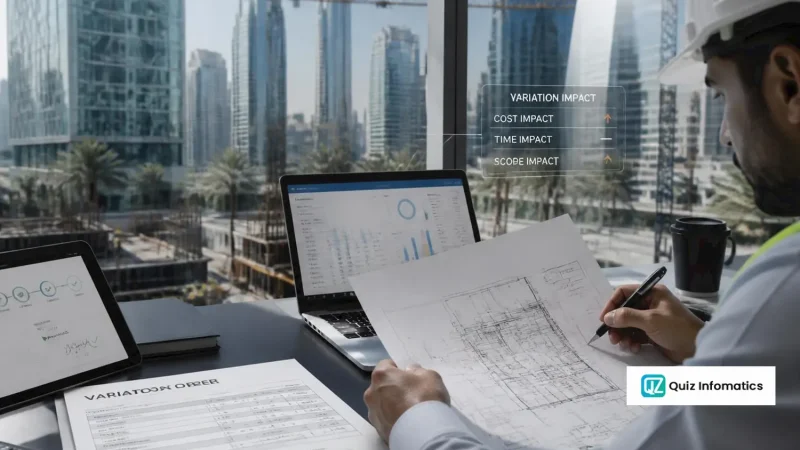
What a variation order is, how FIDIC Clause 13 and the UAE Civil Code treat them, how variations are valued, and why so many end up built but never billed.
Read the guide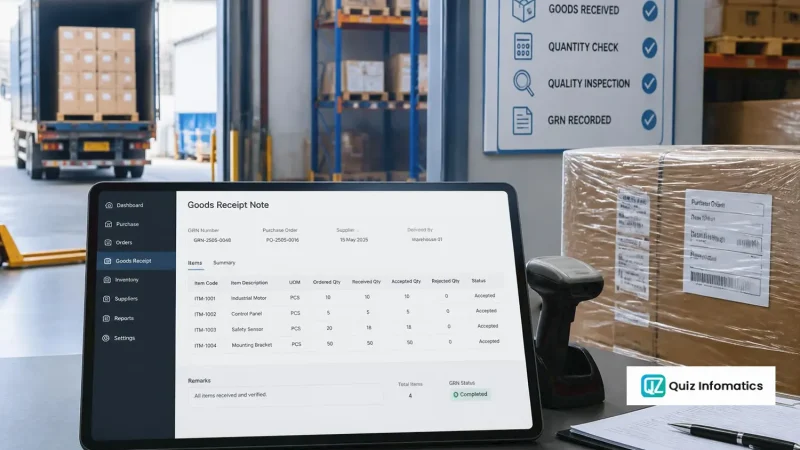
A GRN, or goods receipt note, records what was actually delivered against a purchase order. What it contains, how three-way matching works, and its accounting effect.
Read the guide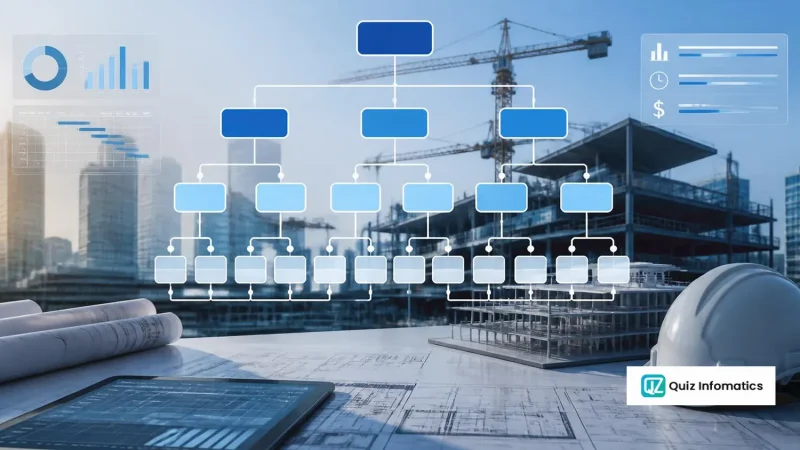
A work breakdown structure divides a project into deliverables and work packages. The 100% rule, levels, control accounts, and how a WBS drives cost control.
Read the guide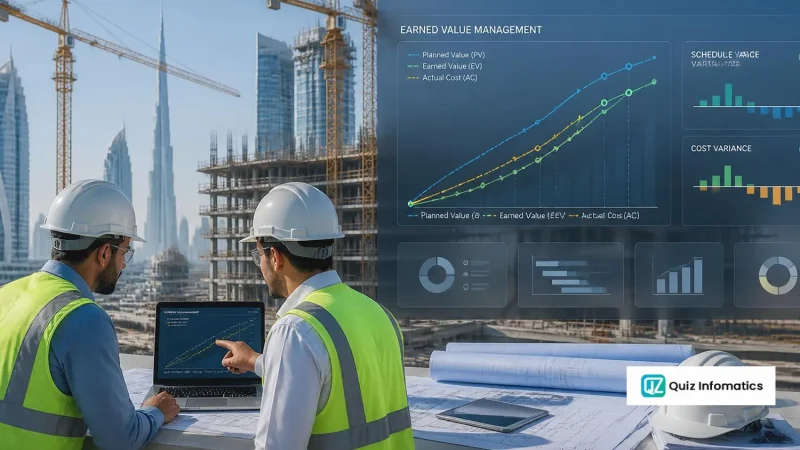
Earned value management explained — planned value, earned value and actual cost, the variance and index formulas, forecasting, and how to apply EVM in construction.
Read the guide
How Primavera P6 and an ERP work together — linking schedule activities to cost codes, XER exchange, earned value, and what to integrate and what to leave alone.
Read the guide
A BOQ, or bill of quantities, is a measured schedule of every item of work in a construction project. What it contains, how it is prepared and how it is priced.
Read the guideIf you are evaluating rather than reading, three things are more useful than more content.
Run the numbers on a live project. The Project Profitability Calculator forecasts final margin using committed cost rather than invoices received — which is the calculation most contractors cannot produce monthly.
Check what is sitting in retention. The Retention Calculator produces a dated release schedule and flags anything already overdue.
Talk to someone who has done it. Construction ERP software in the UAE sets out what we implement and for whom, including a client whose implementation we took over after it stalled.
Frequently asked questions
ERP for construction companies is an integrated system organised around projects, linking estimating, procurement, subcontracts, site progress, plant, labour and accounting to a single project ledger. Unlike product-based ERP, it treats the contract as the unit that revenue, cost and profitability are measured against.
Because a contractor's core question — will this project finish profitably — cannot be answered from period accounts. It needs committed cost, cost to complete, retention, variations and WIP together. Accounting software reports last month's position; construction ERP gives a current forecast on every live job.
Project costing and procurement, because committed cost is where over-runs get caught. Finance follows, then subcontract management and progress billing. Document control, plant and HR are better phased in later. Attempting to launch everything at once is the most common reason contractor implementations stall.
It surfaces over-runs while they can still be acted on. Committed cost visibility at order stage, cost-to-complete forecasts reviewed monthly, and variation tracking that ensures approved work actually gets billed together address the three largest leaks: unrecorded commitments, late cost recognition and unbilled variations.
ERP handles the commercial and financial side — budget, procurement, subcontracts, billing and cost. Project management software handles delivery — programme, progress, RFIs, quality and snagging. Some platforms cover both. Where they are separate, the integration between them decides whether progress and cost can be read together.
Agreeing one cost-code structure across estimating, procurement and finance, loading opening positions for live projects, configuring subcontract and billing workflows, migrating master data, then training commercial, procurement and site staff. Three to six months is typical for a UAE contractor of moderate size.
VAT on progress applications and retention, WPS payroll for site labour, corporate tax reporting, e-invoicing readiness, and support for the advance payment and retention structures used in standard UAE construction contracts. Systems built for other markets often cover the first two and miss the rest.
Start from your own commercial process rather than a feature list, then test candidate systems against a real project with its actual variations and retention structure. Ask each vendor to demonstrate a payment application and a cost-to-complete report using your figures. Most shortlists resolve themselves at that point.
Continue reading
How to move a priced BOQ from CCS Candy into an ERP as the project cost structure — mapping, validation, and what breaks at the estimating-to-execution handover.
What a variation order is, how FIDIC Clause 13 and the UAE Civil Code treat them, how variations are valued, and why so many end up built but never billed.
A GRN, or goods receipt note, records what was actually delivered against a purchase order. What it contains, how three-way matching works, and its accounting effect.
Talk to a consultant
Book a free 30 minute call with QZ Infomatics in Dubai. You will leave it with a platform recommendation, the reasoning behind it, a realistic timeline and an indicative budget band — before you commit to anything.